
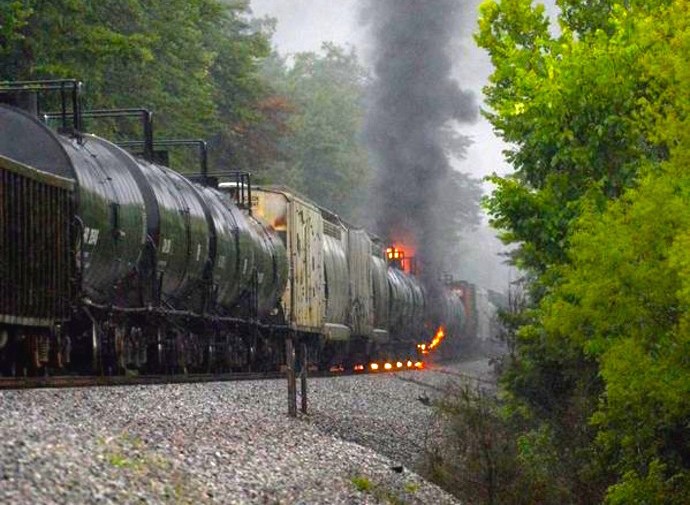
Just when 5,000 or so evacuated Maryville residents thought it was safe to go home after a freight train chemical spill and fire, new water worries have arisen.
Officials on Monday issued an advisory about the nearby Culton Creek, a waterway that flows a short distance to Pistol Creek and the Little Tennessee, a tributary to the Tennessee River.
At about 4:30 Sunday afternoon, biologists installing a water treatment system found dead fish in the creek. Officials believe the fish died during the time of the CSX train derailment in Maryville on Wednesday night.
Read more
* Dead fish found in creek after Tennessee train derailment
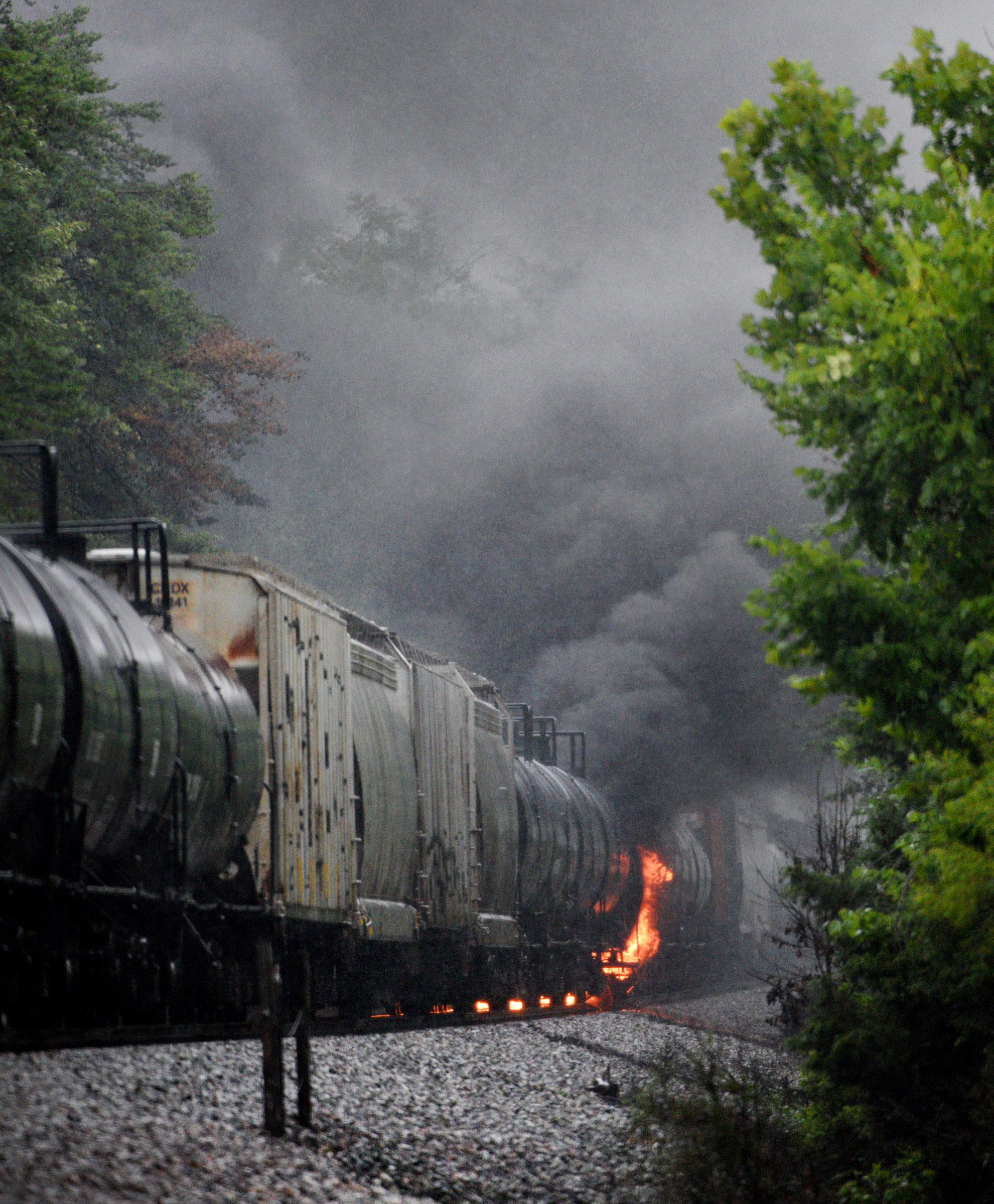 Smoke and fumes rise from a CSX train in Maryville, Tenn. The burning car carried a highly flammable and toxic chemical and the fumes included cyanide, causing the evacuation of 5,000 people and the hospitalization of 44. (Michael Patrick/Knoxville News Sentinel via AP)
Wednesday night was four very rainy days before the fish were found and a single word was mentioned about surface-water contamination from the train car fire and derailment. The accident sent black smoke full of toxic material including cyanide pluming for nearly 18 hours and prompted the evacuation of people within a two-mile radius. One eyewitness told a Knoxville area television station that she saw the train with a burning rail car fly past until it derailed nearby.
Thank heavens, the car and train did not tip off the tracks.
Emergency officials let the car burn for nearly 18 hours because it was too hot and too dangerous to be near with anything beyond an early effort to keep other nearby cars filled with the same material or worse from igniting.
After the dead fish surfaced, officials issued a precautionary advisory for people to refrain from activity in the creek, according to East Tennessee news reports. Those officials said sample results from Pistol Creek and Little River have so far indicated the water there is still safe for normal activity, but active water treatment and daily surface water sampling has begun.
Meanwhile, 125 people reported to Blount Memorial Hospital with symptoms of exposure to the hazardous chemicals and fumes. Officials said 44 of those people had been admitted. By Saturday, all but four had been discharged.
Now the environmental disaster worry begins on other fronts – water and soil. Throughout the weekend, officials said there was no indication that water wells in the area had been affected. But it wasn’t until Sunday that the creek concerns arose when officials found fish that apparently were killed on Wednesday. In the meantime, about 4,000 tons of soil were removed at the site of the spill. It will be tested to determine the extent of contamination and then disposed of in an appropriate manner, CSX officials told local reporters.
Nonetheless, “Everything is still very safe,” Maryville City Manager Greg McClain said during a news conference Monday morning. “There is still no threat to humans.”
Really? The air sends 125 people to the hospital? Creeks and soil don’t impact groundwater and wells?
We hope there is no further threat. Time will tell. Yet the Maryville incident serves as a stark reminder of the roulette we play everyday with deadly chemicals that also make our lives better.
The single burning tank car was carrying 24,000 gallons of acrylonitrile, used in making plastic and fibers. The train also was pulling eight or nine other cars holding acrylonitrile and 16 cars carrying propane. If that seems like a nightmare, it is. And think of the millions of train cars traveling in and around Chattanooga day in and day out.
Last December, East Tennessee got a scare when sensors alerted to a small spill of the flammable solvent, acetonitrile, at Oak Ridge. Thankfully there were no injuries. And 18 months ago, in Charleston, W. Va., a chemical known as 4-methylcyclohexane methanol, also called MCHM and used to clean coal among other things, leaked from an rusty silo tank beside the Elk River. The contamination was so dangerous that water supplies to 300,000 people in nine counties downriver – almost the population of greater Chattanooga – were left without water for at least five days. Emergency workers literally shut the water off because it was so dangerous.
When the water was turned on again, people were told: Don’t drink the water. Don’t touch it. Don’t wash with it. Don’t cook with it. Don’t use if for anything except flushing toilets. Over the first weekend after the spill was found, about 170 people were treated in emergency rooms for symptoms of chemical exposure, including throat and eye burning, nonstop vomiting, trouble breathing or skin blistering.
This past week, East Tennessee probably dodged another bullet, though we may yet suffer some ricochet damage.
It’s past time for America to seriously review chemical safety – especially with an eye toward safer chemical substitutes as well as the safer transportation and storage of all chemicals.
And just what caused that train car to catch fire, anyway?