
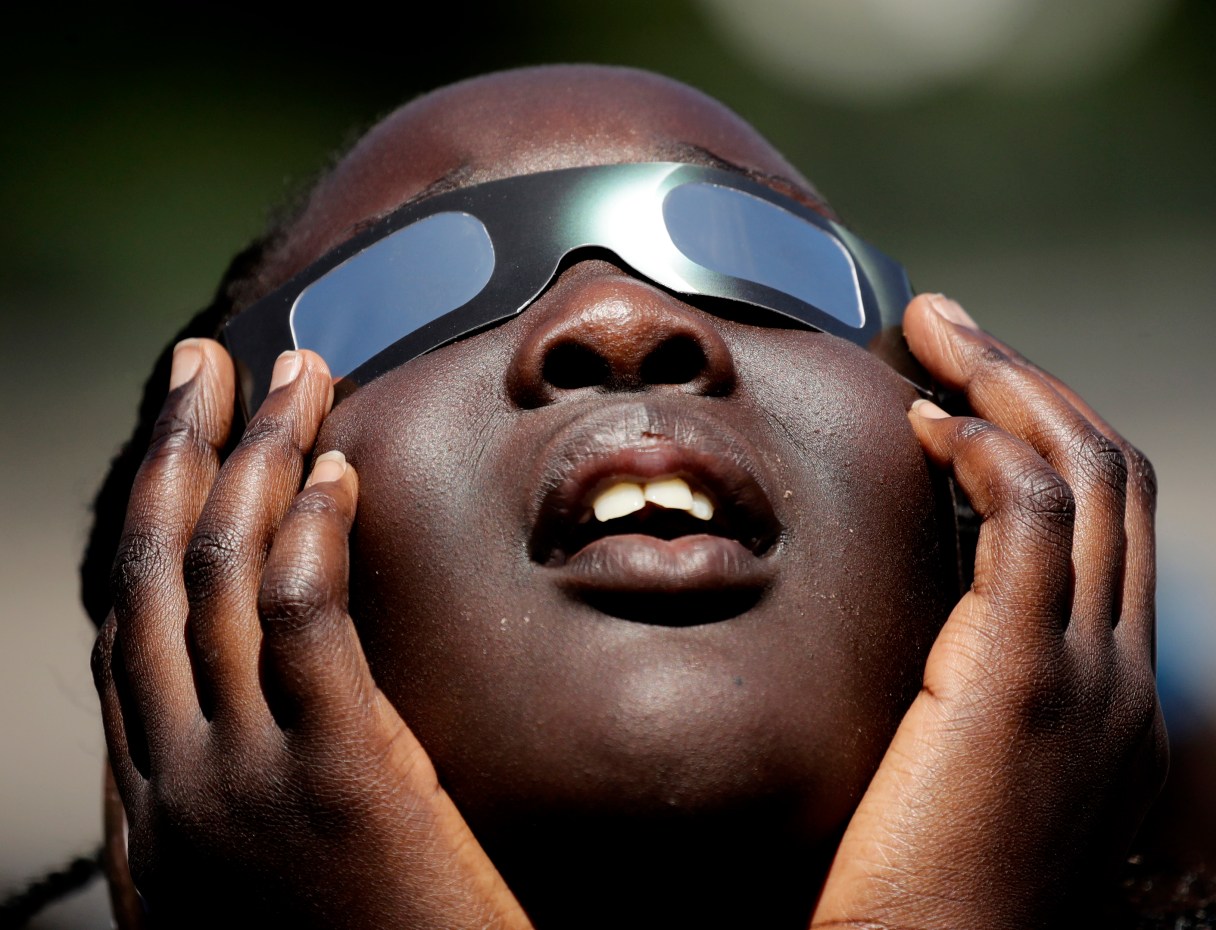
KANSAS CITY, Mo. (AP) – A fourth-grade class at a suburban Kansas City school erupted in wonder when they tried on their solar eclipse glasses for the first time and turned toward the sun for an eclipse “practice.”
“The sun looks like the moon!” ”It’s really dark!” ”There’s just a little circle of light!” ”It’s just a speck up there!”
The students at Clardy Elementary School in North Kansas City were practicing the proper use of the glasses Friday in anticipation of Monday’s solar eclipse. Their teacher, Christy Lister, had gone through slides detailing how and when to wear the glasses, how to care for them and proper behavior during the eclipse. It was only the third day of the school year, but the students had already talked about eyes, the solar system and other eclipse-related topics.
The district’s teachers and administrators began planning for the big event last May and worked through the summer on age-specific activities for the district’s 20,000 students. The activities will include kindergartners using beads that react to ultraviolet light from the sun, while others will conduct experiments measuring atmospheric changes during the eclipse or create solar viewers with 3-D printers.
U.S. schools along and near the coast-to-coast path where the sun will be totally blacked out by the moon during the eclipse are taking widely varying approaches. While some districts are seizing the opportunity for ready-made lessons, others are closing for the day or keeping kids inside because of safety concerns. In Idaho, districts in and around Twin Falls are using the day for science education, while many districts in the eastern part of the state either canceled school or will start the school year a day later. In Wyoming, the Laramie School District moved the first day of school to Tuesday after the superintendent said he had “grossly underestimated” the event’s significance.