

Chappell Guerry Kane was a board member of the Humane Educational Society and already had housed her share of dogs and cats before she learned her ancestors were contributors to the organization for nearly all of its existence.
“I was clueless,” she said of the donations. “I was asked to be on the board. I guess they figured (I would be appropriate) since I took in tons of strays.”
ANNIVERSARY EVENTS* What: Party Animal for the Animals (cocktails from Barefoot Wine & Bubbly, dinner from 212 Market and dancing with the Standing Room Only band)* When: 5:30 p.m. Friday* Where: Loose Cannon Gallery, 1800 Rossville Ave.* Admission: $75 each or $100 per couple; $400 for table of eight* Phone: 624-5302, ext. 241, or 443-6125* What: 100th anniversary celebration/opening of Weezie’s Way* When: Noon-4 p.m. Saturday* Where: Humane Educational Society, 212 N. Highland Park Ave.* Admission: Free* Phone: 624-5302, ext. 241SOCIETY TIMELINE1910 — Ethel Soper Hardy and business leaders found the Humane Educational Society.1919 — The society begins work with children.1926 — HES shifts to child protection services and animal control.1940 — Ethel Hardy provides funds for temporary children’s home, offices and animal shelter at the organization’s present location (as well as helping fund it in her will).1946 — Judge Alexander W. Chambliss gives $30,000 to build the Chambliss Home, which is run by HES and is adjacent to it.1953 — HES ends management of children’s home but continues to investigate and prosecute child abuse and neglect cases.1960s-1970s — The society becomes a “catch and destroy” shelter.2003 — HES begins moving toward no-kill/cageless shelter status.2010 — Weezie’s Way children’s educational center dedicated/100th anniversary celebration.
On Friday and Saturday, the animal shelter will mark its 100th anniversary. On Saturday officials will dedicate a new children’s educational center in honor of Mrs. Kane and her mother, Louise P. “Weezie” Guerry.
The new center, known as “Weezie’s Way,” will be in the former Chambliss Home dormitory, which once housed neglected and abused children through the Humane Educational Society.
Guy Bilyeu, the society’s executive director, said the Guerry family, through the charitable foundation of Chattem, the family’s longtime business, contributed most of the money to renovate the building.
However, he said letterhead in the organization’s files proves Chattem (then called Chattanooga Medicine Co.) has been a supporter for decades.
“For 100 years, they have supported HES,” Mr. Bilyeu said. “They’ve done a lot of wonderful things.”
He said the organization has changed radically over the years and even in the nearly seven years he’s been on the job.
Begun in 1910 by Ethel Soper Hardy as an institute to save what were referred to as “dumb” animals and later young children from abuse, neglect and abandonment, the Humane Educational Society dealt with both human and animal subjects until 1983.
In 1977, governmental agencies began to take over responsibilities for protecting children. Six years later the HES facility that housed children and was known as the Chambliss Home merged with the Children’s Home orphanage.
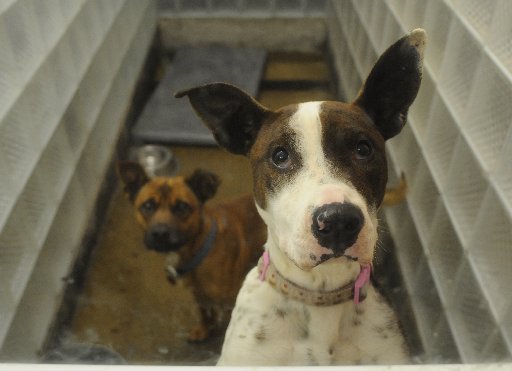
Since Mr. Bilyeu came, he said, he gradually has been moving the organization toward being a no-kill shelter and renovating the facilities so dogs and cats are not housed in wire cages.
“We’re 99 percent through,” he said. “We’ve got six more wire kennel cages (to go). I’m really, really excited about that.”
Connie and Lee Winters of East Ridge adopted two dogs, Birchwell Harris and Superdog Amy, from those cages seven years ago after their grandson, Dylan McPherson, then 3, invented an imaginary dog.
“I would recommend it to anybody,” Mrs. Winters said. “They (offer) such unconditional love. You get more than you give. (Without the shelter), these dogs could have been in bad trouble. It turned out to be a wonderful experience for all of us.”
The renovated 3,000-square-foot, two-story building will allow the Humane Educational Society to get back to serving both children and animals, Mr. Bilyeu said.
It will afford space for children to learn how the animals live, how to play with them and how to train them, he said. It also will allow the organization to host parties, summer camp programs and various classes, he said.
“We need to have the children here so they can touch the animals,” Mr. Bilyeu said. “(The room) makes it much more exciting for them.”
Mrs. Kane said the shelter already reaches 10,000 children a year in one way or another and will be able to reach many more through the education center.
“You can come here to love animals,” she said. “It makes everybody a better person. I don’t think people understand how kindness to animals … translates to people’s lives. You can’t come here and not leave without your heart throbbing.”