
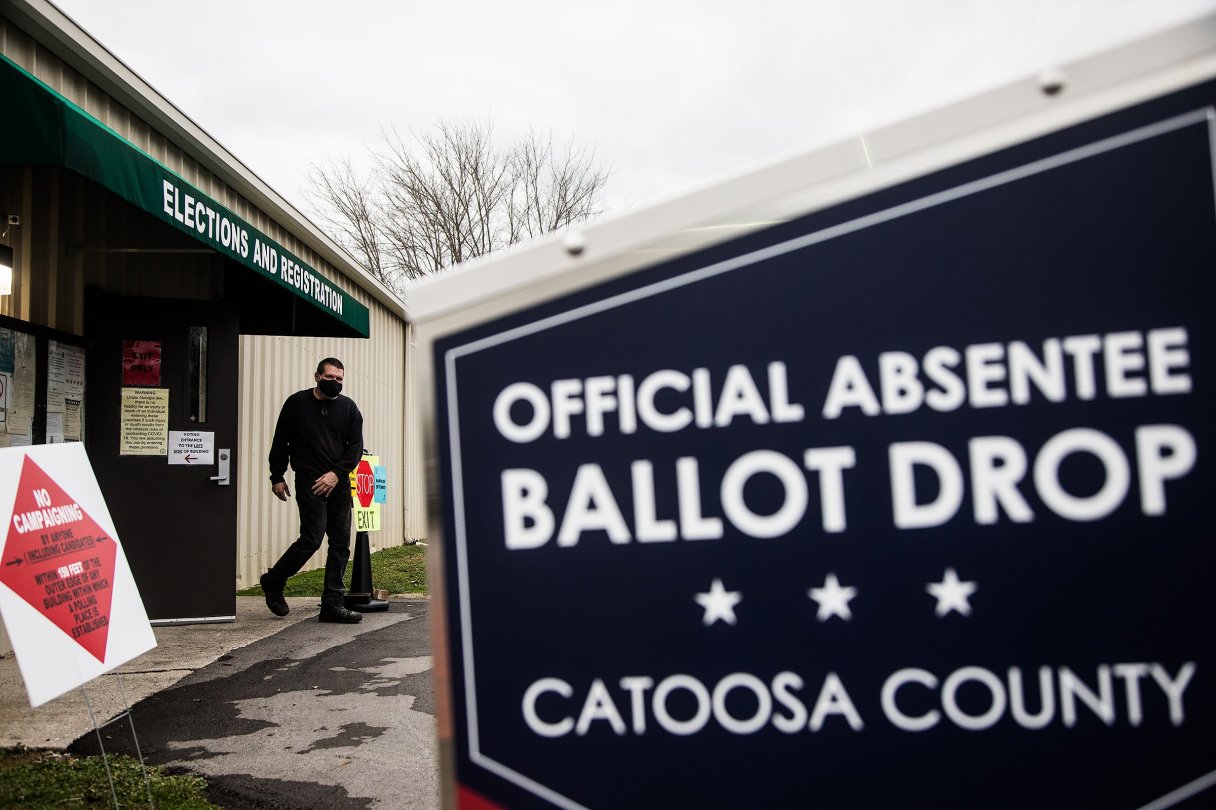
Northwest Georgia elections officials have been busy preparing for the May 24 primary, which will operate somewhat differently from years past as a result of changes enacted just over a year ago by state legislators.
Officials gathered at a conference hosted by the Georgia Secretary of State’s Office in Athens late last month to hear about the changes, which Catoosa County elections director Tonya Moore said in a phone interview most officials haven’t had experience with yet, unless they conducted their city elections or they had a special election.
“So this conference was to go over all the changes … just to make sure that everyone is aware of all the law changes,” she said.
Topics included how to work with poll watchers, as well as reconciling ballots, audits and recounts, she said.
The Georgia Election Integrity Act of 2021 limited the availability of drop boxes, reduced the time period during which voters may request an early ballot, expanded early voting and required more staffing at some polling places to combat long wait times, among other changes.
(READ MORE: Judge declines to toss lawsuits challenging Georgia voting law)
The Georgia General Assembly was considering more elections legislation as part of House Bill 1464. On Tuesday a state Senate committee eliminated most of what was planned for HB 1464, partly responding to opposition from elections officials concerned about increased workloads.
Stripped from the bill were provisions including ballot chain-of-custody requirements, allowances for ballot inspection and expanded investigative rights for the Georgia Bureau of Investigation. Remaining in the bill was a requirement for employers to give time off for early voting.
(READ MORE: Georgia senators scrap proposal for more election rules)
Currently, Moore said her office is busy proofing ballots, which are to be mailed out by April 25.
Last year’s legislation requires voters to file a new application for an absentee ballot, and Moore said the window for requesting an absentee ballot has been reduced from six months to 78 days. What’s different on the ballot is that voters are now required to list their driver’s license and date of birth. The application must be signed. A stamp or computer-printed signature isn’t allowed, she said.
The application is checked by date of birth and signature, Moore said.
“Used to be, that’s how we had to verify the absentee ballots when they came in, by signature. Now it’s by their Georgia driver license and date of birth,” she said.
The elections office does have the right to check if they have reason to believe that’s not their signature, she said.
“Just for the public, make sure they know the last day they can request a ballot, it’s changed now to 11 days before the election. So the very last day we can mail out the ballot is May 13. Before, they had [until] May 20,” Moore said.
Across the state, drop boxes are only available during early voting from 8 p.m. to 5 p.m. and are inside the building, Moore said. The new law added an extra day of Saturday voting, too, Moore said. Saturday voting will be May 7 and 14.
Moore said her office is also training poll workers, and earlier this week still need 44 more for the upcoming election season.
To do the job, someone must be a citizen of United States, a resident of the county, be able to speak English, read and write, and not be an officeholder, relative of an officeholder, or a felon. If someone gets a waiver from the county where they live, they can work as a poll worker in a neighboring county, she said.
Poll managers have to work from 6 a.m. to 8 or 9 p.m., while poll clerks can work one of two shifts the day of the election. Call or visit the county website for questions about the election, but not with questions about candidates – voters have to do their own research, Moore said.
Chuck Fletcher, elections assistant in Walker County, said officials try to check signatures on absentee ballots, and that’s a lot easier because they have far fewer since the pandemic has subsided. They have had 50 or 60 applications for this election, he said by phone earlier this week, and last year they ended up having about 2,000.
Walker County is less in need of poll workers, he said, but will still accept people interested in the job.
“Even if we didn’t need someone this time, it’s always good to have backups in case someone gets sick or something happens,” Fletcher said.
Some of the bigger counties have Sunday voting, but Fletcher said that’s a lot of work for elections officials since it means fewer days off for workers.
Dade County‘s elections supervisor Lowanna Vaughan said in a phone interview her office is still needing a few poll workers for their seven voting locations.
Sheena Weaver, chief registrar in Chattooga County, said by phone the office has all the poll workers needed for this upcoming election season. One recent change she noted was the consolidation of polling places, reducing the number from 13 to seven.
Mary Hammontree, Whitfield County board of elections registrar, said the office is “always needing poll workers,” in case someone is absent, but doesn’t have an exact number. In a phone interview, she said the pay is different for every county, but the clerks make $140, and training is paid by the hour.
When asked if the new laws made it easier or harder to vote based on the new elections law, she said it’s easier, especially with the options to stay open longer.
“It’s easier, because we’ve got more Saturdays to vote, and they give us the option to stay open later,” Hammontree said. “We’re not going to do Sundays, but there’s options to do Sundays also.”
Contact Andrew Wilkins at awilkins@timesfreepress.com or 423-757-6659. Follow him on Twitter @tweetatwilkins.