
Tuesday, November 10, 2026Nov 10

Hamas rebrands itself in new manifesto, but old goals remain

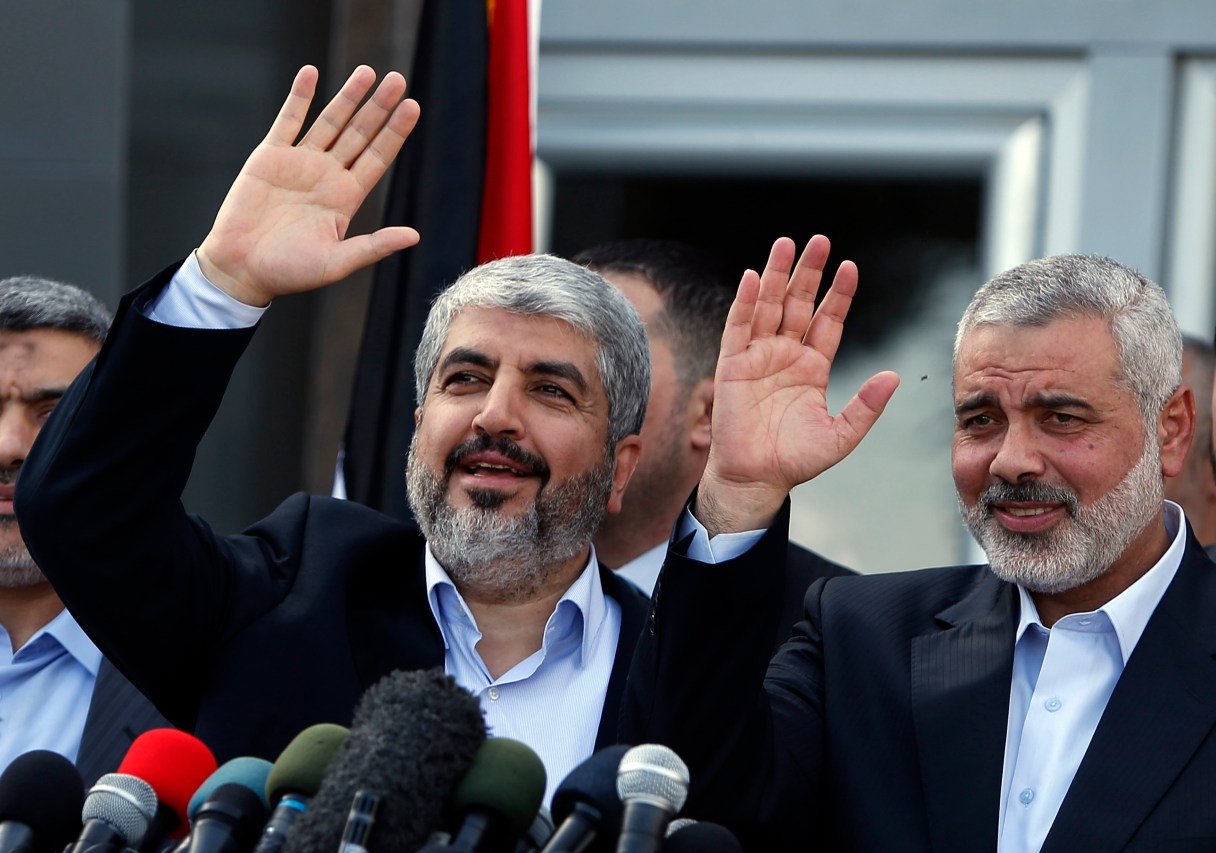
FILE -- In this Dec. 7, 2012 file photo, formerly exiled Hamas chief Khaled Mashaal, left, and Gaza's Hamas Prime Minister Ismail Haniyeh wave during a news conference upon Mashaal's arrival at the Rafah crossing in the southern Gaza Strip. A new political program of Hamas, published Monday, May 1, 2017, is meant to help the Islamic militant group break out of its international isolation. (AP Photo/Suhaib Salem, Pool)
FILE -- In this Dec. 7, 2012 file photo, formerly exiled Hamas chief Khaled Mashaal, left, and Gaza's Hamas Prime Minister Ismail Haniyeh wave during a news conference upon Mashaal's arrival at the Rafah crossing in the southern Gaza Strip. A new political program of Hamas, published Monday, May 1, 2017, is meant to help the Islamic militant group break out of its international isolation. (AP Photo/Suhaib Salem, Pool) FILE -- In this Dec. 7, 2012 file photo, formerly exiled Hamas chief Khaled Mashaal, left, and Gaza's Hamas Prime Minister Ismail Haniyeh wave during a news conference upon Mashaal's arrival at the Rafah crossing in the southern Gaza Strip. A new political program of Hamas, published Monday, May 1, 2017, is meant to help the Islamic militant group break out of its international isolation. (AP Photo/Suhaib Salem, Pool)

GAZA CITY, Gaza Strip (AP) – The new political program of Hamas, published Monday, is meant to help the Islamic militant group break out of its international isolation. The manifesto does not formally replace the group’s fiery 1987 founding charter, but adopts more conciliatory language, even if some goals remain unchanged – such as the eventual “liberation” of all of historic Palestine, including what is now Israel.

Here is a look at the program and the group behind it:

WHAT ARE THE MAIN POINTS?

The new program for the first time raises the possibility of establishing a Palestinian state in the West Bank, Gaza Strip and east Jerusalem, territories Israel captured in 1967. In the past, Hamas criticized its main rival, the Fatah party of Palestinian President Mahmoud Abbas, for pursuing a two-state deal with Israel.

Even now, Hamas considers such a state as an interim step, not a way to end the conflict. The new document does not contain an explicit call for Israel’s destruction, but says Hamas “rejects any alternative to the full liberation of Palestine, from the river to the sea.” This refers to the area reaching from the Jordan River to the Mediterranean Sea, which includes the lands that now make up Israel.