
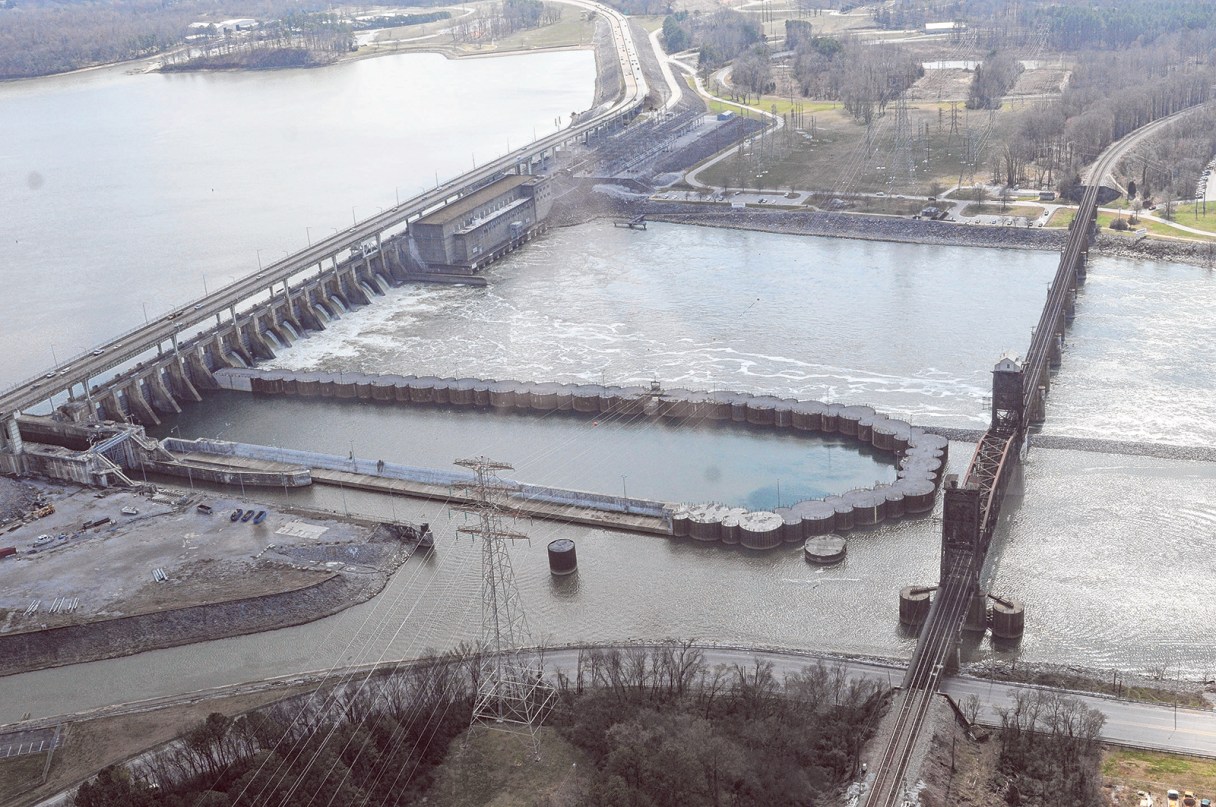
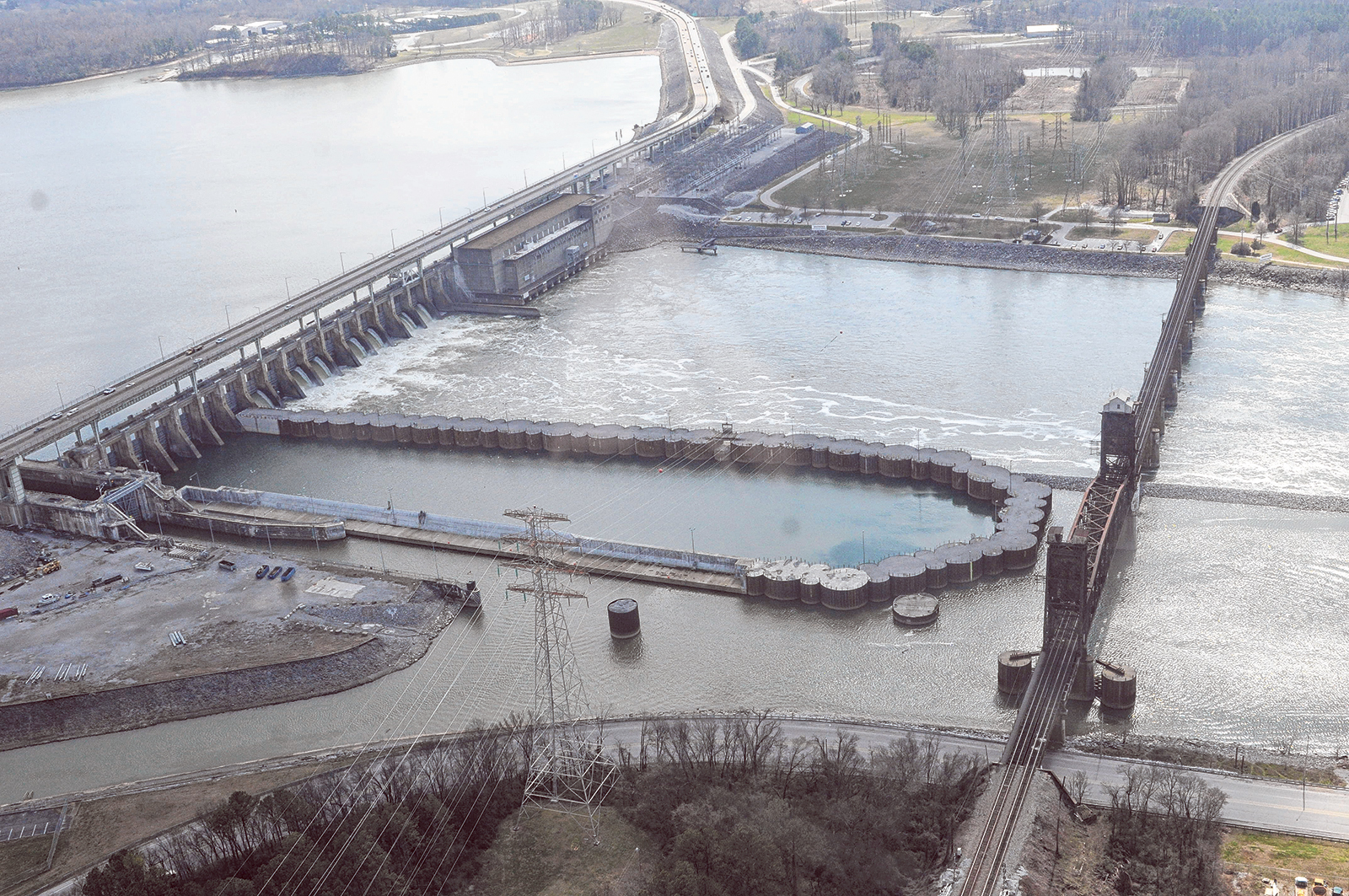
 Work on the Chickamauga lock is stagnant in this February 2014 view below the Chickamauga Dam.
An increase in the fuel tax in April on barge operators should generate an extra $30 million to $35 million this year for the repair and building of locks and dam projects, a top federal official told Congress today.
But even with more money in the Inland Waterways Trust Fund, officials with the Army Corps of Engineers said today they are still evaluating if there will be any funds available to restart the stalled new lock at the Chickamauga Lock in Chattanooga.
“We are currently looking at evaluating the list of priorities to determine what should be next,” JoEllen Darcy, assistant secretary of the Army Corps of Engineers for Civil Works, told a Congressional subcommittee today. “The Corps is looking at those evaluations so that we can make a determination about the economics and whether we need to relook at our priority (list).”
Darcy said she expects to complete the new study by this summer.
The White House budget unveiled earlier this month didn’t include any money to restart work on the new Chickamauga Lock, which has been stalled for the past two years due to a lack of funding.
The Corps has spent more than $180 million to design a new and bigger lock at the Chickamauga Dam and has installed the walls on the expanded lock beneath the dam. But the new lock is projected to cost another $500 million to complete.
The White House budget allocated $53 million for work at the Olmsted Lock and Dam on the Ohio River and for ongoing work on new locks on the Lower Monongahela River in Pennsylvania.
U.S. Rep. Chuck Fleischmann, R-Tenn., said there is still another $53 million available next year for other projects and he is pushing to use that money to resume work on the new Chickamauga Lock.
Congress has acted to increase funding levels for the Corps by about $1.5 billion above what the president has requested over the past two years. Last year, Congress also revamped the funding formula for the Inland Waterways Trust Fund to provide more support for the biggest lock project, a new dam and locks at the Olmsted Lock on the Ohio River.
“We listened when we heard that the trust fund was broke and needed to be fixed and we listened when you said you needed more revenue,” Fleischmann told Corps leaders during today’s hearing of the House subcommittee on Energy and Water Development.
The Inland Waterways Trust Fund should get about $107 million this year, including an extra $30 million to $35 million from the 9-cent-per gallon increase in the barge fuel tax.
But only about half of those available funds have been allocated, Fleischmann said, leaving at least another $53 million next year for other projects.
“And in reality, we may actually end up having in excess of $53 million because that is a rather conservative estimate (of funds from the higher fuel tax and other sources),” Fleischmann said.
While the White House budget has no money for building the new lock, it does provide $1.6 million in fiscal 2016 to maintain aggressive maintenance programs at the existing lock, which was built in 1940 and suffers from problems with “concrete growth” in the chamber walls.
The Corps has spent $29 million to shore up and maintain the existing Chickamauga lock since 1998 in response to the concrete growth problem.
“The last study we did said that there was no immediate danger of structural failure and what we continue to do with our meters is to monitor significant movement….to ensure that there is a potential failure we take whatever precautions we can,” said Lt. Gen. Thomas Bostick, the commanding general for the Army Corps of Engineers. “Right now, we don’t see that as an issue.”