
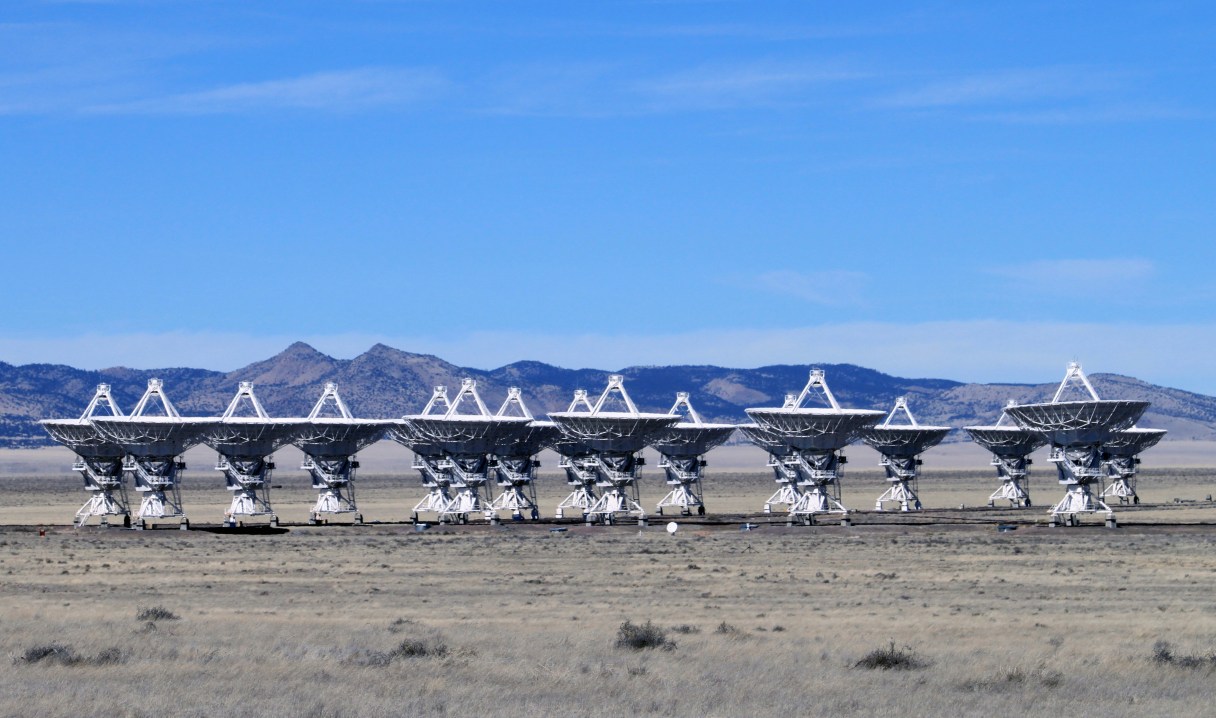
ALBUQUERQUE, N.M. (AP) – Employing an array of giant telescopes positioned in the New Mexico desert, astronomers have started a massive surveying project aimed at producing the most detailed view ever made of such a large portion of space using radio waves emitted from throughout the Milky Way and beyond.
The National Radio Astronomy Observatory announced the project this week, saying the Very Large Array will make three scans of the sky that’s visible from the scrubland of the San Augustin Plains. It is one of the best spots on the planet to scan space, with 80 percent of the Earth’s sky visible from the location.
The array works like a camera. But instead of collecting light waves to make images, the telescopes that look like big satellite dishes receive radio waves emitted by cosmic explosions and other interstellar phenomenon.
Astronomers expect the images gathered by the array will allow them to detect in finer detail gamma ray bursts, supernovas and other cosmic events that visible-light telescopes cannot see due to dust present throughout the universe. For example, the array can peer through the thick clouds of dust and gas where stars are born.
Scientists involved in the project say the results will provide valuable information for astrophysics researchers.