
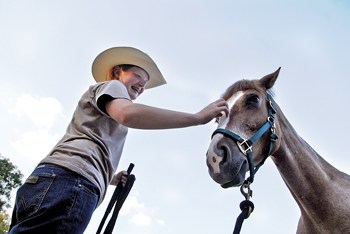

By Maggie Behringer
Correspondent
It was a first for both horse and trainer when Kathy Caylor met a yearling named Ginger in February.
Mrs. Caylor, a veteran trainer and rider who owns Caylor Stables in East Brainerd, had never taken on this kind of project. Ginger, a wild mustang who traveled from Oregon through the Youth and Yearling Mustang Challenge, had never lived in human care.
Four months later, Ginger is now a champion horse, having won first place in the Youth and Yearling Mustang Challenge, held last month in Jamestown, Tenn.
With Ginger fully adapted to her new home, Mrs. Caylor is becoming embedded in the effort to ensure, through training and adoption, the survival of the American mustang.
“You’re preparing them for the rest of their lives,” Mrs. Caylor said.
Though they are characterized as a Western animal, mustangs aren’t uncommon in Tennessee. A magazine article on Soddy-Daisy trainer Chase Dodd and his national success training mustangs piqued Mrs. Caylor’s interest. A demonstration with one of Mr. Dodd’s eight horses convinced her to take the next step.
MUSTANGSThere are roughly 33,700 mustangs roaming on rangelands in 10 Western states and 30,000 horses living in short- and long-term pasture facilities in the West and Midwest. Other herds live on Indian reservations and the Fish and Wildlife Service’s land.Source: U.S. Bureau of Land Management
Ginger wasn’t the stereotypical wild mustang when she arrived at Caylor Stables. She didn’t pace the fence or buck. Mrs. Caylor describes her more as a “wild deer,” letting people within three feet of her before bolting.
“She knew that if she kept that space you couldn’t catch her,” Mrs. Caylor said.
She began Ginger’s training by breaking down the touch barrier. She rubbed the horse’s body, which at first provoked little jumps as if Ginger had been shocked.
Training focused on socializing Ginger by preparing her for experiences she would encounter as a domesticated horse, such as wearing a blanket and having her feet handled by a farrier. That laid the foundation for further training to accept a saddle and rider.
The “natural horsemanship” approach, which Mrs. Caylor has used with her horses for the past 10 years, proved essential to Ginger’s progress.
Though Mr. Dodd agrees the term is a contradiction, as there is nothing natural about saddling a horse, the trainers explain the method develops communication between horse and rider built not on disciplinary correction, but on body language and instinct.
“It’s more about teaching how to communicate with the horse on their level,” Mrs. Caylor said. “You want to build a relationship with the horse. What you’re wanting to do is convince the horse that you’re the leader of the herd.”
Ginger’s progress and intelligence surprised Mrs. Caylor. She found that if she followed through with her end of the training, Ginger would as well.
“It’s an absolute blessing to take a horse that’s completely wild and transform it into something that wants to be a partner and friend,” Mr. Branch said.
Whether that friendship would hold up was tested in the Youth and Yearling Mustang Challenge, an event that tries to place the mustangs in new, permanent homes. Horse trainers may choose to keep their horses after the competition, but if not, the mustangs are auctioned off that day.
“One of the goals is to change lives for both the children and the horses,” said Mike Branch, organizer of the event. “It certainly gives the mustang a chance for a better future.”
Rihanna Roots, 14, one of Mrs. Caylor’s students, was picked to ride Ginger in the challenge.
The first section of the event measures the students’ horsemanship and the communication between horse and student. The second is a freestyle program of the students’ choice.
Ginger performed flawlessly, Rihanna said.
“She did it with absolutely no hesitation,” she said. “She put all of her trust in me.”
Mr. Dodd, who was one of the event’s judges, recalled that Ms. Roots’ horsemanship and the interaction between her and Ginger were so far superior, she had already won the competition after the first section.
“There was no way anyone could beat her,” he said.
Contact Maggie Behringer at maggie.behringer@gmail.com