
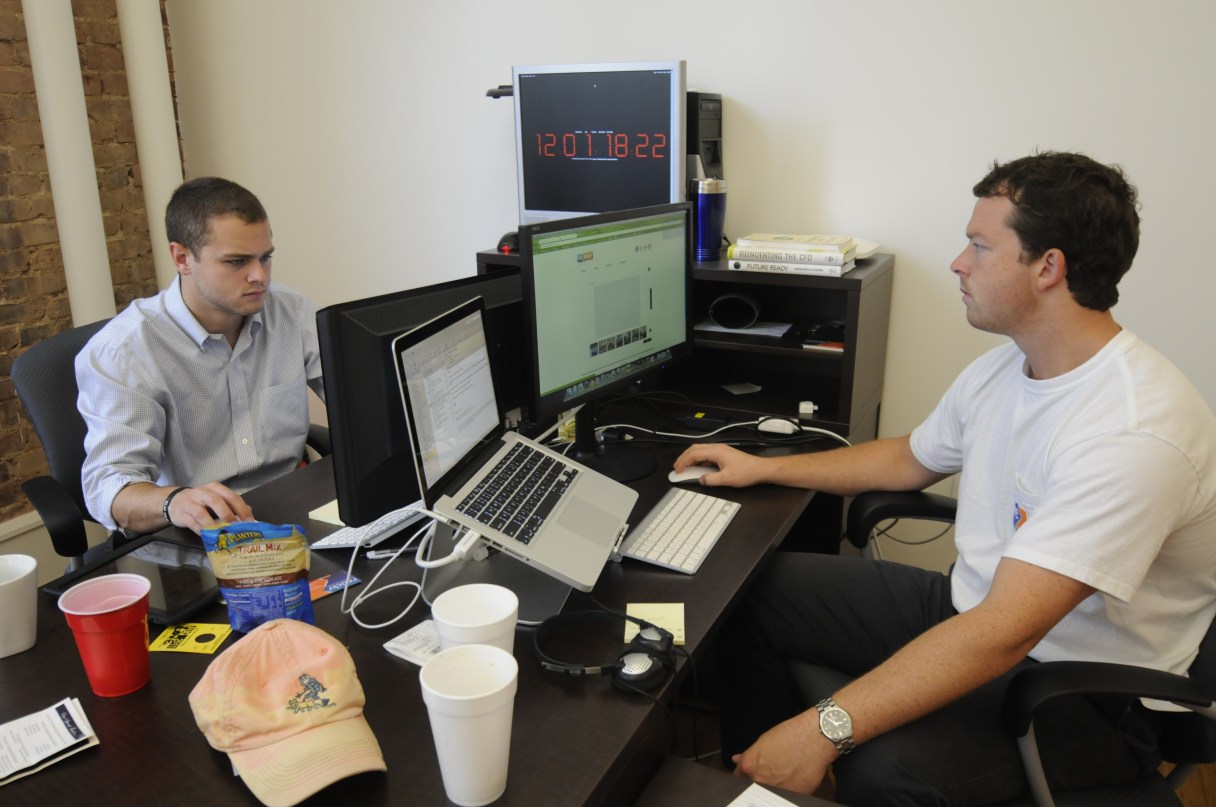
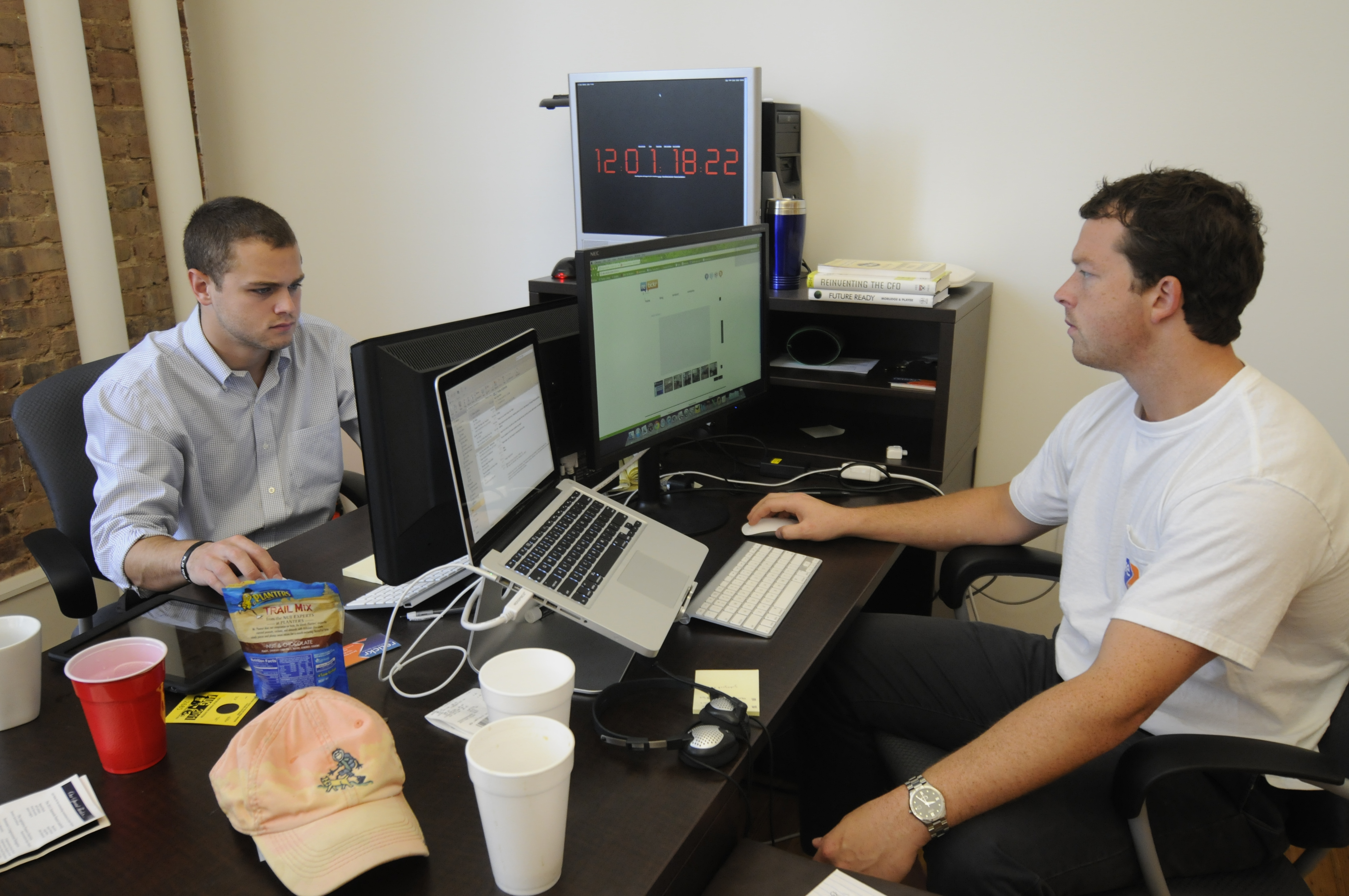
 Jared Houghto, left, and Brian Trautschold work at Retickr Friday inside the Lamp Post Group.
BY THE NUMBERS250,500 – Employment peak reached in metro Chattanooga in December 2007223,700 – Employment in metro Chattanooga at trough of the recession in July 2009, 26,800 below the peak231,300 – Employment in metro Chattanooga during August 2011 – the most recent month for such figures – up 7,600 from two years ago.Source: U.S. Bureau of Labor Statistics. Nonseasonally adjusted figures for metro Chattanooga, including Hamilton, Sequatchie and Marion counties in Tennessee and Catoosa, Dade and Walker in Georgia
After shedding more than 25,000 area jobs, Chattanooga’s economy is reviving faster than the national average and is poised for better growth than most comparable cities, local and state business leaders said Friday.
“Chattanooga is viewed differently from a lot of similar-sized cities right now, and I think the level of optimism here is a lot more than what you see in other cities,” said Chad Eichelberger, the chief executive officer of Access America who has helped boost annual sales of the Chattanooga logistics company from $8 million in 2005 to over $100 million this year. “I think a lot of entrepreneurs in the city are willing to take some risks with new ventures.”
Eichelberger and other leaders of Access America organized a business incubator downtown known as the Lamp Post Group to help foster such entrepreneurs.
“People are willing to take a leap of faith here more than we are seeing nationally,” Eichelberger told a conference Friday organized by one of the state’s biggest accounting firms – Lattimore Black Morgan & Cain.
Buoyed by business startups and major business additions by Volkswagen, Wacker Chemical, Amazon and Alstom Power, Chattanooga added 5,540 jobs in the 12 months ending in August. The 2.3 percent job growth in metropolitan Chattanooga in the past year was nearly 10 times the growth pace of the United States as a whole, according to the Tennessee Department of Labor and Workforce Development.
Even amid the worst credit crisis in decades, a new 12-screen movie theater and two new hotels were added downtown during the recession. But plans to convert empty office buildings into hotels in the Maclellan Building, Chattanooga Bank Building and former BlueCross BlueShield Gold Building have yet to get off the drawing board.
“Sometimes, a pause in business helps you to rethink and refocus,” said Kim White, president of the River City Co., a downtown development agency. “Our area now is attracting a lot of very bright and talented entrepreneurs.”
But White said getting credit for new projects remains a challenge for many developers.
“That’s our biggest problem,” she said.
Nonetheless, Matt Kisber, a former commissioner of economic and community development in Tennessee who now serves as an economic development strategist for LBMC, said people across the Southeast “ask me what is going on in Chattanooga.
“When you look at what’s happening in Chattanooga, it’s really exciting,” he said.
Southeast Tennessee landed two of less than a dozen billion-dollar projects in the past three years with the Volkswagen assembly plant in Chattanooga and the Wacker polysilicon plant in Charleston, Tenn., plus the biggest job generator in Tennessee – $139 million of distribution centers by Amazon.com in Chattanooga and Charleston.
VW has hired more than 2,000 workers; Amazon has hired more than 1,500 workers and 19 VW suppliers have collected added another 1,400 jobs, according to Trevor Hamilton, the chief development officer for the Chattanooga Area Chamber of Commerce.
Unemployment in the Chattanooga area is still twice the rate of five years ago, but Hamilton said Chattanooga “has added jobs at a faster rate than the national or state average, and there are a lot more jobs yet to come into our area.”