
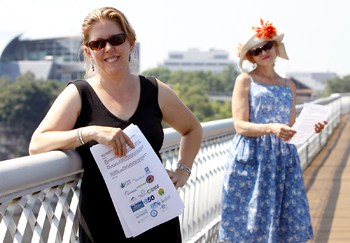
Caara Fritz Stoney wants to change the future.
In this case, the one faced by her children.
“For me it’s important to speak out because of the legacy for my son and my stepson,” said Ms. Stoney. “If we don’t do something about our energy consumption, our consumption of petroleum, there’s not going to be a future for them.”
She is one of dozens of local protesters expected publicly to oppose off-shore drilling Saturday.
The demonstration comes more than 64 days after the BP Deepwater Horizon oil spill left 11 people dead and oil gushing into the Gulf of Mexico.
Louisiana, Mississippi, Alabama and Florida immediately are affected by the oil spill. BP has taken full responsibility for the spill and agreed to put up $20 billion to compensate people who have legitimate claims for damages, according to news reports.
Ms. Stoney and others plan to start gathering at 11 a.m. on the Walnut Street Bridge and, at noon, the group will hold hands to show solidarity against off-shore drilling.
Demonstrators are saying “no to offshore drilling and yes to clean energy,” Ms. Stoney said.
As the Chattanooga group holds a demonstration on the bridge, people in nearly all 50 states and other countries are expected to join hands to show a united front against off-shore drilling.
Vaughan Greene, who lives in St. Elmo and also has a home in Inlet Beach, Fla., encouraged Ms. Stoney to organize the group locally while she organizes a group to demonstrate on Inlet Beach.
IF YOU GOWhat: Hands Across the SandWhen: 11 a.m.-1 p.m. SaturdayWhere: Middle of Walnut Street BridgeInformation: Visit Hands Across The Sand Chattanooga on Facebook or www.handsacrossthesand.com
“It’s raising awareness about oil consumption and telling people we need to head in another direction,” Ms. Greene said. “Wind power, solar power are alternatives, but a lot of energy has not been put toward developing those.”
Local organizers chose the Walnut Street Bridge as the protest site since Chattanooga has no beach. However, the waters of the Tennessee River can still be affected by what goes on in the Gulf, Ms. Stoney said.
“Our Tennessee River feeds directly into the Gulf,” she said. “We’re all interconnected and, if we’re not thinking about it here, we’re not doing justice to the people who come behind us.”
The U.S. government estimates that up to 60,000 barrels of oil are gushing from the ruptured well in the Gulf of Mexico per day, according to news reports.