
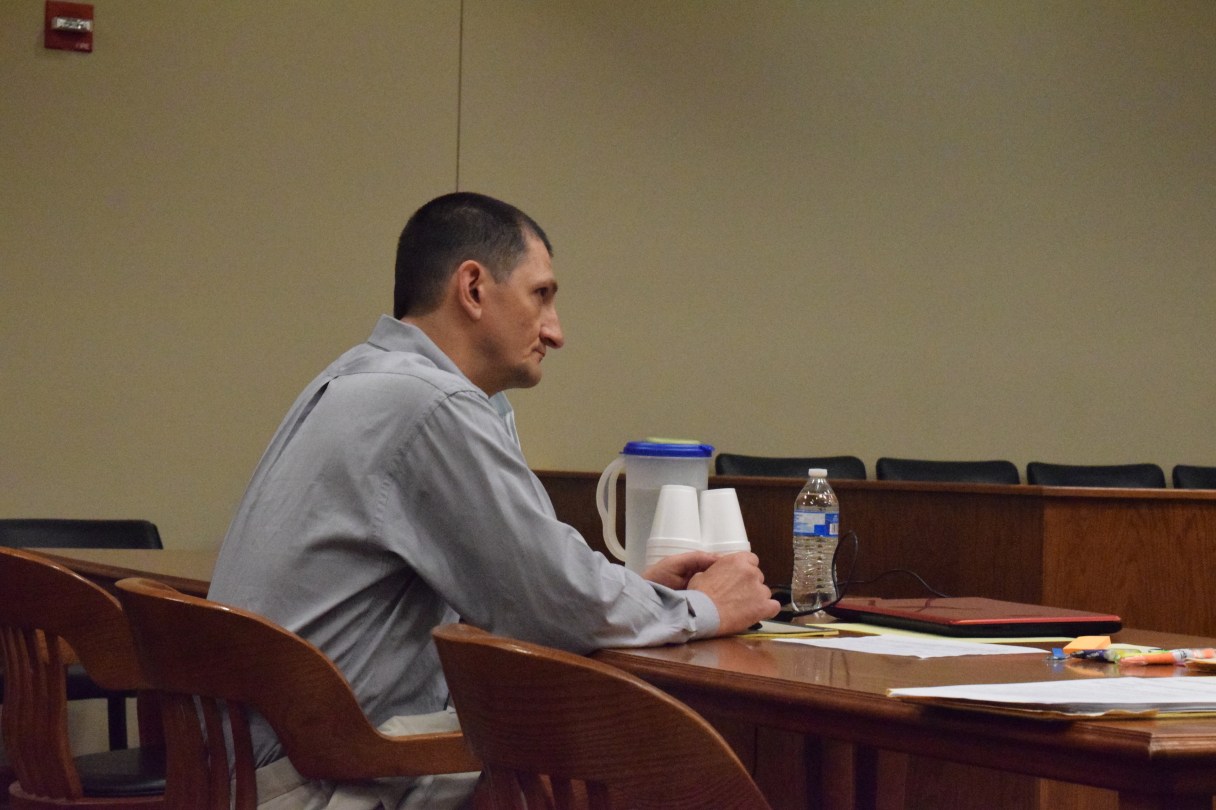

WINCHESTER, Tenn. – The jury in the trial of a Bledsoe County, Tennessee, man charged with hacking his girlfriend and her mother to death with a fireman’s ax found him guilty of two counts of first-degree murder Thursday after more than four hours of deliberation.
Jurors began deliberating Thursday morning in the trial of Robert Joe Whittenburg, 47, of Pikeville, Tennessee, who faced the charges in the killings of Deanna Lawrence, 46, and her daughter, Dedra Lawrence, Whittenburg’s then-24-year-old girlfriend.
After the jury was released from duty, Natasha Stoner, Deanna Lawrence’s niece and Dedra’s cousin, said the family was satisfied with the verdict.
“Obviously, there’s no verdict that would replace our family members, however, that’s enough justice on this side of heaven,” Stoner said. “Our family has been served justice to the extent that we can have here.
“We feel like we can rest easy and now Deanna and Dedra can rest peacefully,” she said.
The jury had been sequestered since being selected Tuesday for the trial, moved from Bledsoe County to Franklin County because of heavy media coverage and traffic from the Highway 127 yard sale, court officials said. Bledsoe and Franklin are both within the 12th Judicial District, and Circuit Court Judge Thomas Graham presided over the case. It was the first criminal trial in the 12th Judicial District since the pandemic began.
During deliberations, Judge Graham announced to the gallery that a court deputy had a conversation with some jurors that was potentially improper. At first, it was thought someone asked the deputy about “reasonable doubt,” but when Deputy Greg McGee took the stand to testify about what he told the jurors, he said they popped a question about the definition of “premeditation.”
McGee said it appeared the jury was taking a cigarette break when he walked into the jury room and he thought the jurors were going to ask about snacks, but they suddenly asked the question about premeditation. He said he was taken by surprise.
“I just walked into the break room to assist in some break stuff. When I walked in they just simply said, ‘Can you help us with something?’ I said, ‘I don’t know what do you need?’ I thought they needed snacks or something,” McGee told the judge. “‘Can you tell us what premeditated means? I kind of threw my hands up and I said, ‘It means basically that you have to have a little forethought about what you’re going to do and then you do it.’ She said, ‘Is that what it means?’ and I said, ‘You need to talk to them about that.'”
Whittenburg’s lawyer, Sam Hudson, took issue with the appearance that jurors were deliberating or discussing the charges without all the jurors present in the room, a violation of court rules. Graham said he didn’t believe jurors had gone far enough through their deliberations to harm Whittenburg’s case, and if smoke breaks were causing a problem he could just put a stop to those.
But Hudson took issue with jurors not being allowed to take smoke breaks. He said he didn’t want a nicotine-addicted juror rushing to judgment to get to have a cigarette.
After a debate with Hudson on the matter, Graham agreed that he’d decide when it was a proper time for the cigarette break.
Hudson made a motion for mistrial on improper deliberation without all jurors present and improper discussion with an outside party. Graham denied the motion.
Much of the focus of Thursday morning’s closing arguments from Hudson and the prosecution team of David Shinn and Steve Strain was on a statement Whittenburg made to TBI agent Keith Herron after Whittenburg was released from the hospital in December 2017 after being treated for self-inflicted injuries.
Whittenburg told Herron he couldn’t remember what happened but surmised he was responsible, according to testimony.
“‘I realize it must have been me because I was the only one there,'” Whittenburg told Herron.
Hudson contended Whittenburg’s story throughout the investigation remained the same, including his inability to remember what happened to the women.
Jeff Seals, Deanna Lawrence’s boyfriend, was the person who found the bodies on Nov. 30, 2017, according to his testimony Tuesday. Seals got off from his construction job earlier than expected – he and Whittenburg worked for the same company but on different crews – and he was concerned because he had been trying to reach someone at the home on Sawmill Road in Pikeville for hours with no response, and when he got home no one would answer the door and the house was dark.
When he finally went to a back bedroom window and knocked, breaking the glass, he made his way into the darkened home where he made the grisly discovery, according to testimony. Seals initially thought Whittenburg, who was unconscious on a bed in the home, was among the dead, as did the first law enforcement officers to arrive, but when Whittenburg gasped they realized he was still alive and sent him to the hospital.
Dedra Lawrence’s body was found in the kitchen of the home and Deanna Lawrence’s body was found in the living room near the front door, according to testimony.
According to testimony about DNA analysis, blood samples were taken from a variety of items investigators took from the scene and the murder weapon, a fireman’s ax. DNA from Whittenburg and Dedra Lawrence was found on several items, but Deanna Lawrence’s DNA was identified only on a sample of the claw portion of the ax, according to testimony.
Whittenburg took the stand in his own defense Wednesday still contending he has no memory of what happened to the women, though he recalled trying to kill himself by using medical supplies to attempt to drain out his own blood and hacking at himself with the ax.
Hudson contended it was possible a situation developed in which Whittenburg was provoked into using the ax on the women. He pointed to defense testimony Wednesday from Whittenburg’s mother that he and Dedra Lawrence had heated arguments and that she sometimes screamed at him and threw things.
Hudson told jurors it was possible the two women got in an argument, engaged in combat, possibly one of them attacked the other with the ax, and Whittenburg became involved trying to stop it. Hudson pointed to testimony that the two women were capable of “pushing buttons” that caused Seals and Whittenburg to lose their usual “calm and chill” demeanors.
Hudson told jurors the state had not proven Whittenburg premeditated any of his actions and that they should consider evidence of the victims’ having violent natures.
Hudson said if jurors believed the state met its burden of proof that Whittenburg took the women’s lives, he should be found guilty of voluntary manslaughter, and if they didn’t believe the state had carried its burden, to acquit him.
After the verdict was read, Graham told the family the state had sought a sentence of life without parole if Whittenburg was found guilty of first-degree murder. That would have required a jury hearing, but the prosecutors told the judge the state would be satisfied with the automatic sentence of life with the possibility of parole, which is a sentence of 51 years.
Whittenburg would have to live to the age of 98 to be eligible for parole.
A hearing was set for Sept. 30 in Sequatchie County for the judge to hear arguments on whether the life sentences should run consecutively or concurrently.
Contact Ben Benton at bbenton@timesfreepress.com or 423-757-6569. Follow him on Twitter @BenBenton.