
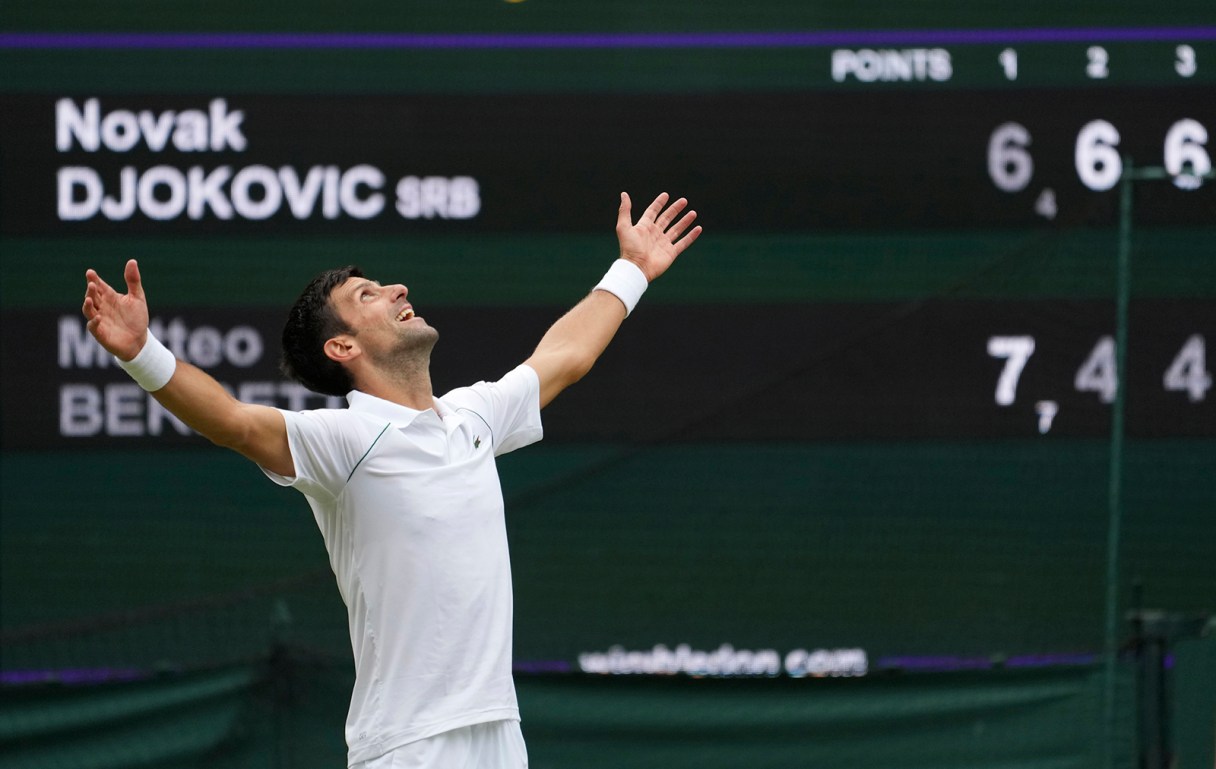
WIMBLEDON, England – The Wimbledon final was locked up at a set apiece after nearly 2 1/2 hours, and Novak Djokovic’s bid for a record-tying 20th Grand Slam men’s singles title was at a critical juncture. The tournament’s reigning champion faced two break points while thousands in the capacity crowd at Centre Court chanted his opponent’s first name.
Bothered, perhaps, by the challenge he was facing between the lines Sunday, and perhaps by the support being thrown behind younger challenger Matteo Berrettini, and perhaps by the weight of the milestone he was pursuing, Djokovic shrugged all of that off and steeled himself, as he has so many times at so many moments on so many grand stages.
On each of the next two points, Djokovic, known for his baseline supremacy, charged forward. On each, Berrettini’s passing attempt found the net. After the second, Djokovic stared into the stands and pointed to his ear, then waved his racket. He got what he wanted as a chorus of his nickname broke out: “No-le! No-le!” Two points later, when he grabbed the game with a 118 mph ace, Djokovic put his racket behind an ear, heard more noise, nodded and smiled.
An hour later, the match was finished – Djokovic won 6-7 (4), 6-4, 6-4, 6-3 – and so, too, was his stated desire to equal the total of major championships collected by his biggest rivals: Roger Federer, who reached 20 in 2018, and Rafael Nadal, who did it last year. No other male tennis player has more than 14 Grand Slam singles titles.
Djokovic, of course, wants more.
“I consider myself best, and I believe that I am the best, otherwise I wouldn’t be talking confidently about winning Slams and making history,” said Djokovic, a 34-year-old from Serbia who is No. 1 on the ATP Tour and has spent more weeks in that top spot than anyone. “But whether I’m the greatest of all time or not, I leave that debate to other people.”
It is a popular topic, certainly. And every member of the so-called Big Three has his supporters. This season might tilt the balance in Djokovic’s favor in the minds of those yet to be convinced.
Already the first man since Australia’s Rod Laver in 1969 to win the first three major tournaments in a year, Djokovic will take aim at a true calendar Grand Slam at the U.S. Open, which starts Aug. 30 in New York. Only two men – American star Don Budge in the 1930s and Laver twice in the 1960s – have gone 4-for-4.
“I’m going to definitely give it a shot,” Djokovic said during Sunday’s trophy presentation. “I’m in a great form and obviously playing well. … So let’s keep it going.”
He earned a third consecutive championship at the All England Club and sixth overall at the grass court major. Those go alongside nine titles at the Australian Open, three at the U.S. Open and two at the French Open.
“I have to pay a great tribute to Rafa and Roger. They are legends. Legends of our sport. They are the two most important players that I ever faced in my career,” Djokovic said. “They are, I think, the reason that I am where I am today. They’ve helped me realize what I need to do in order to improve, to get stronger mentally, physically, tactically.”
Federer and Nadal both tweeted their congratulations.
This was Djokovic’s 30th major singles final – among men, only Federer has played more, 31 – and the first for Berrettini, a 25-year-old from Italy who was seeded No. 7.
“Hopefully,” Berrettini said, “it’s not going be my last one.”
The opening game featured signs of edginess from both finalists, but especially Djokovic, whose pair of double faults contributed to the half-dozen combined unforced errors. He faced a break point but staved it off.
“Definitely,” Djokovic acknowledged, “felt slightly more nervous than I usually feel.”
The 6-foot-5, barrel-chested Berrettini’s powerful serves sent line judges contorting to get their head out of harm’s way. Djokovic occasionally took cover himself, crouching and raising his racket as if it were a shield to block serves aimed at his body.
Not many opponents manage to return serves at 137 mph and end up winning the point, but Djokovic did that at least twice. And the big forehands Berrettini drives past most other players kept coming back off Djokovic’s racket.
“I didn’t play badly because I didn’t feel well,” Berrettini said. “He made me play badly.”
That’s what Djokovic does: He forces foes to work so hard to win every point, let alone a game, a set, a match. On Sunday, Djokovic made merely 21 unforced errors while accumulating 31 winners.
Indeed, this one could have been over much sooner: Djokovic led 4-1 in the first set, 4-0 in the second and 3-1 in the third. Yet he faltered in the first, wasting a set point at 5-2, getting broken when he served for it at 5-3, then dropping four of the tiebreaker’s last five points.
When Berrettini closed it out with a 138 mph ace, he shouted – and later said he couldn’t hear his own roar because of how loud many of the 15,000 spectators were.
Djokovic is nothing if not a fighter, though. He blunted Berrettini’s best efforts and won the fans over, too. When it was all done, Djokovic dropped to his back on the turf, arms and legs splayed, showered by cheers. Moments later, he rose, threw his head back, spread his arms and basked in the joint appreciation of his accomplishment.
As Berrettini put it: “He’s writing the history of this sport, so he deserves all the credit.”
Djokovic has won eight of the past 12 men’s singles major championships – all since turning 30. And for all of the questions about when the younger generation might finally step forward, Djokovic is singlehandedly holding off the kids.
In this year’s three majors, he is 21-0, with finals wins over 25-year-old Daniil Medvedev in Australia, 22-year-old Stefanos Tsitsipas in France and now Berrettini.
Djokovic’s returns are as good as anyone in the sport’s history. His two-handed backhand is a constant threat. His ability to anticipate and reach shots is remarkable. And he does whatever it takes: Djokovic won 34 of 48 points when he went to the net, and he was 7-for-9 when he took a serve-and-volley approach.
What sets him apart above all is a quality stats can’t trace, what he called “the ability to cope with pressure.” When the tension and heart rate ratchet up, Djokovic is either impervious to that sort of thing – or plays as if he is.
It’s the experience. The grit and guts. The talent and hard work.
This has been a year of dominance by Djokovic, on top of a decade of success.
“The last 10 years has been an incredible journey,” he said, “that is not stopping here.”