
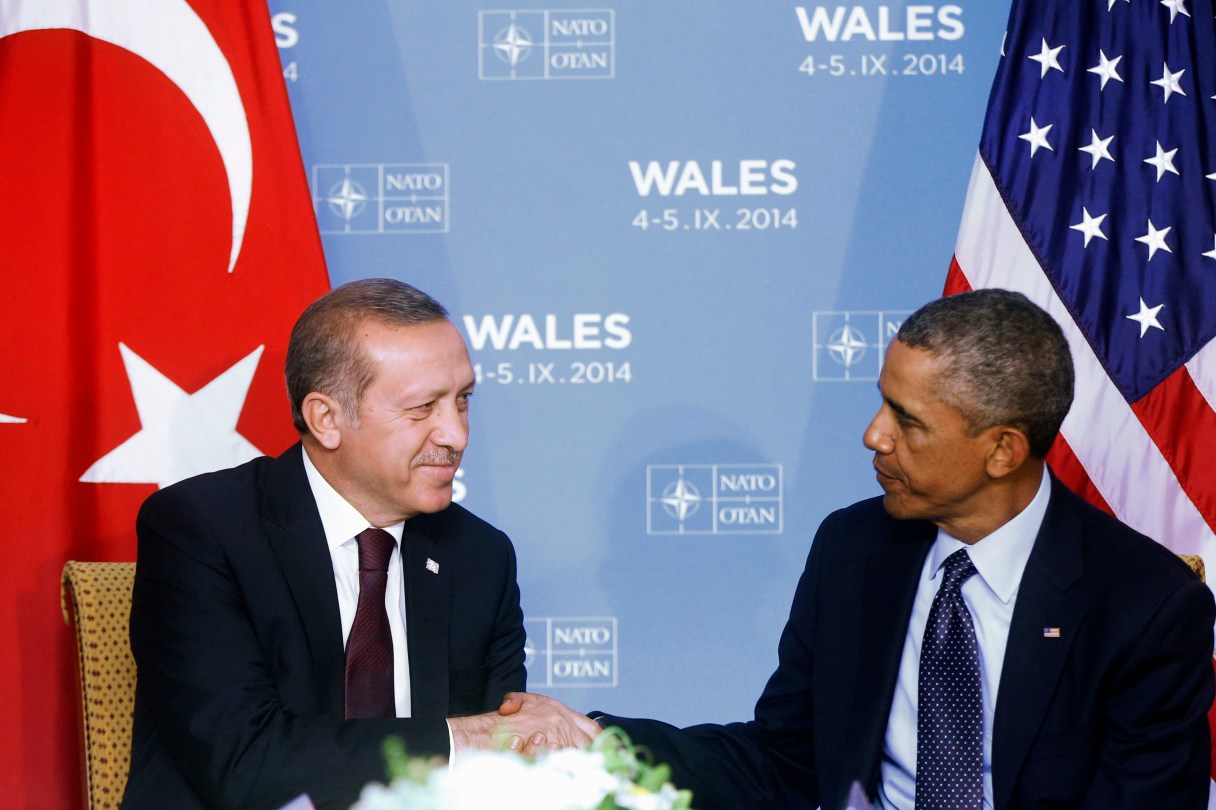
WASHINGTON (AP) – President Barack Obama and Turkish President Recep Tayyip Erdogan are both taking a big gamble as they agree to work together against the Islamic State group militants in Syria.
Their goals, while overlapping in some ways, are far different in others, mainly on the question of how to handle Kurdish militants battling Islamic State fighters in Syria. And that’s the problem.
Erdogan wants to combat Islamic State militants in his country who had flown freely across the border with Syria. But his biggest priority is one that’s driven by domestic politics: curtailing growing Kurdish power along Turkey’s southern border. Ankara is worried that Kurdish gains in Iraq and in Syria will encourage a revival of the Kurdish insurgency in Turkey in pursuit of an independent state.
To that end, Erdogan used the start of Turkish air strikes against Islamic State forces in Syria to also attack Kurdistan Workers’ Party (PKK) rebels in northern Iraq. And on July 27, the main Syrian Kurdish militia, the People’s Protection Unit, known as the YPG, claimed that it had been shelled by Turkish troops. A Turkish official said the military was only returning fire, and that the military campaign does not include the YPG.
Since the U.S.-Turkey agreement was announced late last month, Turkish warplanes have attacked PKK bases in northern Iraq and its forces in southeastern Turkey on an almost daily basis.