
ROME (AP) – The Latest on the upcoming European Union summit (all times local):
6:45 p.m.
Prime Minister Xavier Bettel of Luxembourg says in an interview with The Associated Press that in the future, more decisions in the European Union may be made without unanimity.
“I’d rather have a two-speed Europe than a dead-end and no speed,” said Bettel. A two-speed Europe is one in which some countries can integrate more closely than others.
Bettel said: “When a country says ‘I don’t want to,’ I can say ‘Well, too bad. Don’t block me. Let me get on with it with others.'”
Bettel said that the idea, first pushed by Luxembourg, Belgium and the Netherlands, is catching on. “We were alone at the beginning with the Benelux. Then we had country after country because we saw that certain tried to take us hostage,” he said. That was a reference to the Polish government, which sought to sabotage the last summit two weeks ago by refusing to approve conclusions because the 27 other nations appointed Donald Tusk, a local political rival, for another term as EU president.
___
5:00 p.m.
Italy’s premier is spurring fellow EU leaders to use their Rome summit to make jobs and business growth their priorities.
Premier Paolo Gentiloni told EU officials Friday, on the summit’s eve, that the European Union, marking 60 years since its founding treaty was signed in Rome, must focus on the needs of workers and entrepreneurs as it charts its future.
The EU is grappling with big challenges, including Britain’s decision to leave the bloc and populist politicians who are taking advantage of a sense among citizens that EU bureaucrats are ignoring their problems.
Gentiloni says “it’s from work and know-how that any reflection on (the EU’s) future must begin.” He said EU leaders are also keenly aware that the “European welfare model” must be strengthened.
His own country has struggled to re-start economic growth.
___
1:45 p.m.
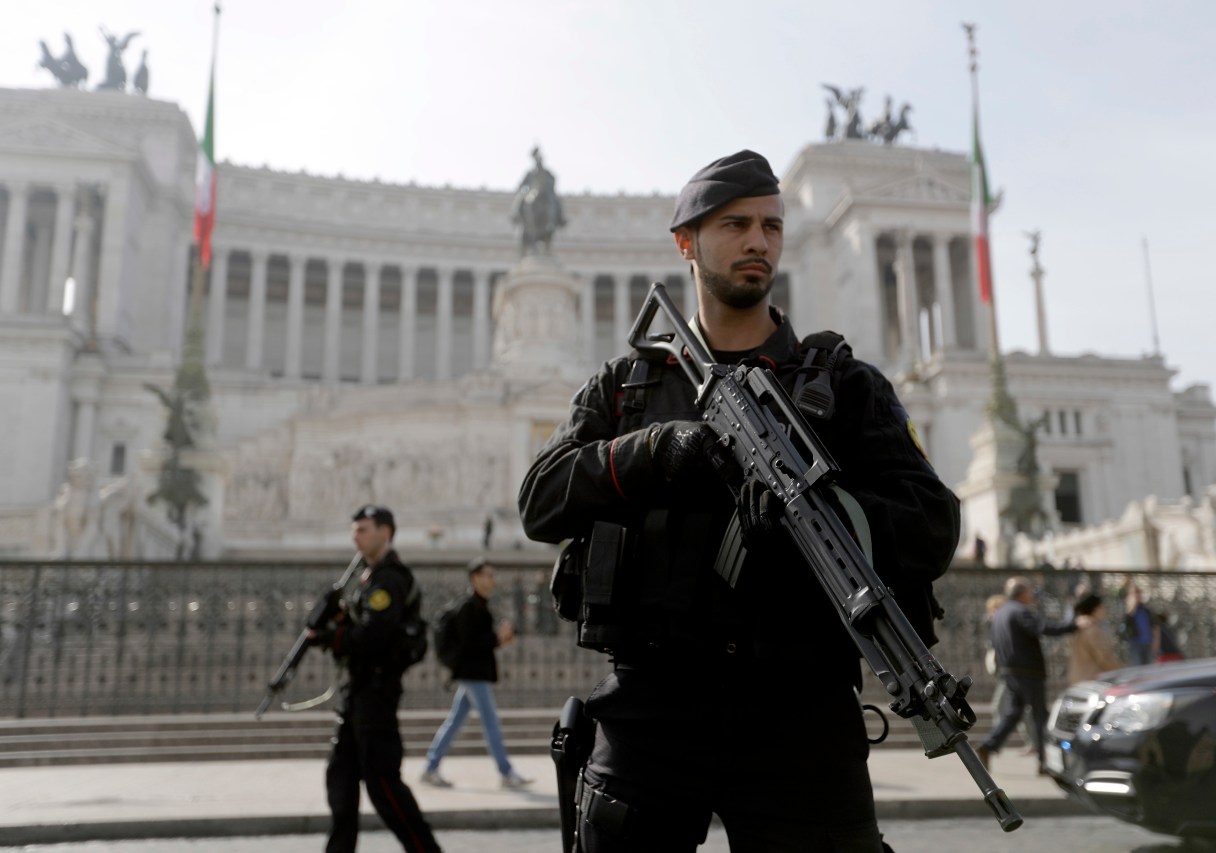
Italian police are securing Rome a day before a European Union summit to highlight the 60th anniversary of the bloc’s foundation.
Police dinghies are patrolling the Tiber River, inspecting the undersides of bridges which EU leaders will travel across.
Security arrangements for the summit atop the Capitoline Hill already called for increased vigilance. But concerns were heightened after the attack in London. Some of the leaders from 27 EU nations started arriving in Rome on Thursday night. Pope Francis will meet with them at the Vatican on Friday evening.
About 5,000 police, including bomb-sniffing dog units, are being deployed. They are preparing for possible violence by anarchists or other protesters in marches planned for Saturday in Rome.
___
1:15 p.m.
Poland’s prime minister will sign the declaration from the weekend’s European Union summit, saying it’s a compromise acceptable to all.
The declaration from the EU’s 60th anniversary summit in Rome is intended to show the group’s unity and strength just days before Britain triggers a procedure to leave the 28-nation bloc.
Prime Minister Beata Szydlo, who heads a nationalist government critical of the EU, had been threatening that she wouldn’t endorse the declaration. She had been concerned that the document would fail to address issues of prime concern for Warsaw, like EU unity, a common market equal to all, defense cooperation with NATO and strengthening of national parliaments.
Before leaving for the summit, Szydlo said that the text addresses them all and can be signed as a “compromise acceptable to all.”
___
1 p.m.
Hurt by Britain’s planned exit, European Union leaders are making a pilgrimage to Rome this weekend with the hope that a visit to the cradle of their project of unity can somehow rekindle the vigor of youth.
Saturday marks the 60th anniversary of the signature of their bond, which started with six founding nations but steadily grew to 28. But the biggest setback in the EU’s history looms next week when Britain officially triggers exit negotiations.
“Ever closer union” – long the EU’s mantra – pointed toward a seamless continent and an economic and political juggernaut. Now others, besides Britain, are looking for more of a “living apart together” relationship.
The climax of Saturday’s ceremonies will be the adoption of a Rome Declaration, a blueprint for the way ahead.