
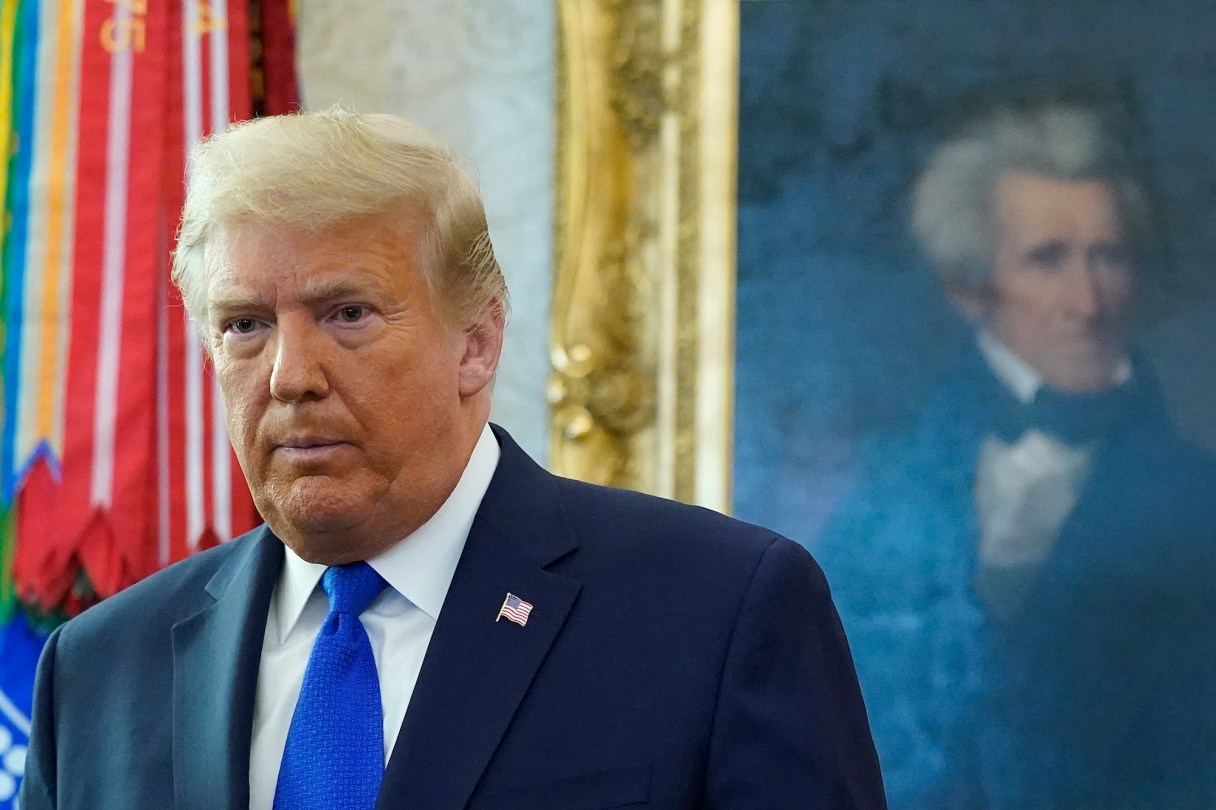
President Donald Trump came to office unencumbered by close study of our founding documents.
From the start, there was only one bit of the Constitution he found compelling: “I have an Article II, where I have the right to do whatever I want,” he said.
Thus misinformed, he applied the lessons of his business career and set out to see what he could get away with.
Not surprisingly, his four years in office have tested the resilience of American democracy.
Under Trump, presidential norms fell like dominoes. He refused to release his income tax returns. When one of his golf resorts ran short of guests, he proposed holding an international summit there. He demanded that Justice Department prosecutors investigate his opponents and go easy on his friends.
He pardoned two former advisers suspected of concealing misdeeds on his behalf after they were convicted of federal crimes. When whistleblowers filed official complaints, he retaliated, and when Congress subpoenaed executive branch officials, he ordered them not to comply. When winning Senate confirmation for Cabinet nominations became irksome, he appointed “acting secretaries” instead, explaining that “it gives me flexibility.”
I could go on, but you get the idea.
The good news is that most of democracy’s guardrails held. Federal courts struck down dozens of Trump’s orders and regulations. His own aides derailed some of his worst ideas, including the G-7 summit at the golf club. We were lucky in one respect: As an autocrat, Trump wasn’t very competent.
Still, the lesson should have been sobering: Presidents’ powers are restrained mostly by their willingness to observe unwritten rules and political constraints.
If a chief executive ignores those norms, there is little to stop him.
That’s why the next president and Congress need to strengthen the guardrails – much as happened after Nixon resigned amid the Watergate scandal in 1974.
We need a period of “detrumpification,” a process to make sure no future president sees Article II as a blank check.
Jack Goldsmith, who was assistant attorney general under President George W. Bush, and Robert F. Bauer, a former counsel to President Barack Obama, have jointly produced a long list of reforms they hope Congress and the Biden administration will take up.
Their suggestions include prohibiting future presidents from pardoning themselves and making it clear that a president who dangles pardons before potential witnesses can be prosecuted for obstruction of justice, a question that is unsettled under current law.
Some of their proposals have already been embraced. President-elect Joe Biden has already said he will prohibit White House aides from attempting to influence Justice Department investigations and will give the department’s inspector general full power to investigate any violations.
But to have lasting effect, some proposals will require action in Congress. Some legislation is already in the works. House Democrats have introduced a bill that would increase protection for inspectors general and whistleblowers and strengthen Congress’ ability to enforce subpoenas.
Some reforms under discussion lean toward more transparency in government.
One would require presidents and candidates for president to release their tax returns each year, as most already do.
Another would require more detailed public reports on a president’s financial holdings. No more blind trusts.
A third is strengthening the Presidential Records Act, to make sure presidential records don’t disappear.
All these ideas are debatable, of course. The important thing is to have a debate – soon, before our memories of the last four years fade.
Tribune Content Agency