
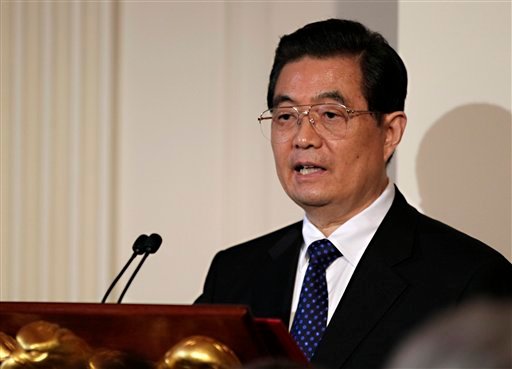
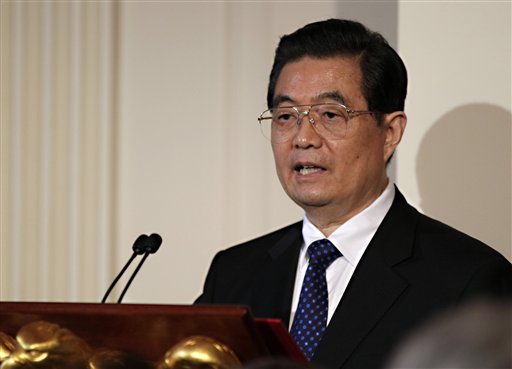
 China’s President Hu Jintao speaks before offering a toast during a State Dinner hosted by President Barack Obama and first lady Michelle Obama, Wednesday, Jan. 19, 2011, in the East Room of the White House in Washington. (AP Photo/Carolyn Kaster)
WASHINGTON — President Barack Obama and Chinese President Hu Jintao sparred over human rights on Wednesday, with Obama declaring that Americans believe such rights are among “core views” and Hu declaring China had made progress but “a lot still needs to be done” to improve his country’s record.
The concern over human rights was balanced against U.S. happiness about what Obama said was $45 billion in expected new export sale for the U.S. because of business deals with China cemented by the summit meeting of the world’s two largest economies. Obama said those deals would help create 235,000 U.S. jobs.
“I absolutely believe China’s peaceful rise is good for the world, and it’s good for America,” Obama said, addressing a major concern in Beijing that the United States wants to see China’s growth constrained.
“We welcome China’s rights. We just want to make sure that (its) rise occurs in a way that reinforces international norms, international rules, and enhances security and peace as opposed to it being a source of conflict either in the region or around the world.”
The two leaders vowed closer cooperation on critical issues ranging from increasing trade to fighting terrorism. But they also stood fast on differences, especially over human rights.
Obama acknowledged that differences on rights were “an occasional source of tension between our two governments.”
He said at a joint news conference with Hu at the White House, “We have some core views as Americans about the universality of certain rights: freedom of speech, freedom of religion, freedom of assembly.”
Obama said he drove that home forcefully in his discussions with the Chinese leader, but “that doesn’t prevent us from cooperating in these other critical areas.”
China “faces many challenges in social and economic development. A lot still needs to be done in China on human rights,” the Chinese president and Communist Party leader said.
He said that while China “is willing to engage in dialogue” with the U.S. and other nations on human rights issues, countries must exercise “the principle of noninterference in each other’s internal affairs.”
Seeking to build ties withChina, the White House said Wednesday that China would purchase $45 billion in U.S. exports, including a highly sought-after $19 billion deal for 200 Boeing airplanes.
Hu told the executives that he welcomed U.S. companies to do business in China, and said his country is speeding up its economic restructuring and trying to increase domestic consumption. Increased Chinese demand for goods is a prime U.S. concern because it could help reduce a U.S.-China trade gap.
In addition to the Boeing deal, China will also invest in U.S. exports from agriculture, telecommunications and technology companies, including General Electric, Honeywell and Navistar. The White House said the deals will support up to 235,000 jobs in the U.S.
On another contentious issue, Obama said that the United States continues to believe that China’s currency is undervalued, making Chinese imports cheaper in the United States and other countries and U.S. goods more expensive in China.
“I told President Hu that we welcomed China’s increasing the flexibility of its currency,” Obama said. But, he added, the yuan, also called the renminbi, “remains undervalued, that there needs to be further adjustment in the exchange rate, and that this can be a powerful tool for China boosting domestic demand and lessening the inflationary pressures in their economy.”
In a sign of the growing economic bonds between the two superpowers, Obama said the countries had made business deals that would mean $45 billion in new U.S. exports. Obama also said China was taking significant steps to curtail the theft of intellectual property and expand U.S. investment.
Obama said China had become “one of the top markets for American exports” and that these exports have helped to support a half million U.S. jobs.
Hu said he and Obama had agreed to “share expanding common interests.”
“We both agreed to further push forward the positive cooperative and comprehensive China-U.S. relationship and commit to work together to build a China-U.S. cooperative partnership based on mutual respect and mutual benefit, so as to better benefit people in our own countries and the world over,” Hu said.
Hu, speaking through a translator, said both countries should “respect each other’s sovereignty, territorial integrity and development interests.”
Obama said, “I absolutely believe China’s peaceful rise is good for the world, and it’s good for America.”
As both countries continue to recover from the global economic crisis — a recovery that began in China well before it did in the U.S. and other developed nations — the United States increasingly sees China as a market for its goods, Obama said.
“We want to sell you all kinds of stuff,” Obama told Hu. “We want to sell you planes, we want to sell you cars, we want to sell you software. …
“And as President Hu and his government refocuses the economy on expanding domestic demand, that offers opportunity for U.S. businesses that ultimately translates into jobs.”