
Tuesday, November 10, 2026Nov 10

Houston reservoir reborn as public space, canvas for art

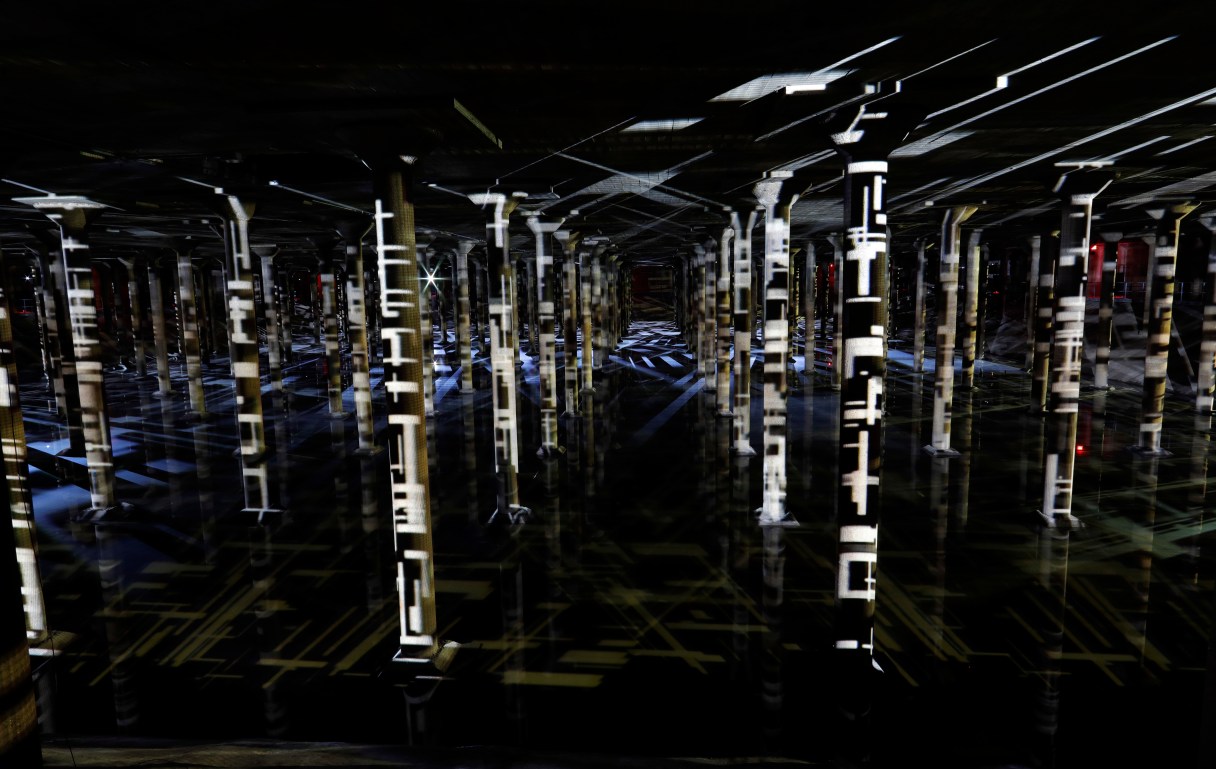
In this Friday, Dec. 16, 2016, photo, the exhibition of an abstract-video installation called "Rain" by Venezuelan artist Magdalena Fernández is projected inside a former water reservoir dubbed the "Cistern" in Houston. Once eyed for demolition, the former water reservoir built in 1926 has now found new life as a public space that's also serving as an unusual canvas for art. The reservoir's rebirth is the latest example of efforts by cities around the country to reuse and repurpose abandoned and dilapidated pieces of infrastructure as public spaces. (AP Photo/David J. Phillip)
In this Friday, Dec. 16, 2016, photo, the exhibition of an abstract-video installation called "Rain" by Venezuelan artist Magdalena Fernández is projected inside a former water reservoir dubbed the "Cistern" in Houston. Once eyed for demolition, the former water reservoir built in 1926 has now found new life as a public space that's also serving as an unusual canvas for art. The reservoir's rebirth is the latest example of efforts by cities around the country to reuse and repurpose abandoned and dilapidated pieces of infrastructure as public spaces. (AP Photo/David J. Phillip) In this Friday, Dec. 16, 2016, photo, the exhibition of an abstract-video installation called "Rain" by Venezuelan artist Magdalena Fernández is projected inside a former water reservoir dubbed the "Cistern" in Houston. Once eyed for demolition, the former water reservoir built in 1926 has now found new life as a public space that's also serving as an unusual canvas for art. The reservoir's rebirth is the latest example of efforts by cities around the country to reuse and repurpose abandoned and dilapidated pieces of infrastructure as public spaces. (AP Photo/David J. Phillip)

HOUSTON (AP) – Houston’s first underground drinking water reservoir – a decades-old collection of more than 200 concrete columns inside a cavernous space near downtown – had been unused for years and was set for demolition when a nonprofit group reimagined it as something new: a public space.

The 87,500-square-foot-space, dubbed the “Cistern” and reminiscent of ancient European water reservoirs, opened its doors to visitors in May. Then earlier this month, the structure’s darkened pillars and walls became the canvas for a piece of modern art.

“Repurposing it for a contemporary audience is the perfect solution,” said Judy Nyquist, a board member with the Buffalo Bayou Partnership, which incorporated the reservoir as part of a $58 million park renovation project.

It’s the latest example of efforts by U.S. cities – including Atlanta; Buffalo, New York; Philadelphia; San Francisco; and Washington, D.C. – to repurpose abandoned and dilapidated pieces of infrastructure as public spaces. Urban planners see the preservation of historic buildings and other structures as essential in creating the kinds of communities people want to live in, said Stephanie Meeks, president and CEO of the Washington, D.C.-based National Trust for Historic Preservation.

Probably the best-known project is New York City’s High Line, an abandoned elevated railroad section converted into a park in 2009. It’s shown cities that such pieces of infrastructure can be diamonds in the rough, said Robert Steuteville, with the Congress for the New Urbanism, a Washington, D.C.-based nonprofit that promotes sustainable communities.