
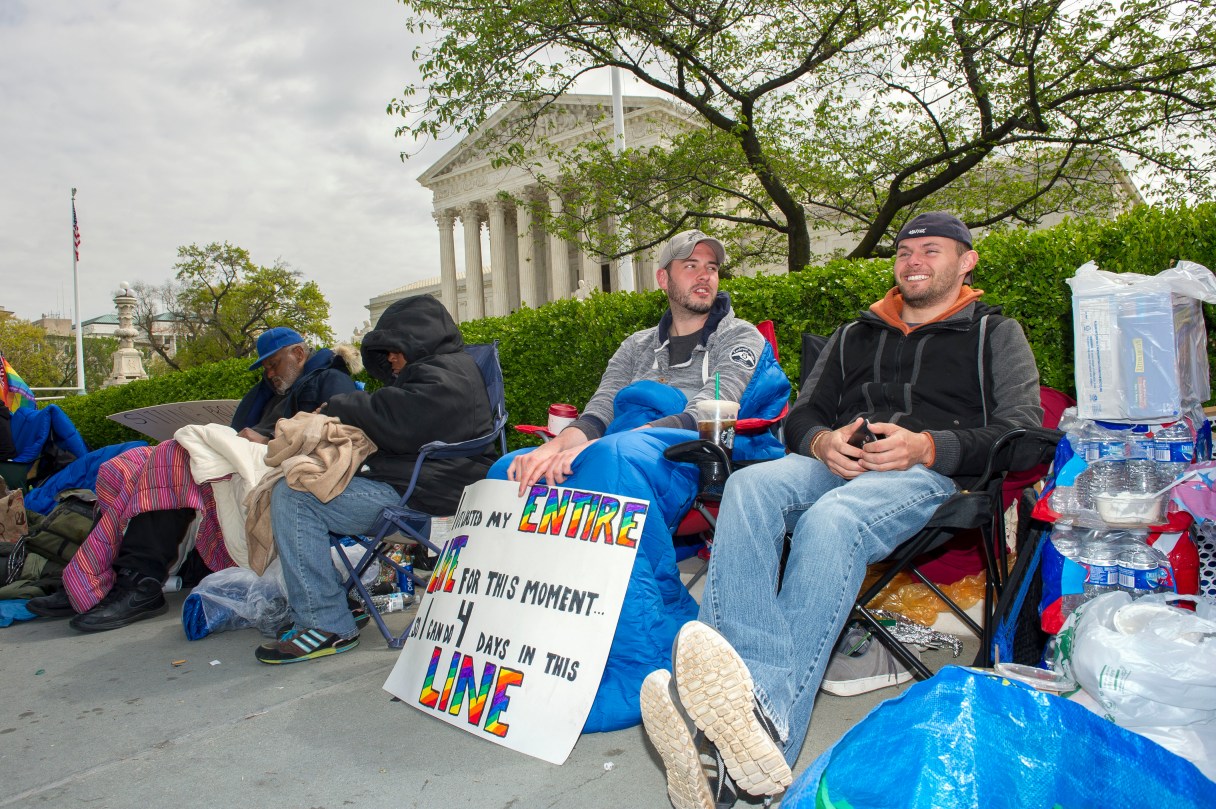
WASHINGTON (AP) – Tuesday is a potential watershed moment for America’s gay and lesbian couples. After rapid changes that have made same-sex marriage legal in all but 14 states, the Supreme Court will hear arguments over whether it should be the law of the land.
All eyes will be on the justices for any signals that they are prepared to rule that the Constitution forbids states from defining marriage as the union of a man and a woman. On the sidewalk outside, people have been waiting in line since Friday for prized seats for the historic arguments.
The cases before the court come from Kentucky, Michigan, Ohio and Tennessee, all of which had their marriage bans upheld by the federal appeals court in Cincinnati in November. That is the only federal appeals court that has ruled in favor of the states since the Supreme Court in 2013 struck down part of the federal anti-gay marriage law.
The first state to allow gay and lesbian couples to marry was Massachusetts, in 2004. Even as recently as October, barely a third of the states permitted it. Now, same-sex couples can marry in 36 states and the District of Columbia, a dramatic change in the law that has been accompanied by an equally fast shift in public opinion.
Now that everyone else has weighed in through mountains of legal briefs, the justices get to say, or at least hint, what they will decide. On Tuesday, five lawyers will present arguments over 2½ hours to help the court conclude whether, on this question, the 14 remaining states must join the rest of the country.