
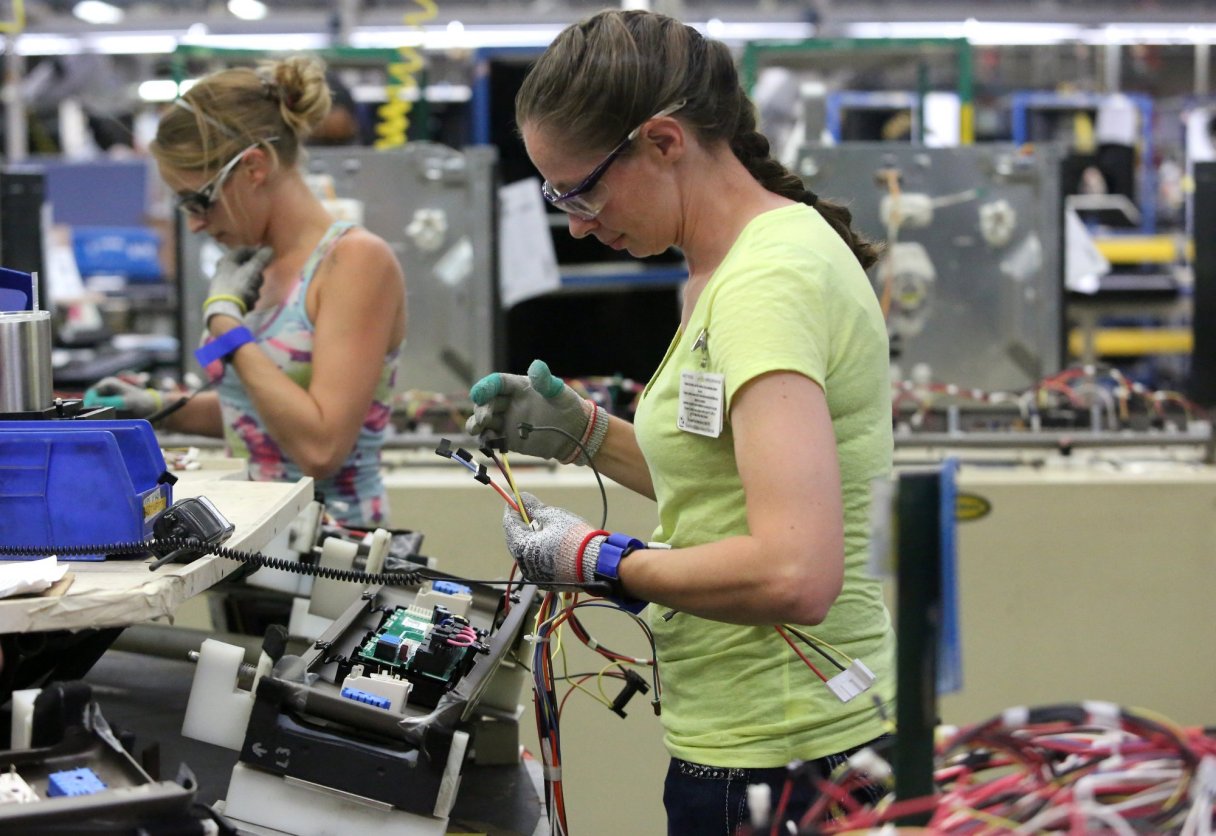
Employees at the GE Appliances Roper oven production plant in LaFayette, Georgia, are working in a safe environment amid the COVID-19 outbreak, a spokesman for the Georgia Department of Health’s regional office said Wednesday.
The regional office’s health director, Dr. Gary Voccio, visited the plant on Wednesday and saw enough to make the determination, said Logan Boss, the spokesman for the 10-county Northwest Georgia health district.
“It was not an inspection but we did go through the plant,” Boss said. “We were impressed with the measures they’re taking in an extremely hard work environment to make these kind of employee safety measures.”
(READ MORE: Roper cuts production line at Georgia plant in response to coronavirus)
Boss said the measures aren’t perfect but “we don’t think anyone could engineer a plant like that which is totally perfect. We were very impressed,” he said.
Boss said the unusual visit was spurred by a large number of calls from the public, including some employees.
Worker complaints emerged over conditions at the 2,000-employee plant in LaFayette, with those centering around what some saw as a lack of social distancing in the wake of the coronavirus.
Walker County resident Tricia Harris, executive aide to former United States ambassador and Atlanta mayor Andrew Young, had called on GE Appliances to temporarily close the plant. She said she has heard from relatives who work at the plant and seen employee worries on social media.
On Wednesday, Harris said the fundamental issue is why is Roper an essential business.
“Why are they open?” she asked. “Why is GE Appliances allowed to remain open to make stoves at the risk of our entire community? There is no national stove crisis. They feign care when real care is community first.”
But Roper Corp. President Lois Crandell said the visit from the regional health district “went very well.”
“The Roper team has worked very hard to implement new measures to ensure our employees’ health and safety,” she said.
(READ MORE: Roper steps up donations to local groups amid COVID-19 crisis)
State Rep. Steve Tarvin, R-Chickamauga, said he thinks GE Appliances “acted responsibly.”
“Many don’t understand the demand for stoves. There are about 6 million stoves manufactured in the U.S. annually. That is a stove for about every 21 households in America. It becomes essential when a mother of four or an elderly couple need a stove. We can’t have folks sitting at home in need of repair and/or replacements for their shelter. Demand drives supply. This about more than money, it is about people.”
GE Appliances spokeswoman MarySusan Abell said representatives of the Redmond Regional Medical Center in Rome, Georgia, also took part in the visit.
The medical center runs the Roper plant’s on-site wellness center that serves as a full-service primary care medical provider for employees and their families, as well as the site’s occupational health clinic, she said.
Boss said the district believes that Roper’s actions could be used as benchmarks.
“We didn’t have any recommendations,” he said. “We were impressed by the fact that they’d done a remarkable job in a short amount of time to engineer into plant operations a very good degree of safety for employees and people in that facility.”
Harris, in an earlier email to GE Appliances CEO Kevin Nolan, had requested an “immediate shut down” of the facility that makes ovens and stoves. A petition on Change.org calling on the company to do so had more than 1,800 signatures on Wednesday afternoon.
One Roper employee said on social media that she took personal leave without pay over concerns about working at the plant.
But Abell said every job at the Roper facility was audited and jobs and workplaces modified to allow for at least six feet of space between employees as they work. About a third of the jobs needed modifications, Abell said.
“In places where six feet of distance was practicable,” she said earlier, “we have have implemented other measures deemed safe by public health officials to provide additional protection, including commercial-grade dividers, face shields and additional safety supplies.”
Abell said every person entering the plant must go through temperature screening.
Also, more than 100 hand-washing and sanitation stations are available throughout the plant, she said.
Harris said Roper has put in Plexiglass and splash masks “since we last triggered it” and “at our behest.”
“That plant and all nonessential plants need to abide by state lockdowns and do what’s in the best interests of those of us who wish to live,” she said.
Contact Mike Pare at mpare@timesfreepress.com. Follow him on Twitter @MikePareTFP.