
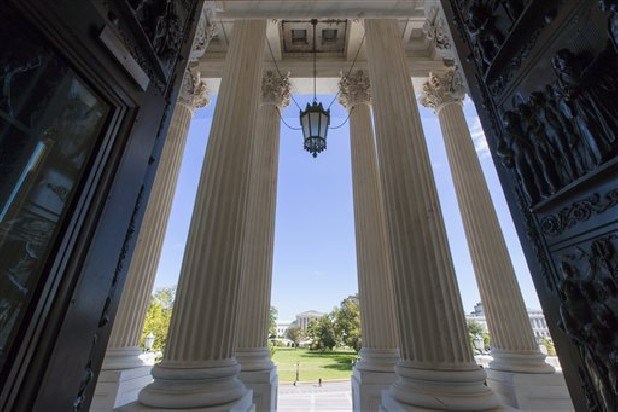
 The entrance to the Senate is seen on Capitol Hill in Washington.
WASHINGTON – House Republicans are far less ambitious this week in their demands for spending cuts to erase new debt issued to pay the government’s bills than they were during a budget battle two years ago.
The list of cuts under consideration now tallies up to a fraction of the almost $1 trillion in additional borrowing that would be permitted under a GOP proposal for enabling the government to pay its bills through December of next year.
Two years ago, House Speaker John Boehner, R-Ohio, insisted on spending cuts totaling $2.1 trillion over a decade as the price to meet President Barack Obama’s demand for a like-sized increase in the government’s borrowing cap, also known as the debt ceiling.
Those cuts involved tighter “caps” on agency operating budgets as well as the automatic, across-the-board cuts known as sequestration triggered by the failure of a deficit “supercommittee” to reach a deal.
The problem now is that there isn’t a roster of big, politically palatable cuts ready to go. Instead, Republicans have put together a grab bag of smaller savings ideas, like higher pension contributions for federal workers, higher premiums for upper-income Medicare beneficiaries, caps on medical malpractice verdicts and reduced payments to hospitals that treat more poor people than average.