
Tuesday, November 10, 2026Nov 10

Stolen statue, painting returned to Italian government in NY

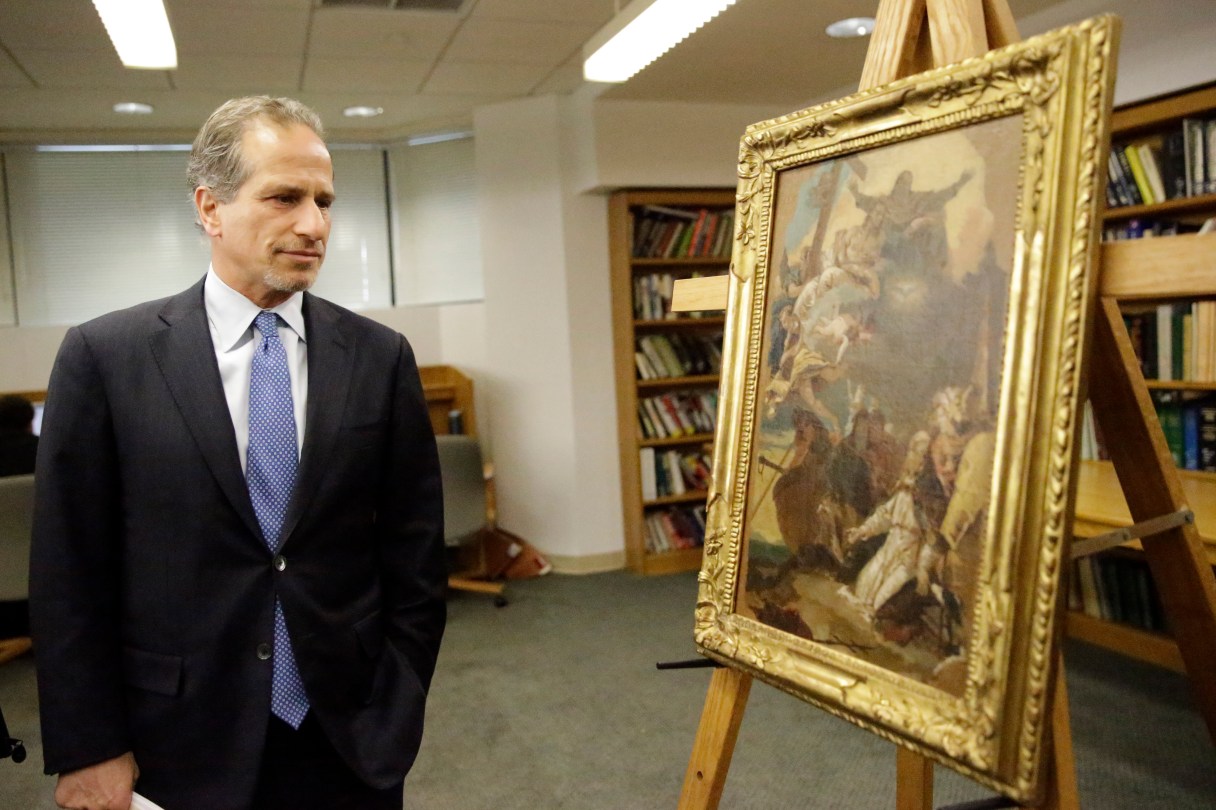
Richard Zabel, Deputy U.S. Attorney for the Southern District of New York looks at the 18th-century painting attributed to painter Giovanni Battista Tiepolo, "The Holy Trinity appearing to Saint Clement," during a ceremony to return the painting and an Etruscan bronze statuette depicting the Greek hero Herakles, to the Italian government Tuesday, Feb. 24, 2015, at the United States Attorney’s Office for the Southern District of New York.  (AP Photo/Mary Altaffer)
Richard Zabel, Deputy U.S. Attorney for the Southern District of New York looks at the 18th-century painting attributed to painter Giovanni Battista Tiepolo, "The Holy Trinity appearing to Saint Clement," during a ceremony to return the painting and an Etruscan bronze statuette depicting the Greek hero Herakles, to the Italian government Tuesday, Feb. 24, 2015, at the United States Attorney’s Office for the Southern District of New York. (AP Photo/Mary Altaffer) Richard Zabel, Deputy U.S. Attorney for the Southern District of New York looks at the 18th-century painting attributed to painter Giovanni Battista Tiepolo, "The Holy Trinity appearing to Saint Clement," during a ceremony to return the painting and an Etruscan bronze statuette depicting the Greek hero Herakles, to the Italian government Tuesday, Feb. 24, 2015, at the United States Attorney’s Office for the Southern District of New York. (AP Photo/Mary Altaffer)

NEW YORK (AP) – An ancient statuette and an 18th-century painting that were stolen from Italy decades ago have been returned to its government after turning up in New York.

U.S. prosecutors and the FBI gave the artworks to an Italian official on Tuesday.

The painting of “The Holy Trinity Appearing to Saint Clement” is attributed to the renowned Giovanni Battista Tiepolo (tee-EH’-poh-loh), also called Giambattista Tiepolo. It disappeared from a Turin home in 1982.

The Etruscan bronze statuette of Herakles dates to the sixth or fifth century B.C. It vanished from the Oliveriano Archaeological Museum in Pesaro in 1964.

The works eventually ended up with an art dealer and an art-investment firm, which consigned them for sale in recent years. They relinquished the items after learning of the thefts and aren’t accused of involvement.