
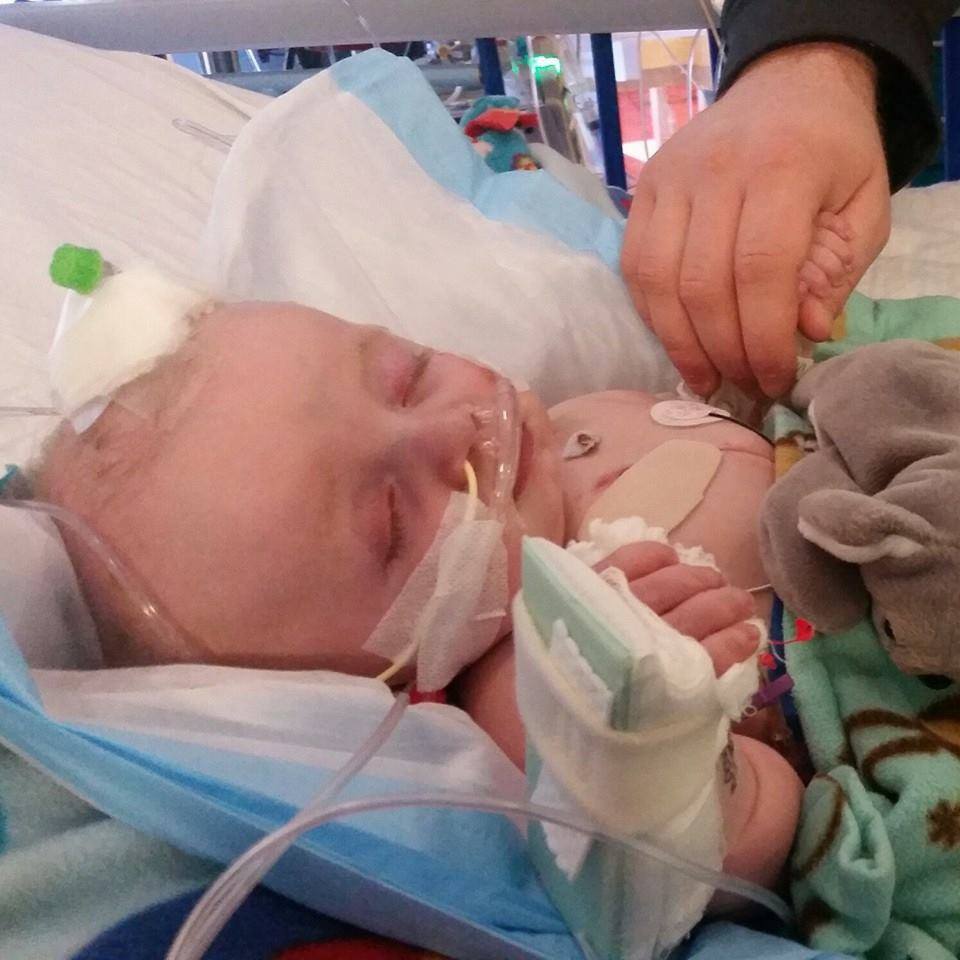
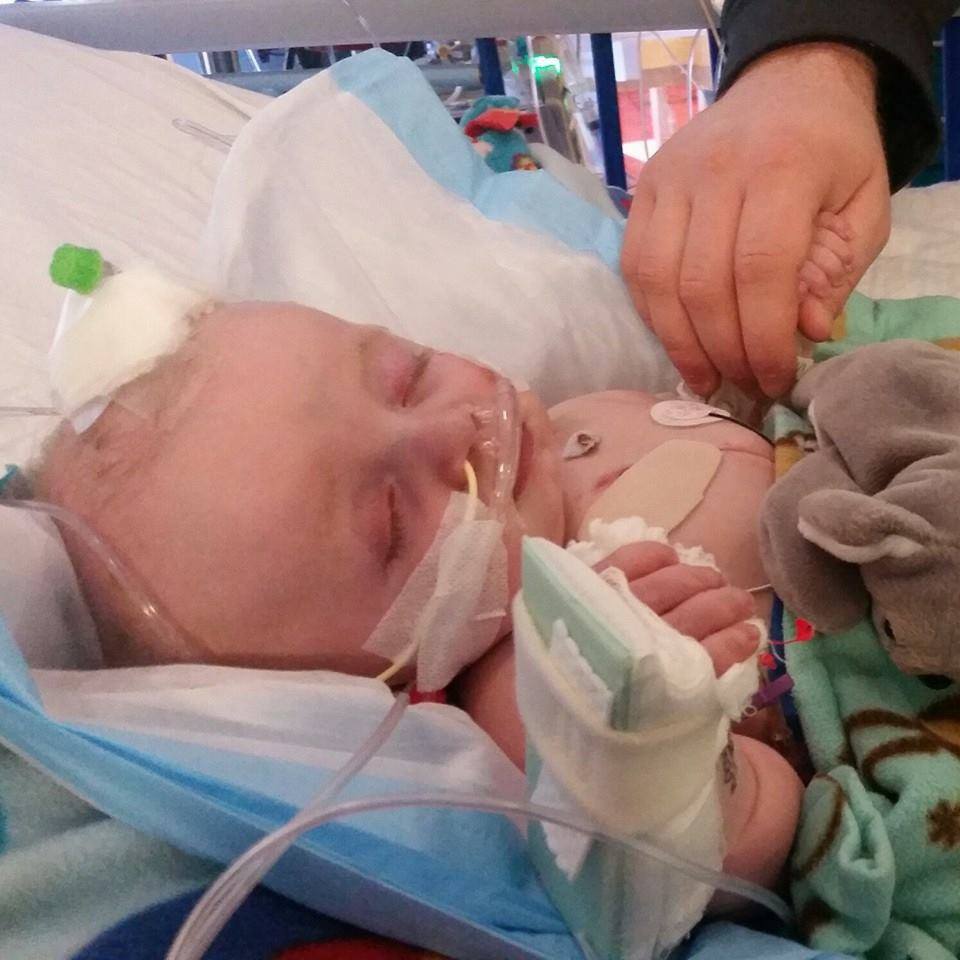
 Andrew Rhodes rests in a hospital bed in Children’s Healthcare of Atlanta, waiting for a heart transplant.
HOW TO HELP
Donate to help the Rhodes family at http://littleironman.weebly.com. All donations made before the transplant will be matched by the site to help pay for the cost of future transplants. Contact the family at ourlittleironman@gmail.com.
Chasity Rhodes said it was during the first ultrasound that she and her husband nicknamed their son Ironman.
“It was the way a shadow fell across his face,” Rhodes said. “He looked like he was wearing Ironman’s mask.”
Several weeks later, the Rhodes family, which recently moved to Flintstone, Ga., learned the dire significance of their son’s nickname: They were told he had a rare heart defect — just like the famous superhero.
Their son, later to be named Andrew — which means courageous, strong, and brave — was diagnosed with hypoplastic left heart syndrome while he was still in the womb.
The syndrome’s cause is unknown, but it is a congenital birth defect that affects the left side of the heart. It causes the left ventricle to be underdeveloped or too small, along with the mitral valves, aortic valve and the ascending portion of the aorta.
“We were completely blindsided by this,” Rhodes said. “We have three healthy little girls. … We had never even heard of this defect.”
The U.S. Centers for Disease Control and Prevention estimates 960 U.S babies are born with the condition each year.
“There is no cure,” Rhodes said. “But we have options.”
Five-month-old Andrew now rests in a hospital bed in Children’s Healthcare of Atlanta’s cardiac intensive care unit, attached to a web of machines and tubes, on a constant concoction of medications, waiting for a heart transplant.
“It’s his only hope,” Rhodes said. “He can’t leave the hospital until he gets a new heart.”
Almost all of Andrew’s short life has been spent in the hospital, and he has already survived three open-heart surgeries.
Doctors were not available for comment late Friday, but Rhodes said they told her on Friday afternoon that Andrew is medically approved for the transplant, and they are waiting on his insurance approval before his name will be added to the transplant list early next week.
The average wait for a heart for someone listed in status 1A — the most urgent placement — is 90 days, Rhodes said. She and her family are confident Andrew can hold on that long.
Natasha Sawyer, director of communications for Sisters-by-Heart, a nonprofit organization dedicated to supporting families affected by the syndrome, said the waiting period before a heart transplant can be one of the most difficult times for families.
“You don’t really know what is going to happen, because the surgeries that are out there are not guaranteed for every child,” she said.
Hospitals also put a lot of responsibility on families to prove they can afford ongoing care, and a parent must always be there with the child, which can force someone in the family to stop working, Sawyer said.
Insurance is covering most of Andrew’s medical costs, but does not cover the family’s room and board while they live at the hospital with him.
Shaun Rhodes, Andrew’s father and Chasity’s husband, just completed active-duty service with the Air Force and began a job at Aerotek in Dalton.
For 2014 alone, the family has had to pay about $10,000, Chasity Rhodes estimates.
That’s not even worth consideration compared to the cost of the transplant and a lifetime of care afterward. She said Andrew would be on constant medications, in and out of hospitals, and in need of a new heart every 12 years or so for the rest of his life. Insurance isn’t always available or dependable, she said.
“My biggest concern is just getting him to this first transplant,” Chasity Rhodes said. “He is a fighter. … He has already overcome many things.”
Contact staff writer Kendi Anderson at kendi.anderson@timesfreepress.com or at 423-757-6592.