
Thursday, November 12, 2026Nov 12

Japanese research institute earns right to name element 113

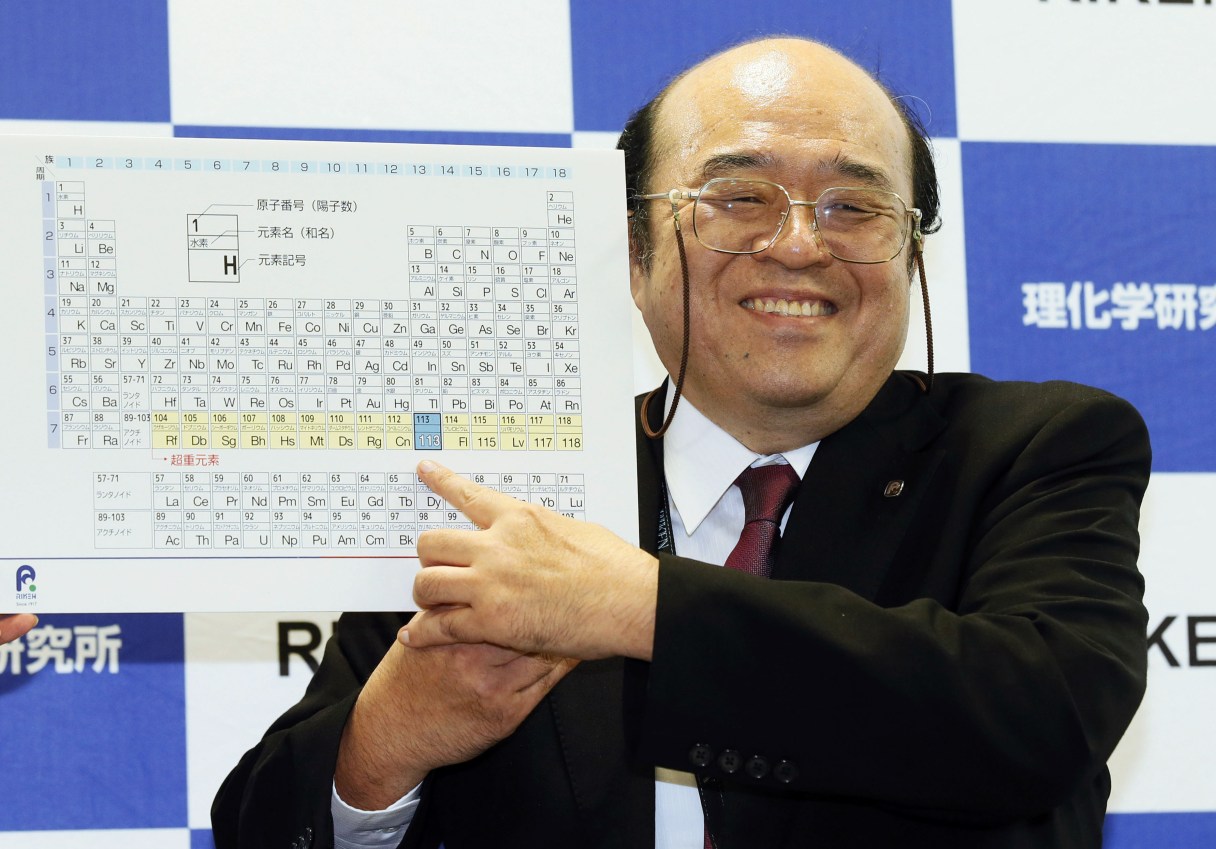
Kosuke Morita of Riken Nishina Center for Accelerator-Based Science points at periodic table of the elements during a press conference in Wako, Saitama prefecture, near Tokyo Thursday, Dec. 31, 2015. A team of Japanese scientists have met the criteria for naming a new element, the synthetic highly radioactive element 113, more than a dozen years after they began working to create it. Morita was notified of the decision on Thursday by the U.S.-based International Union of Pure and Applied Chemistry. (Kyodo News via AP) JAPAN OUT, MANDATORY CREDIT
Kosuke Morita of Riken Nishina Center for Accelerator-Based Science points at periodic table of the elements during a press conference in Wako, Saitama prefecture, near Tokyo Thursday, Dec. 31, 2015. A team of Japanese scientists have met the criteria for naming a new element, the synthetic highly radioactive element 113, more than a dozen years after they began working to create it. Morita was notified of the decision on Thursday by the U.S.-based International Union of Pure and Applied Chemistry. (Kyodo News via AP) JAPAN OUT, MANDATORY CREDIT Kosuke Morita of Riken Nishina Center for Accelerator-Based Science points at periodic table of the elements during a press conference in Wako, Saitama prefecture, near Tokyo Thursday, Dec. 31, 2015. A team of Japanese scientists have met the criteria for naming a new element, the synthetic highly radioactive element 113, more than a dozen years after they began working to create it. Morita was notified of the decision on Thursday by the U.S.-based International Union of Pure and Applied Chemistry. (Kyodo News via AP) JAPAN OUT, MANDATORY CREDIT

TOKYO (AP) – A team of Japanese scientists have met the criteria for naming a new element, the synthetic highly radioactive element 113, more than a dozen years after they began working to create it.

Kosuke Morita, who was leading the research at the government-affiliated Riken Nishina Center for Accelerator-Based Science, was notified of the decision on Thursday by the U.S.-based International Union of Pure and Applied Chemistry.

“Now that we have conclusively demonstrated the existence of element 113, we plan to look to the unchartered territory of element 119 and beyond,” Morita said in a statement.

A joint working group of the IUPAC and International Union of Pure and Applied Physics also announced decisions on recognition of discoveries of elements 115, 117 and 118.

Discoveries of atomic elements have often involved competition between scientists. The news is a morale booster for Riken, which has undergone a reorganization of some of its research following a scandal over stem-cell research.