

President Barack Obama set a goal of bringing high-speed Internet to most schools by 2017. Now he’s promoting a new program to help close the digital divide even further by bringing that faster Internet to more people, particularly students who live in public and assisted housing.
Obama on Wednesday announced a pilot program under which the public, private and nonprofit sectors will work together to provide high-speed Internet and digital devices to more families at a lower cost. ConnectHome will begin in 27 cities and the Choctaw Nation of Oklahoma, where Obama made his announcement Wednesday. Although Nashville, Memphis, Atlanta and Macon were among the selected cities, Chattanooga’s application did not make the initial cut.
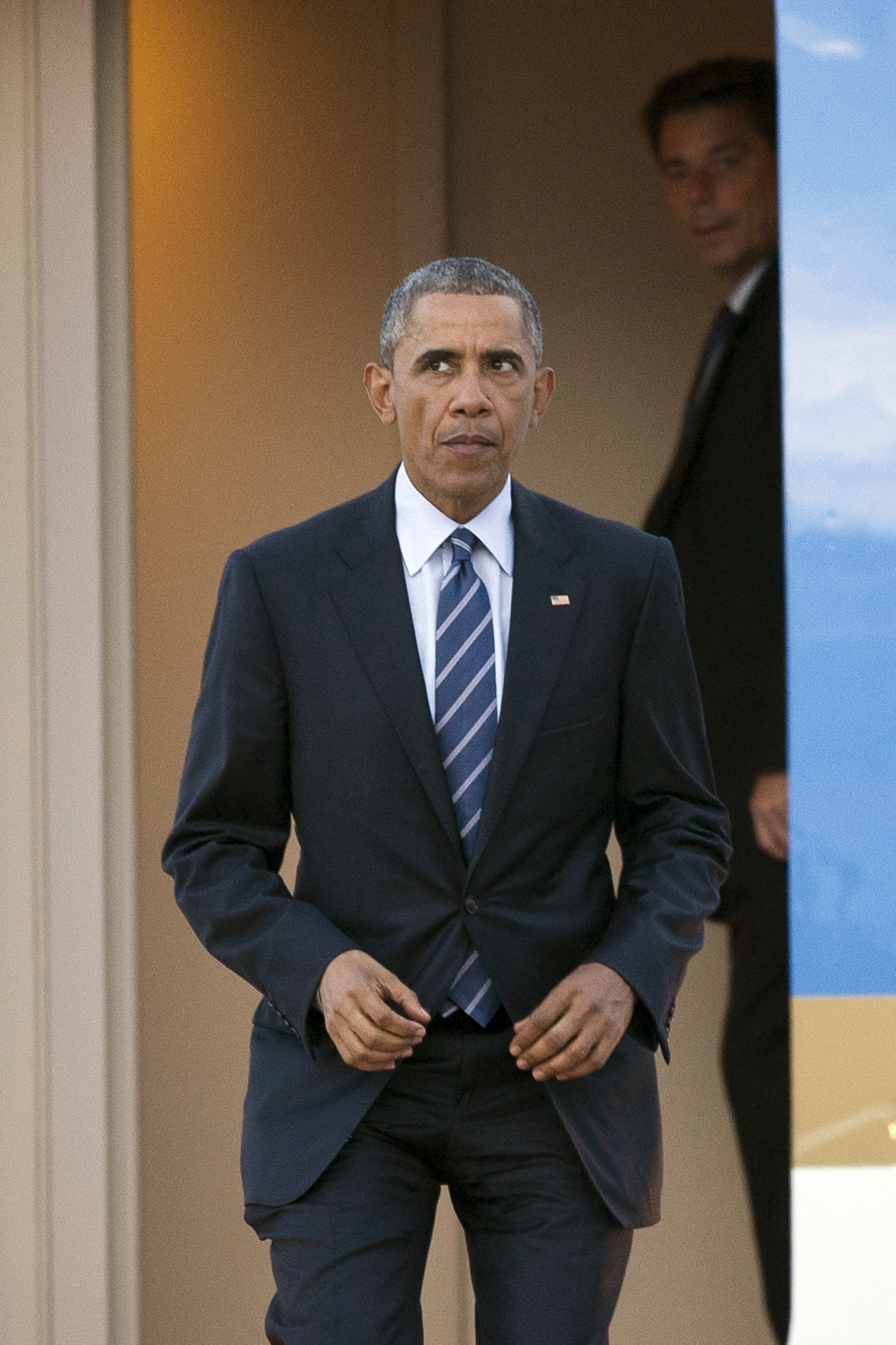 President Barack Obama looks up at dark clouds in the sky as he exits Air Force One at Andrews Air Force Base, Md., Tuesday, July 14, 2015. Obama is returning from Philadelphia where he addressed the NAACP’s 106th national convention, and attend a Democratic fundraiser. (AP Photo/Cliff Owen)
Nashville and Atlanta are Google Fiber markets where Google is offering no-cost residential service to residents in select public housing projects.
But Chattanooga, the self-described “Gig City,” is already working to broaden its Internet connections for low-income families through its “Tech Goes Home” program launched in January. Backed by the support of local governments, the Chattanooga Housing Authority, the Benwood Foundation and the Enterprise Center, Tech Goes Home is trying to provide training and equipment to allow at least 2,000 low-income persons to gain Internet access and knowledge by 2016.
Those who complete a 15-hour course to be offered at 20 Chattanooga area locations this summer or fall will have the option of purchasing a new Chromebook for only $50.
Kelly McCarthy, the program manager for the technology training initative, said the program provides Internet literacy programs for all ages and helps those unfamiliar with computers and the Internet learn how to access needed equipment, connections and web services.
“We’re served folks from ages 4 to 84,” McCarthy said.
The city of Chattanooga is giving Tech Goes Home $210,000 and Hamilton County government is giving another $110,000 in the current fiscal year. The program is in the midst of a private fundraising campaign to raise the other $190,000 for the $500,000 program.
To tout his new ConnectHome program, Obama traveled Wednesday night to the Choctaw Nation in Oklahoma, which is the nation’s third-largest Native American tribe with about 200,000 members. Last year, the president designated the Choctaw Nation as a federal “Promise Zone,” making it eligible for tax incentives and grants to help fight poverty.
The Choctaw nation, and the 27 selected cities in the pilot ConnectHome program, will intially reach more than 275,000 low-income households – and nearly 200,000 children – with the Internet assistance programs funded by nonprofit groups and Internet Service Providers.
The White House said Obama’s school-based Internet program, ConnectEd, is on track to connect 99 percent of K-12 students to high-speed Internet in their classrooms and libraries by 2017. The new program aims to help less privileged students, as well as their families, access the Internet and continue learning at home.
Housing Secretary Julian Castro said Wednesday less than half of the poorest households have a home Internet subscription, but that most college applications are now submitted online and more than 80 percent of job openings at Fortune 500 companies are posted on the Web.
He said families cannot thrive without 21st century tools.
Federal money is not expected to be spent on the program, beyond a $50,000 Agriculture Department grant to the Choctaw Nation, officials said.