
NASHVILLE (AP) – Ford’s blockbuster announcement this week that it would build four sprawling new factories in Kentucky and Tennessee by 2025 and hire nearly 11,000 workers raised a big unanswered question: Just how good will those jobs be?
No one – not Ford, not the United Auto Workers union, not the future job holders themselves – yet knows how much the workers will be paid or whether they will vote for union membership.
Three of the plants, to be built with Ford’s South Korean corporate partner, SK Innovation, would produce batteries for 1 million electric vehicles annually. A fourth would make the next generation of electric F-Series pickup trucks, a version of America’s top-selling vehicle.
The new factories represent an $11.4 billion bet by Ford on a vision for the future in which tens of millions of drivers will shift from pollution-belching internal combustion engines to electric vehicles that emit nothing from the tailpipe.
The stakes are high for Ford’s employees as well as for the UAW, which is counting on ensuring union membership at battery factories to replace jobs that will be lost should the transition to electric vehicles happen as Ford and others envision. Union workers generally are paid, on average, 20% more than their nonunion counterparts, typically receive more generous benefits and wield a larger voice on safety and other workplace rules at their factories.
On Monday, when Ford’s plans were announced, CEO Jim Farley stopped short of publicly supporting the UAW, saying only that union representation at the plants would be decided by the workers themselves. In Kentucky and Tennessee, states in which unions have often been shunned by workers and opposed by political leaders, representation by the UAW is far from assured.
On Wednesday, Ford said it expected to continue a “strong, mutually beneficial” relationship with the UAW.
“We respect the UAW’s efforts to organize future hourly workers at the new facilities coming to Tennessee and Kentucky,” Ford and SK said in statements.
By stopping short of offering explicit support for union membership at its new plants, experts say, Ford may be trying to appease politicians who have been vocal opponents of union organizing. Political leaders in both states still have to approve money for worker training and other incentives to Ford, said Dan Cornfield, who teaches sociology and political science at Vanderbilt University in Nashville, and the company wouldn’t want to jeopardize that support.
“The company is in between its union partners and its state government partners in this,” Cornfield said. “So they probably are not speaking out about unionization one way or the other because they don’t want to antagonize their longstanding partners.”
Not to mention rankle President Joe Biden, who has frequently promoted an industry-wide transition to electric vehicles as a vital way to counter climate change and create “good-paying union jobs.”
A letter attached to Ford’s national contract with the UAW pledges the company will remain neutral when the union tries to organize any new factories. It will agree to “card check” sign-up efforts, which let unions recruit workers to sign cards saying they want to be represented. Once 51% of workers sign on, the plant becomes union.
In Tennessee, in particular, political leaders, including Republican Gov. Bill Lee, have fought the UAW, which lost recent factory-wide organizing votes at a Volkswagen plant in Chattanooga.
In opposing the UAW, Lee argued that union membership would make it harder for the state to recruit other manufacturers.
“It is more difficult to attract companies into states that have a high level of organized union activity,” Lee said ahead of a 2019 vote at VW. “For that reason, I think that Volkswagen remaining a merit shop facility is beneficial to the economy of Tennessee.”
Difficult as it is, union organizing in the South is not impossible. The UAW already represents nearly 16,000 hourly workers at two Ford plants in Louisville and at a General Motors complex in Spring Hill, Tennessee.
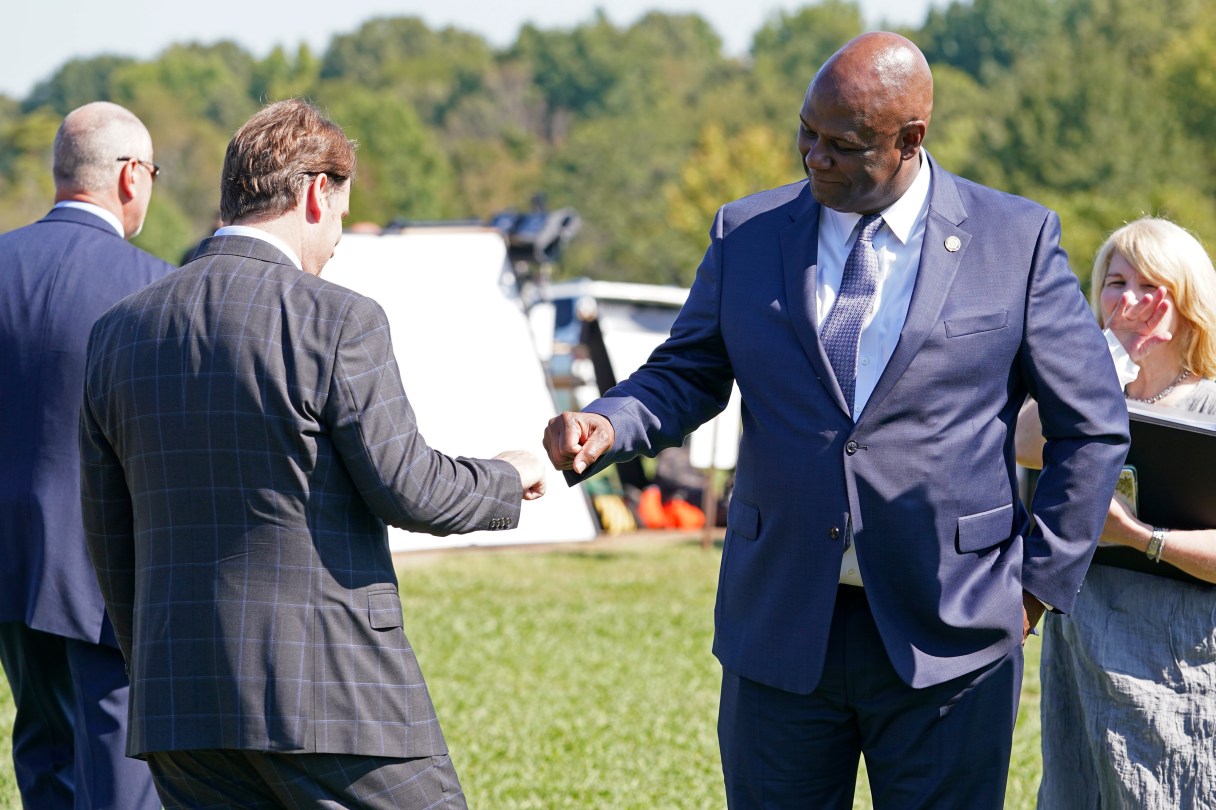
UAW President Ray Curry, who attended the Tennessee ceremony this week, said he didn’t think Ford had chosen sites in Stanton, Tennessee, and Glendale, Kentucky, to avoid the UAW. He expressed optimism about organizing the new factories.
“We’ve got a long-term working relationship with Ford,” Curry said. “It’s just a great opportunity to continue in that relationship.”
Todd Dunn, president of the UAW local office in Louisville, sounded hopeful, too. He said he regarded the remarks this week by Ford’s CEO Farley as cautionary in a politically charged environment.
“I think that might be them saying, ‘Hey, in a right-to-work state, we’re going to make sure they [workers] have their choice.’ “