
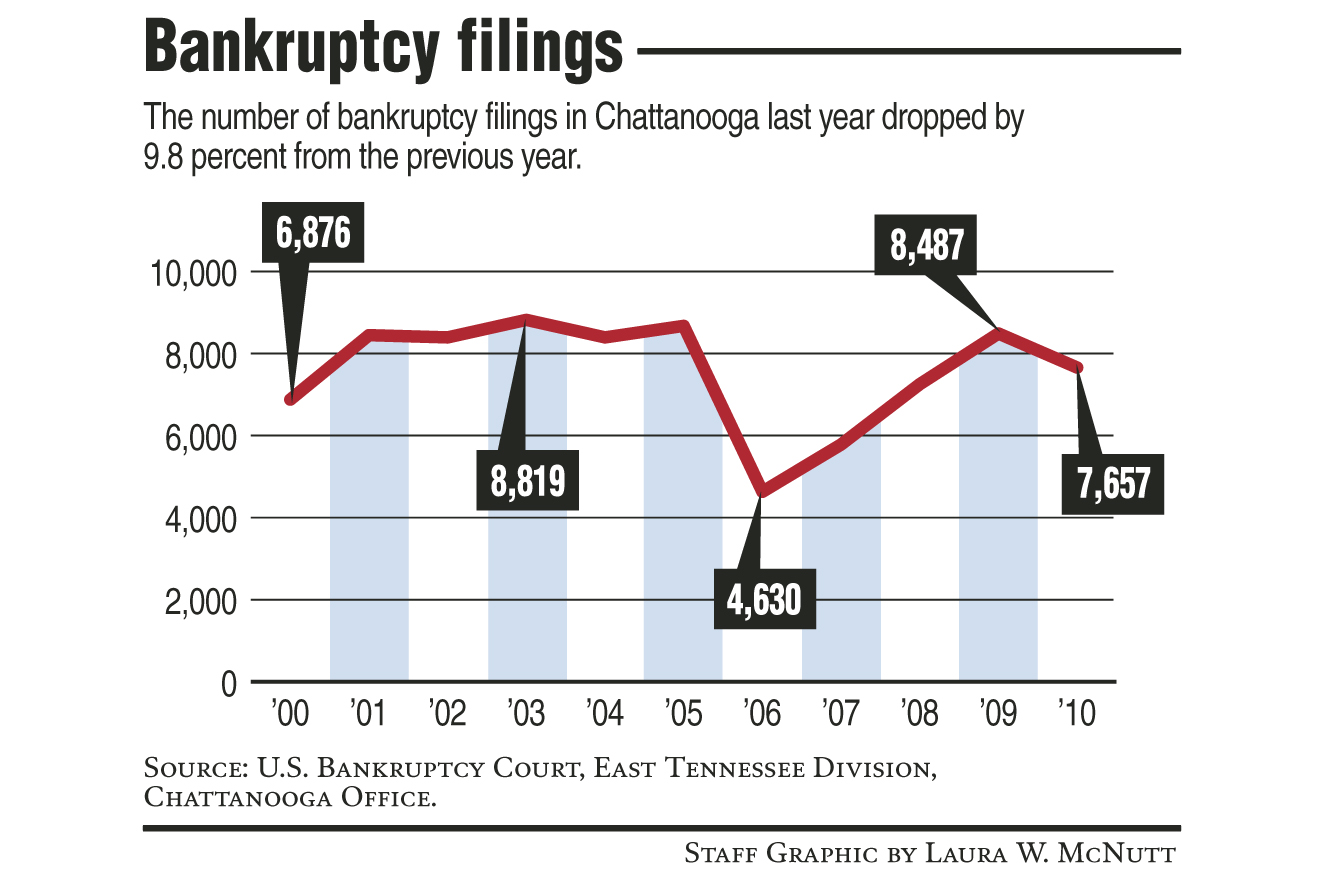
Chattanooga bucked the nationwide increase in bankruptcies last year with the first decline in four years in the number of local businesses and individuals seeking debt relief in federal court.
Despite a 9 percent jump in consumer bankruptcies nationwide, the number of people going broke in Chattanooga declined nearly 10 percent last year.
“Hopefully, we’re seeing some improvement in the economy, but I still see a lot of people in financial trouble every day who have run out of options,” said Kenneth Rannick, a Chattanooga bankruptcy attorney for the past 26 years. “Bankruptcy is usually a lagging indicator, so I’m not sure we’ve turned any corner yet.”
Indeed, the American Bankruptcy Institute projects bankruptcy filings nationwide will continue to grow in 2011. Although filings are still below the peak reached before federal bankruptcy laws were tightened in 2005, the number of Americans going to court for debt relief rose in each of the past five years.
“The steady climb of consumer fillings, notwithstanding the 2005 bankruptcy law restrictions, demonstrates that families continue to turn to bankruptcy as a result of high debt burdens and stagnant income growth,” said Samuel Gerdano, executive director of the American Bankruptcy Institute in Washington, D.C.
BY THE NUMBERS7,657: Number of individuals and businesses filing bankruptcy in 2010 in the Chattanooga office of the U.S. Bankruptcy Court.52: Percentage of Chattanooga bankruptcy filings in 2010 that were Chapter 13 repayment plans.$104 million: Amount collected in fiscal 2010 for creditors through the Chattanooga Chapter 13 trustee.Source: U.S. Bankruptcy Court, Chapter 13 Trustee Kenneth Still
With unemployment at or near double-digit levels across much of Tennessee and Georgia, many jobless workers have run out of options.
Robert and Deborah Maddox both lost their jobs with nonprofit agencies more than a year ago, and the Chattanooga couple recently filed for bankruptcy protection to help save their Ivy Street home from foreclosure.
“I’ve never been unemployed this long, and in this economy at our age it’s very hard to find another job,” said Deborah Maddox, a 56-year-old former employee of Community Impact, a neighborhood development agency. “There are plenty of people with master’s degrees who can’t find a job in this economy. It’s rough.”
Georgia Labor Commissioner Michael Thurmond said many of the nearly 8 million jobs lost during the Great Recession aren’t coming back even after the economy recovers.
“The high unemployment rate isn’t due just to a cyclical recession,” Thurmond said. “This is a restructuring of the economy, and we are witnessing the demise of the 20th century industrial-age job market and the painful birth of the 21st century information and technology-driven job market.”
comparing the states
Tennessee and Georgia trailed only Nevada last year in the rate of bankruptcy filings. While Nevada’s per capita bankruptcy rate was double the U.S. average, the bankruptcy rate in Tennessee and Georgia was nearly 50 percent above the U.S. average.
Southern states have some of the highest bankruptcy rates, in part, because they allow creditors to garnish wages to recover on bad debts sooner than many other states.
In addition, residents in the Southern states carry relatively higher credit card debt for their income, according to a report released this week by Columbia University law professor Ronald Mann.
But last year, the number of bankruptcies in Tennessee and Alabama declined as employment edged up in both states and consumers borrowed less money.
In metropolitan Chattanooga, November’s 8.5 percent jobless rate, although still historically high, was down 1.5 percent from the start of the year and remained well below the U.S. rate of 9.8 percent.
In contrast, bankruptcies jumped by 25 percent last year in California and by 24 percent in Arizona – states with double-digit unemployment rates, according to data from the National Bankruptcy Research Center.
Mark Young, a Chattanooga bankruptcy attorney for 33 years, said the tough economy may actually have cut some bankruptcy filings since unemployed people don’t have wages that creditors can seize, which often leads many people to seek bankruptcy relief.
“I’m not sure the economy is getting that much better, but in recent years, credit has tightened and fewer loans have been made, so there has been some falloff in the filings I’m handling,” he said.
chapter 13 reorganizations
Among those filing bankruptcy last year in Chattanooga, nearly 52 percent filed Chapter 13 petitions to reorganize their finances and repay debts under a court-supervised plan of up to five years.
Kenneth Still, the Chapter 13 trustee in Chattanooga for the past 42 years, said his office collected a record $104 million through such repayment plans in the federal fiscal year that ended Sept. 30.
“Most people, especially in the Bible Belt, want to repay their debts,” Still said. “Judges have been more favorable in Tennessee to such Chapter 13 filings. Even though they are more work and harder to administer, we usually end up collecting more money for creditors.”