
Highlights from Tuesday’s primary elections in Missouri, Kansas, Michigan and Washington.
___
TOP OF THE TICKET
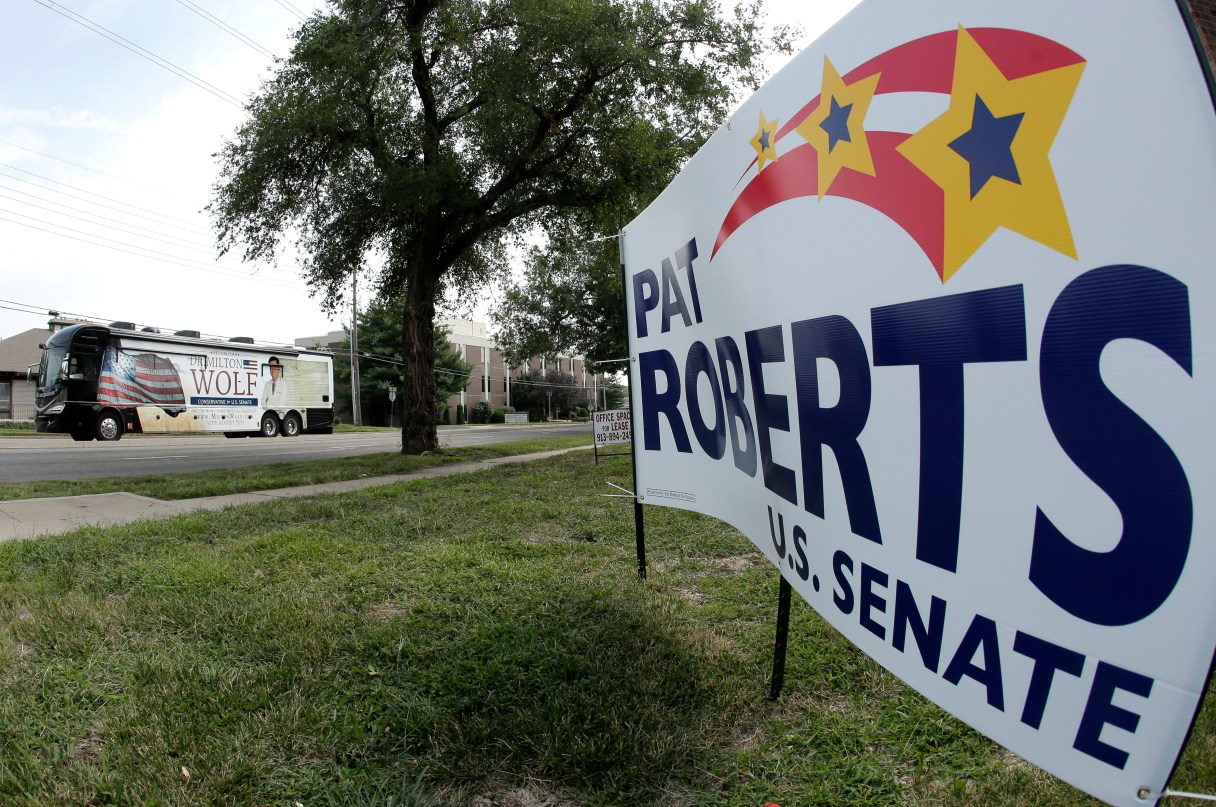
The Republican primary in Kansas topped election headlines Tuesday, as Republican Sen. Pat Roberts sought his party’s nomination against radiologist Milton Wolf.
Roberts, seeking a fourth term in the Senate, questioned Wolf’s fitness for office by running television ads focused on the 43-year-old’s posting in 2010 of X-ray images of patients’ injuries on his Facebook page. They included images of fatal gunshot wounds and comments intended to be humorous, for which Wolf apologized.
Along with his tea party supporters, Wolf cast the 78-year-old Roberts as a senator who barely lives in the state he represents in Washington. They got a boost from Roberts when he told a radio interviewer last month, “Every time I get an opponent – uh, I mean, every time I get a chance – I’m home.”
___
SENATE CONTROL
Should Roberts win, he’s all but a lock to return to Washington on Election Day.
Kansas is a reliably Republican state and his race isn’t among the roughly ten expected to determine control of the Senate. But a Roberts loss turns the campaign into a wide-open three candidate race between Wolf, likely Democratic nominee Chad Taylor, a district attorney from Topeka, and independent candidate Greg Orman, a businessman from suburban Olathe who has submitted more than twice the number of signatures to qualify for the November ballot.
In Michigan, six-term Sen. Carl Levin, a Democrat, is not seeking re-election. Voters were expected Tuesday to nominate Republican Terri Lynn Land to face Democratic Rep. Gary Peters, and their prospective race is considered a toss-up.
___
U.S. HOUSE IN MICHIGAN
Two establishment-minded Republicans made bids Tuesday to knock off incumbent House members in Michigan who often side with the tea party.
Dave Trott contributed almost $2.5 million of his own money to his campaign against first-term U.S. Rep. Kerry Bentivolio, while investment adviser Brian Ellis lent his campaign $1 million to fund his challenge against U.S. Rep. Justin Amash, who has sparred often with Republican leaders since his election in the 2010 tea party wave.
Meanwhile, Democratic Rep. John Dingell, who has been in Congress for a record 58 years, is retiring. But his wife, Debbie, is on the ballot Tuesday and expected to extend the Dingell dynasty come November.
___
MISSOURI ROADS AND RIGHTS
Missouri primary voters were deciding whether to raise sales taxes for transportation and fortify their constitutional rights through a variety of ballot measures.
The three-quarters-of-a-cent sales tax for roads, bridges and other types of transportation was projected to generate at least $540 million annually for 10 years. By taxing almost all consumer items, the proposal would mark a historic shift for a state that until now has funded its roads by taxing drivers for fuel and vehicles. State transportation officials promised it would pay for more than 800 projects, including the widening of Interstate 70 to three lanes in each direction between Kansas City and St. Louis.
Supporters and opponents spent well over $1 million battling over a measure that would make Missouri the second state after North Dakota to create a constitutional right to engage in farming. It was backed by agricultural industry groups such as the state’s pork, corn and soybean associations. Opponents were financed heavily by the Humane Society of the United States, which had helped sponsor a 2010 Missouri initiative imposing stricter limits on dog breeders.
Other proposals would enhance the state’s right to bear arms by subjecting gun-control policies to strict legal scrutiny and add cellphones and other electronic data to the list of things protected by search-warrant requirements.
___
IN WASHINGTON STATE
A dozen people – eight Republicans, two independents and two Democrats – sought to replace retiring Republican U.S. Rep. Doc Hastings in a central Washington district. The state has a top-two primary system, meaning that the top two vote-getters advance to Election Day regardless of party affiliation.
Republican Dan Newhouse, a former state lawmaker and agriculture director, raised the most money among candidates in the race. He emerged as a favorite along with Clint Didier, a former NFL star who won two Super Bowl rings with the Washington Redskins and campaigned as a tea party candidate.
The district hasn’t elected a Democrat since 1992, and Hastings generally cruised to re-election victory after first winning the seat in 1994. It’s home to farms that grow much of the nation’s crop of apples, cherries, grapes and hops to flavor beer, as well as the giant Hanford Nuclear Reservation, a federal installation that hold the nation’s largest volume of nuclear waste.
All of the state’s other incumbent members of the U.S. House were on the ballot seeking re-election Tuesday, when about 40 percent of Washington’s registered voters were expected to cast ballots in the vote-by-mail election.
___
UP NEXT
Tuesday’s primary was the first of three election days this week. Voters in Tennessee will cast ballots Thursday, when GOP Sen. Lamar Alexander faces a challenge in the GOP primary from tea party-backed state lawmaker Joe Carr.
On Saturday, Democratic Sen. Brian Schatz seeks his party’s nomination in Hawaii against Rep. Colleen Hanabusa, as they both seek to complete the term of the late Sen. Daniel Inouye, who died in 2012.
___
Associated Press writers David A. Lieb in Jefferson City, Mo., and Nicholas K. Geranios in Spokane, Wash., contributed to this report.