

 Robert Prince works Tuesday at Jed’s Wholesale Tires in Oldfort, Tenn. The company struggled for years to sell tires online without access to broadband Internet, a common problem for rural areas in Southeast Tennessee and North Georgia.
WHAT SPEED DO YOU NEED?RESIDENTIAL HOUSEHOLD BROADBAND GUIDEEmailing, web surfing, streaming basic video• One user on one device: 1 to 2 mbps• Two users or two devices at once: 1 to 2 mbps• Three users: 1 to 2 megabits per second• Four users: 6 to 15 mbpsRunning one high-demand application, like online gaming, HD video, video conferencing• One user: 1 to 2 mbps• Two users: 1 to 2 mbps• Three users: 6 to 15 mbps• Four users: 6 to 15 mbpsRunning multiple high-demand applications at the same time, i.e. gaming while video conferencing• One user: 6 to 15 mbps• Two users: More than 15 mbps• Three users: More than 15 mbps• Four users: More than 15 mbpsBROADBAND BY THE NUMBERS• 19 million Americans have no access to fixed broadband• 14.5 million of those Americans live in rural areas• 100 million Americans don’t subscribe to broadband even when it’s available• 85 percent of Americans with access to broadband use cable providers• 18 percent of Americans with acces to broadband use fiber providersSource: Federal Communications Commission
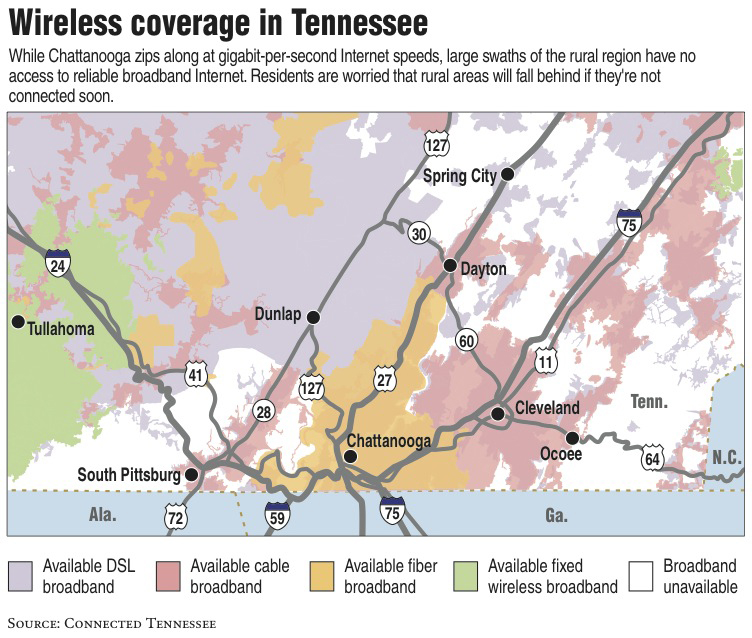 Graphic outlining the state’s wireless coverage.
Jed Arthur was at his wits’ end.
He lives on a remote road in Polk County, Tenn., and runs a successful tire business, Jed’s Wholesale Tires, out of a warehouse just 300 yards from his house. His son and daughter-in-law live next door. He’s fourth, maybe fifth generation Polk County, named after “The Beverly Hillbillies” character and proud of it. (No one ever forgets his name once he tells them that, he said.)
He and his nine employees have been selling tires since 1990, peddling on Amazon, eBay and the company’s own websites. At least 50 percent of Arthur’s business comes directly from online — but for years, Arthur ran the business on a measly 1.5 megabits-per-second Internet line, and dished out $800 a month for it.
With seven computers plugged into that line, it took three minutes just to upload a photo. Sometimes, Arthur would start an upgrade at 6 p.m. and it still wouldn’t be done at 8 a.m. the next day. His employees were wasting valuable time.