
There should be little to no effect in Chattanooga from Hurricane Matthew, according to Mary Black, a meteorologist with the National Weather Service in Morristown, Tenn.
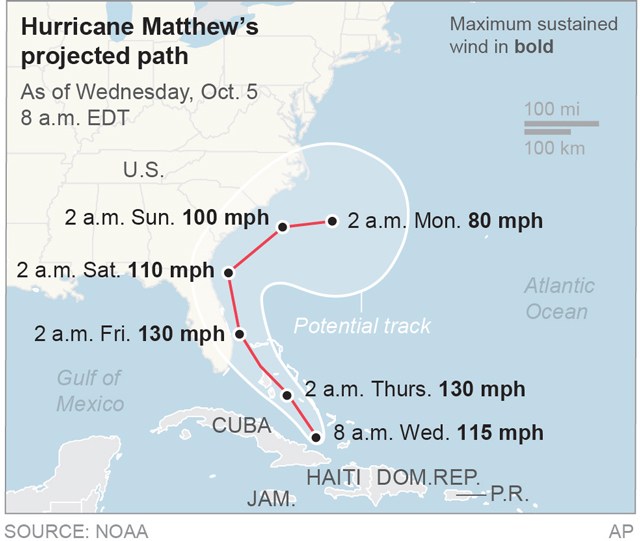
She said all the models she has seen indicate that the storm will drift off into the coast off the Carolinas after passing over Florida. The storm could hit parts of eastern Florida, or come close enough to cause hurricane-like conditions Thursday and continue to move along the eastern United States, according to the National Weather Service.
“If that continues to hold, it shouldn’t have a significant effect across East Tennessee,” she said. “I wouldn’t anticipate receiving much in the way of precipitation. For the most part, we are expecting Chattanooga to stay dry.”
Whatever inclement weather Tennessee does experience from the hurricane will be felt in higher elevations along the state border with North Carolina and in the northeast.
The threat of Hurricane Matthew prompted local officials on the Georgia coast Wednesday to urge evacuations for thousands of people – something that hasn’t happened for 17 years.
The National Hurricane Center placed all 100 miles of the Georgia coast under a hurricane watch Wednesday, saying hurricane winds of 74 mph or greater could reach the state by late Friday.
At least 11 deaths were blamed on the hurricane during its weeklong march across the Caribbean, five of them in Haiti. But with a key bridge washed out, roads impassable and phone communications down, the western tip of Haiti remained cut off a day after Matthew made landfall and there was no full accounting of the dead and injured in its wake.
After moving past Haiti, Matthew rolled across a corner of Cuba and then began pounding the southern Bahamas with winds of 120 mph and heavy rain on a course expected to take it near the capital city of Nassau during the night.
Matthew could become the first major hurricane to blow ashore in the U.S. since Wilma slashed across Florida in 2005, killing five people.