
 University of New Mexico Press / “The Gospel According to Billy the Kid”
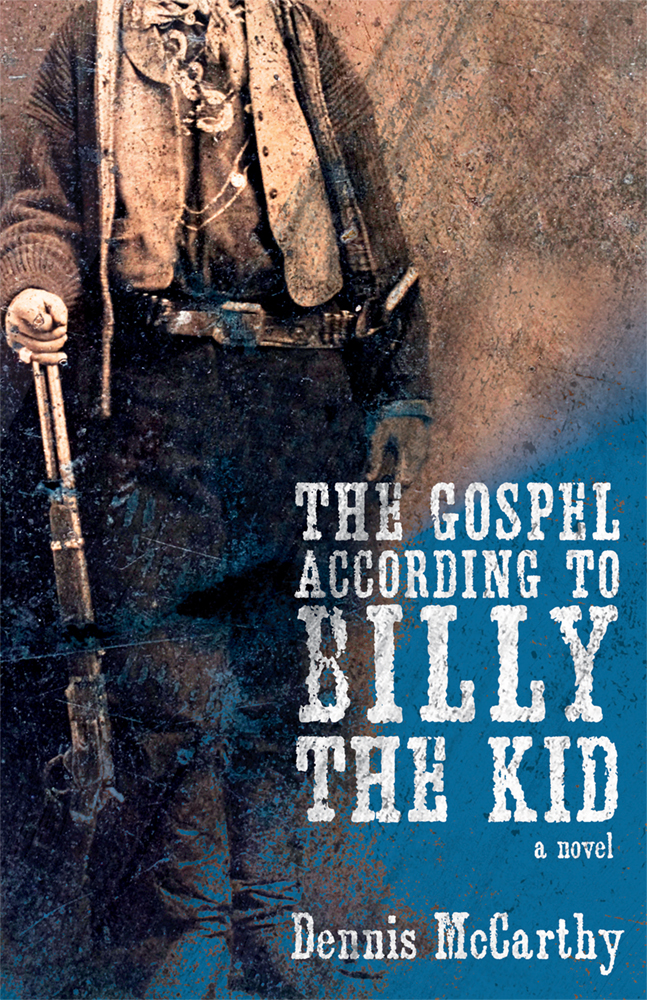
“THE GOSPEL ACCORDING TO BILLY THE KID” by Dennis McCarthy (University of New Mexico Press, 165 pages, $20).
Near the conclusion of Dennis McCarthy’s “The Gospel According to Billy the Kid,” that most notorious of outlaws confronts his friend and nemesis Pat Garrett for the last time, in Fort Sumner, New Mexico. Only in McCarthy’s account, the meeting occurs not in 1881 but 15 years later, after Billy returns from a sojourn in California to discover that, thanks to Garrett’s false account of his infamous end, he has been transformed from outlaw into legend. “I showed him a Billy he never knowed. He laughed. Said he’d written about a Billy I never knowed.”
“The Gospel According to Billy the Kid” manages to be both an homage to the Western genre and a thoughtful critique of the ways in which fact is fashioned into myth. McCarthy begins with the popular premise that Billy the Kid survived that fateful encounter with Pat Garrett in 1881; the tale is told by Billy himself, in 1914. Billy narrates the events leading up to the 1878 Lincoln County War, a violent conflict between rival ranchers that culminated in a five-day gunfight on the streets of Lincoln, New Mexico, and went on to inspire dozens if not hundreds of interpretations, from contemporaneous dime novels to more than half a dozen Western films. McCarthy’s novel leans on decades of research – attempting to filter fact from fiction in a time and place when even eyewitness accounts were dubious – and delivers an adventurous but comparatively sober and unromantic accounting of events and characters familiar to aficionados of “Old West” outlaw narratives.
After Billy’s rendezvous with Sheriff Pat Garrett in 1881, however, McCarthy departs into his own mythic territory, having Billy escape to California, where he attempts to make peace with his past. Years later, Billy returns to New Mexico with a new legend to tell and seeks out Pat Garrett en route to Cuba, where he will join up with Teddy Roosevelt’s Rough Riders in hopes of finding fortune and glory in the Spanish- American War.
The tale McCarthy tells via Billy does not sidestep the problematic nature of Manifest Destiny, particularly regarding its consequences for the indigenous peoples of the West, especially the Comanche and Apache nations. But he does so without sentiment, from the perspective of a hardscrabble son of Irish immigrants conditioned by poverty and violence to see life as a kill-or-be-killed proposition.