
I have a theory about the future of America that I don’t want to come true: that with the browning of America, white supremacy could simply be replaced by — or buffeted by — a form of “lite” supremacy, in which fairer-skin people perpetuate a modified anti-Blackness rather than eliminating it.
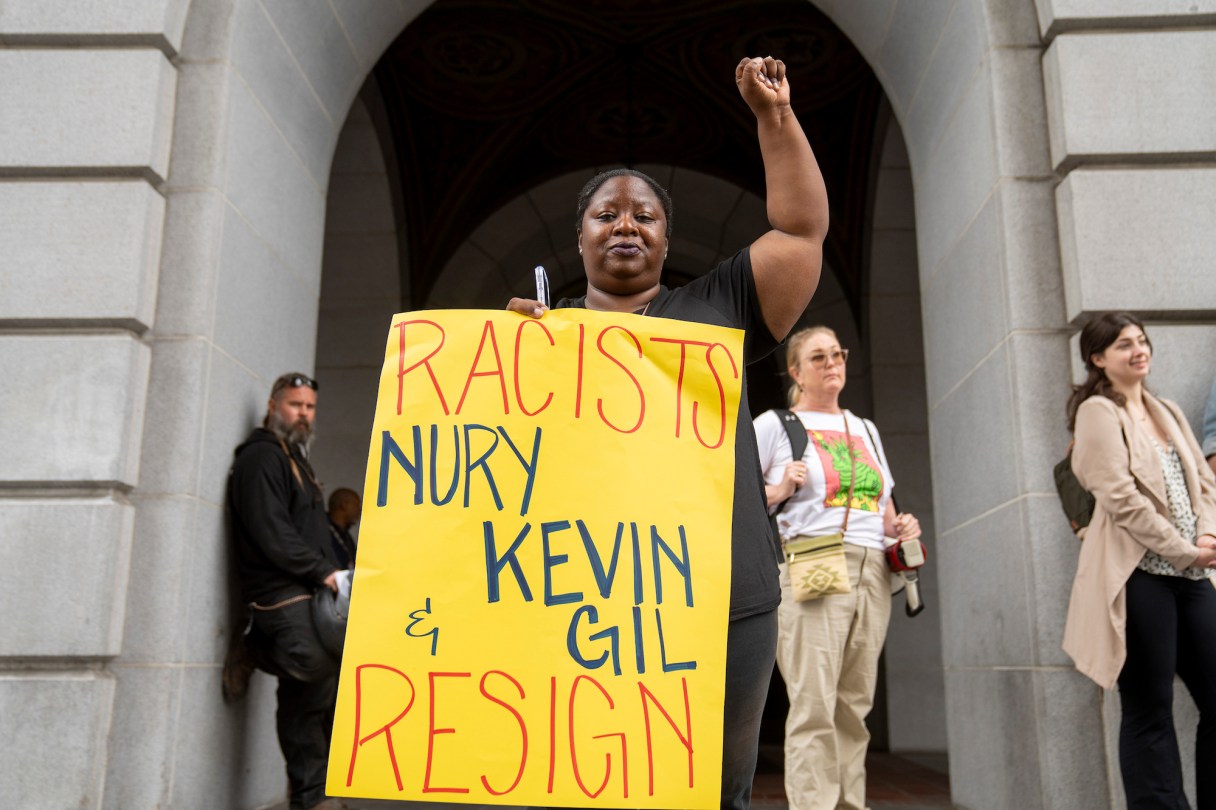
The racist comments revealed this week on a recording of Latino leaders in Los Angeles — three City Council members and a labor union leader — did nothing to allay those fears.
In the recordings, the Council president, Nury Martinez, who resigned as Council president on Monday and resigned from the Council on Wednesday, offered the most egregious comments. She insulted people in the most racially offensive ways, comparing a colleague’s Black son to a monkey and appearing to insult Oaxacans — people from the disproportionately Indigenous Oaxaca region of Mexico — by calling them “little short dark people” who are “ugly.”
But what disturbs me most is the racial, ethnic tribalism of her political calculations. After all, the recording is of a meeting to discuss the city’s once-in-a-decade redistricting process. This is a meeting about power, about who can be helped — or hurt — by how districts are drawn.
On the recording, when the former Los Angeles County Federation of Labor president, Ron Herrera, says, “I’m sure Katz and his crew have an agenda,” referring to the former state Assembly member Richard Katz, who is Jewish, Martinez responds that the Jews “cut their deal with South LA.”
Even more directly, Martinez dismisses one official by saying, “[expletive] that guy … He’s with the Blacks.”
I don’t want to suggest that the people on that call are representative of society at large, but I do understand that politics is a full contact sport and that it divides people into groups. Sometimes those groupings are around policy and vision. Sometimes they are around more basic things like identity and culture.
To be clear, I believe in representative distribution of political power. Los Angeles is nearly half Latino. There should be strong, unapologetic Latino political power in that city.
The problem this recording poses is that the people on the call seem to see power among the city’s constituents as a zero-sum game, and in that game, they openly disparaged other groups because of their identities.
Instead of allying with other disadvantaged groups, they diminished them. Their discussion was anti-Black, anti-Indigenous, anti-Jewish.
They were doing the work of white supremacy. And not because they see white power as one and the same as their own. At one point in the recording, while discussing whether Council member Mark Ridley-Thomas, who is Black, will continue to be paid after his indictment on corruption charges, Martinez says, “It’s not us. It’s the white members on this council that will [expletive] you in a heartbeat.”
Racism is perpetuated by those who benefit from it. Anti-Black racism benefits those whose appearances are least Black. White supremacy benefits those who are white, or those who are white-adjacent in both appearance, culture and affect.
The unfortunate reality is that anti-Black white supremacy is not confined to white people or to Republicans, even though they court it and coddle it. Martinez is a Democrat in an overwhelmingly Democratic city.
The fallacy is to believe that every person in every community that has been oppressed by white supremacy will reject it. That’s simply not true, for some see oppression as having a perch: You must be elevated to perform it. In that way, being in a position to oppress becomes aspirational; being anti-Black — and being able to skirt most anti-Blackness — becomes a sorting device. It is an achievement. It is most American.
The New York Times