
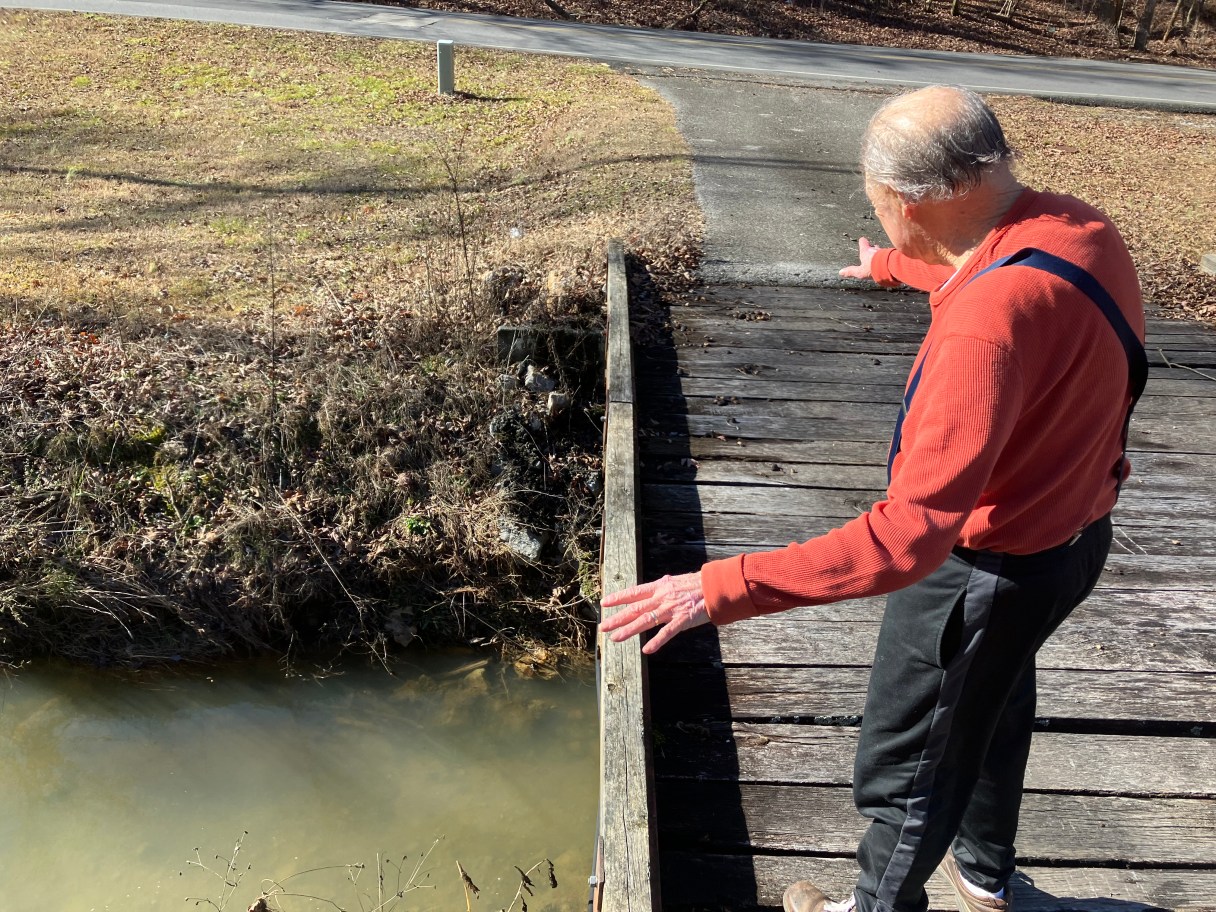
A split Catoosa County Board of Commissioners has denied a Ringgold property owner’s request that the county repair a bridge on his driveway — something he said the county had done before.
“I don’t understand why they built the bridge and maintained the bridge all these years, and now they won’t help me,” said James Harris, the property owner who built his home on Baggett Road in 1975.
Harris said he had to use a neighbor’s driveway to get his heating fuel delivered because his driveway isn’t safe for heavy equipment. He said he doesn’t know what would happen if he had a fire.
County officials said there’s no records that the county built or maintained the bridge, and county spokesperson John Pless said in a phone interview that using county resources in such a way has always been violation of county policy. County resources can only be used for public purpose, he said, and repairing the bridge would only serve Harris because it’s on his private property.
Access to Harris’ property has been washing out due to rain events, said James Davis, director of planning and inspections, during a presentation at the commission meeting Tuesday.
The estimate for repairs is $20,011, Davis said, and would have been paid from the capital projects fund. The project would have replaced the bridge with culverts, he said.
Chuck Harris represents the area of the county where James Harris lives. Chuck Harris said there’s no relation between the two men.
After research and talking with Harris’ neighbors, Chuck Harris said the county did build two property access bridges after an ice storm flood in the early-to-mid-1970s in the area. The other bridge besides James Harris’ has already been replaced with culverts, he said.
Chuck Harris said at the Dec. 20 commission meeting that things were different “back in the day” when the county was managed by a sole commissioner. Public works would help out property owners with projects, he said, like a truckload of gravel.
“That doesn’t necessarily mean the county’s accepted responsibility,” Chuck Harris said, for ongoing repairs.
The easement issue was tabled at the Dec. 20 meeting until this week’s meeting to get a better idea on the price of the project.
Commissioner Vanita Hullander asked if the erosion and stormwater issues on Harris’ property were caused by county-built culverts or anything else. Davis said a lot of water comes down Baggett Road but wouldn’t speculate about its cause.
Commissioner Jeff Long asked Chad Young, county attorney, if repairing Harris’ access would set a precent for other homeowners. Young said decisions would be made on a case-by-case basis because the county can’t fund repairs unless the work has a public purpose.
“We’re not helping the community, we’re basically doing this to be helping this one individual,” Long said about the possibility of James Harris’ repair.
Commissioner Charlie Stephens said he feels bad about denying Harris’ repair, but it’s a lot of money for county taxpayers.
“We can’t do it for everybody, and somewhere we got to draw the line,” Stephens said.
The measure was defeated 3-2. Larry Black, commission chairman, and Chuck Harris voted for the easement, while Stephens, Hullander and Long voted no.
After the vote, James Harris said he understands now the county isn’t able to fix what’s on his private property but said he felt led astray because the county asked him to fund a $1,700 survey for the project — money that could have gone to repairs. James Harris said he provided a written statement from a retired Catoosa County employee that the employee did work on the project.
Over the years, the county resurfaced his wooden driveway bridge twice, James Harris said, and also reinforced the bridge’s foundation once. The last time the county resurfaced his bridge was about 20 years ago, James Harris estimated, adding the bridge was already in place when he bought the property.
Pless said the retired county employee’s statement doesn’t mean the repair was authorized by the county.
Uphill and north on Baggett Road from James Harris’ property are subdivisions with hundreds of homes, many on lots less than a third of an acre. The subdivisions were built in the early 2010s.
Standing near his driveway bridge in his front yard, James Harris said sometimes once or even twice a year Baggett Road is flooded enough to stop traffic. When that happens, he said 15 feet or more of his yard is submerged, but that kind of flooding wasn’t a problem before nearby subdivisions on Baggett Road were built.
“Since they build all those subdivisions up here, and you got all the concrete, it catches the water instead of running it into the ground,” James Harris said. “All the water comes here.”
In the Dec. 20 commission meeting, Davis said some of the nearby subdivisions were developed before current state stormwater regulations and some don’t have stormwater controls. He also said the development isn’t entirely the cause because Baggett Road was built where the nearby hills drain.
Contact Andrew Wilkins at awilkins@timesfreepress.com or 423-757-6659.