
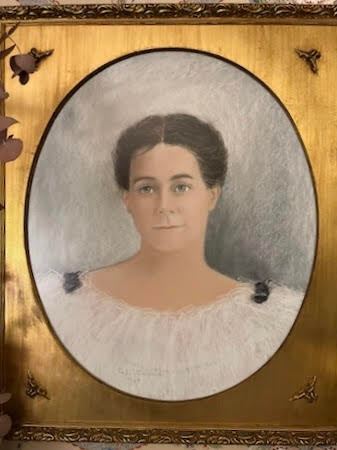
“Heirlooms Recall Days of Franklin” headlined The Chattanooga News on Jan. 18, 1923, reporting a “birthday celebration” for Founding Father Benjamin Franklin. It was a party attended by several hundred guests at the Oak Street home of “Mistress [R.B.] Cooke” where “the fair dames and pretty wrenches made merry until long past the sunset hour.” Susan Russell, author of the news article, acknowledged that “such words would the dead-and-gone makers of history,” had they not attended the event.
The description of the event noted that “what a splendid glimpse into the centuries gone was the precious heritage shown on all sides, lighted by candles that in old, old candlesticks smiled down on the guests.” Sarah Divine Cooke, founding regent of the Chief John Ross Chapter, National Society Daughters of the American Revolution, had chosen to announce Chattanooga’s newest DAR chapter by hosting a celebratory “walk through history.”
In one corner of the parlor stood a historic spinning wheel that “could tell … stories of the women of the Divine family whose fingers piled it” at Watauga, Tennessee’s earliest settlement. Mrs. Cooke shared the story of her female ancestors, recalling that “their dainty hands” had “hardened in service” to their nation and the cause of freedom. Across the room stood another spinning wheel with a history that rivaled the Divine family’s treasure. At the second wheel sat “the illustrious ancestress of the Corbett family” who recalled for the guests her experiences at Watauga, including an attack by the Cherokee where the “arrows flew thick and fast and were deadly in their flight.”
At a table near the second wheel was a book of historic papers, originally gathered and bound in 1834. The papers included diary entries, sketched maps and letters recalling a trip taken by Charles Shipman and his young daughters, Joanna and Betsy, in the 1820s from Ohio to Washington, D.C., and Baltimore. After the binding, the papers had become the property of Joanna Shipman Bosworth and almost a 100 years later were in the possession of her descendant, Mrs. Clarence T. Jones. Another table displayed “Paisley shawls” acquired in China in the first decade of the 19th century, alongside a collection of hand-woven coverlets, now the property of Mrs. John L. Divine, whose great-grandmother had planted the flax, spun and wove the cloth and then fashioned the coverlets, “one for each of her children.”
A multitude of historic treasures were on display, including an antique lace, satin and ivory fan carried by Mary Stroud Greene at her 1809 wedding. A satin and lace wedding dress worn by Margaret Ann Hood, the ancestor of Chattanooga’s Trotter family, when she had married her first husband, William Grames, just weeks after Greene’s wedding, was displayed on a form. Included in the clothing display was a “darling little baby dress” worn by Daniel Greene in 1774, with “exquisitely fashioned buttonholes” and tiny mother of pearl buttons and a second dress, less old, having been used at a 1860 christening, just months before the beginning of the nation’s civil war.
Mrs. James Morrison had contributed one of her historical treasures to the party, a framed handwritten invitation to Col. Henley from George Washington, who “requests the favor of his company to dinner tomorrow, Saturday, June 11.” In groupings throughout the house, guests observed ivory miniatures, a collection of silver colonial buckles, 1809 bank notes, a multitude of candles and silver snuffers fashioned from “old tallow dips.” But perhaps the most unusual artifact on display was a piece of wood from President Washington’s coffin, along with a note explaining its origin as “part of the mahogany covering of the leaden casket which was removed when the remains were placed in the present marble sarcophagus in 1837,” a gift to the owner from Col. John Augustine Washington.
The colonial tea included a speech by Mayor Chambliss, an “educational talk” about Benjamin Franklin by Mrs. Cooke, musical selections offered by Mrs. Eugene R. Howard, Mrs. W.P.D. Mores, and Mrs. R.A. Day, and a dancing troupe featuring Harah Willis Houston, Martha Lanier, Evelyn Busbee and Francis Powell. Mrs. Cooke was assisted in greeting the guests by her daughters, Mrs. David Barton and Miss Adelaide Cooke, along with the regents of the other three Chattanooga DAR chapters, Mrs. John H. Cantrell, Mrs. Thomas F. Walker and Miss Rosalind Ewing, and friends, Mrs. T.E. Travis, Mrs. J.T. Draper, Saide Magill and Louise Oehmig Newell.
It was a memorable afternoon.
Linda Moss Mines, the Chattanooga-Hamilton County historian, is honorary regent, Chief John Ross Chapter, NSDAR. For more information, visit Chattahistoricalassoc.org.