
Thursday, October 29, 2026Oct 29

This story is free to read.

Auschwitz museum begins emotional work of conserving 8,000 shoes of murdered children

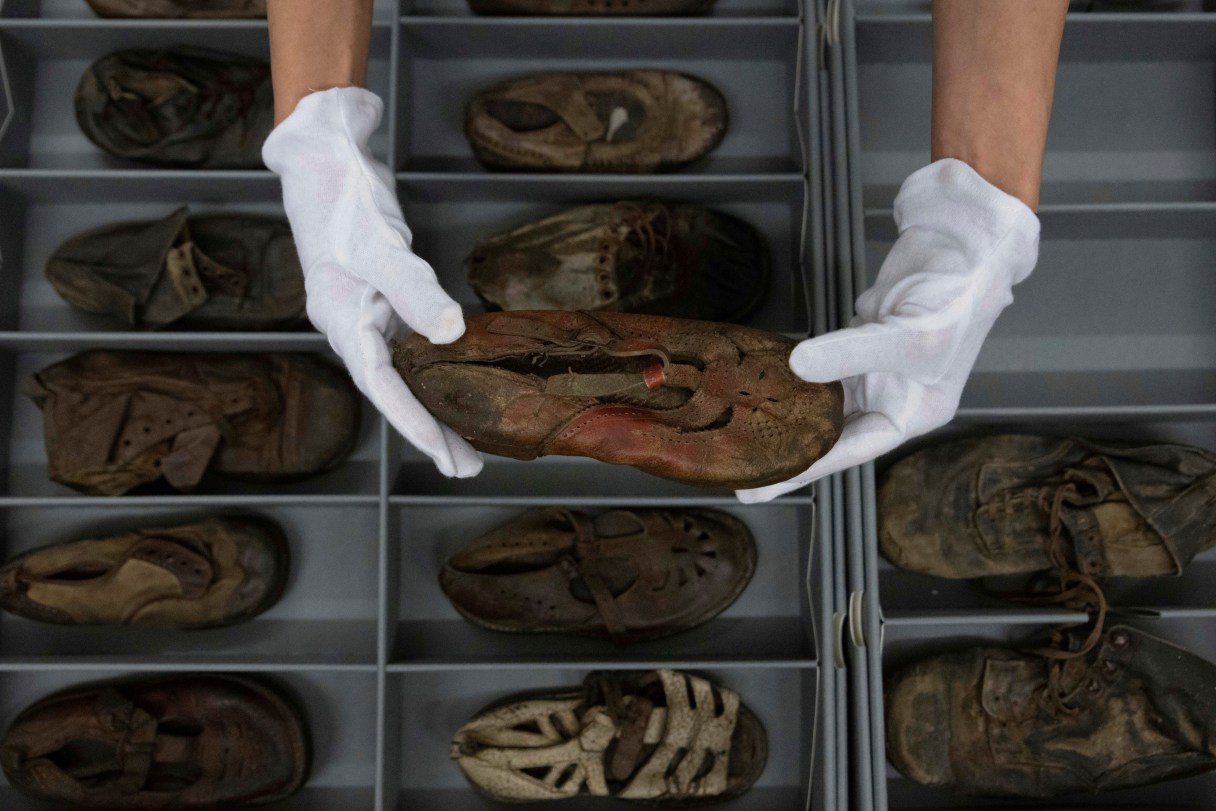
Elzbieta Cajzer, head of the museum's collections department, shows a collection of shoes that belonged to child victims of the former Nazi German death camp Auschwitz-Birkenau at the conservation laboratory on the grounds of the camp in Oswiecim, Poland, Wednesday, May 10, 2023. A two-year effort has been launched in 2023 to preserve 8,000 children’s shoes at the former concentration and extermination camp where German forces murdered 1.1 million people during World War II. (AP Photo/Michal Dyjuk)
Elzbieta Cajzer, head of the museum's collections department, shows a collection of shoes that belonged to child victims of the former Nazi German death camp Auschwitz-Birkenau at the conservation laboratory on the grounds of the camp in Oswiecim, Poland, Wednesday, May 10, 2023. A two-year effort has been launched in 2023 to preserve 8,000 children’s shoes at the former concentration and extermination camp where German forces murdered 1.1 million people during World War II. (AP Photo/Michal Dyjuk) Elzbieta Cajzer, head of the museum's collections department, shows a collection of shoes that belonged to child victims of the former Nazi German death camp Auschwitz-Birkenau at the conservation laboratory on the grounds of the camp in Oswiecim, Poland, Wednesday, May 10, 2023. A two-year effort has been launched in 2023 to preserve 8,000 children’s shoes at the former concentration and extermination camp where German forces murdered 1.1 million people during World War II. (AP Photo/Michal Dyjuk)

OSWIECIM, Poland (AP) — In a modern conservation laboratory on the grounds of the former Auschwitz camp, a man wearing blue rubber gloves uses a scalpel to scrape away rust from the eyelets of small brown shoes worn by children before they were murdered in gas chambers.

Colleagues at the other end of a long work table rub away dust and grime, using soft cloths and careful circular motions on the leather of the fragile objects. The shoes are then scanned and photographed in a neighboring room and catalogued in a database.

The work is part of a two-year effort launched last month to preserve 8,000 children’s shoes at the former concentration and extermination camp where German forces murdered 1.1 million people during World War II. Most of the victims were Jews killed in dictator Adolf Hitler’s attempt to exterminate the Jews of Europe.

The site was located during the war in a part of Poland occupied by German forces and annexed to the German Reich. Today it is a memorial and museum managed by the Polish state, to whom the solemn responsibility has fallen to preserve the evidence of the site, where Poles were also among the victims. The Germans destroyed evidence of their atrocities at Treblinka and other camps, but they failed to do so entirely at the enormous site of Auschwitz as they fled the approaching Soviet forces in chaos toward the war’s end.

Eight decades later, some evidence is fading away under the pressures of time and mass tourism. Hair sheared from victims to make cloth is considered a sacred human remain which cannot be photographed and is not subjected to conservation efforts. It is turning to dust.