
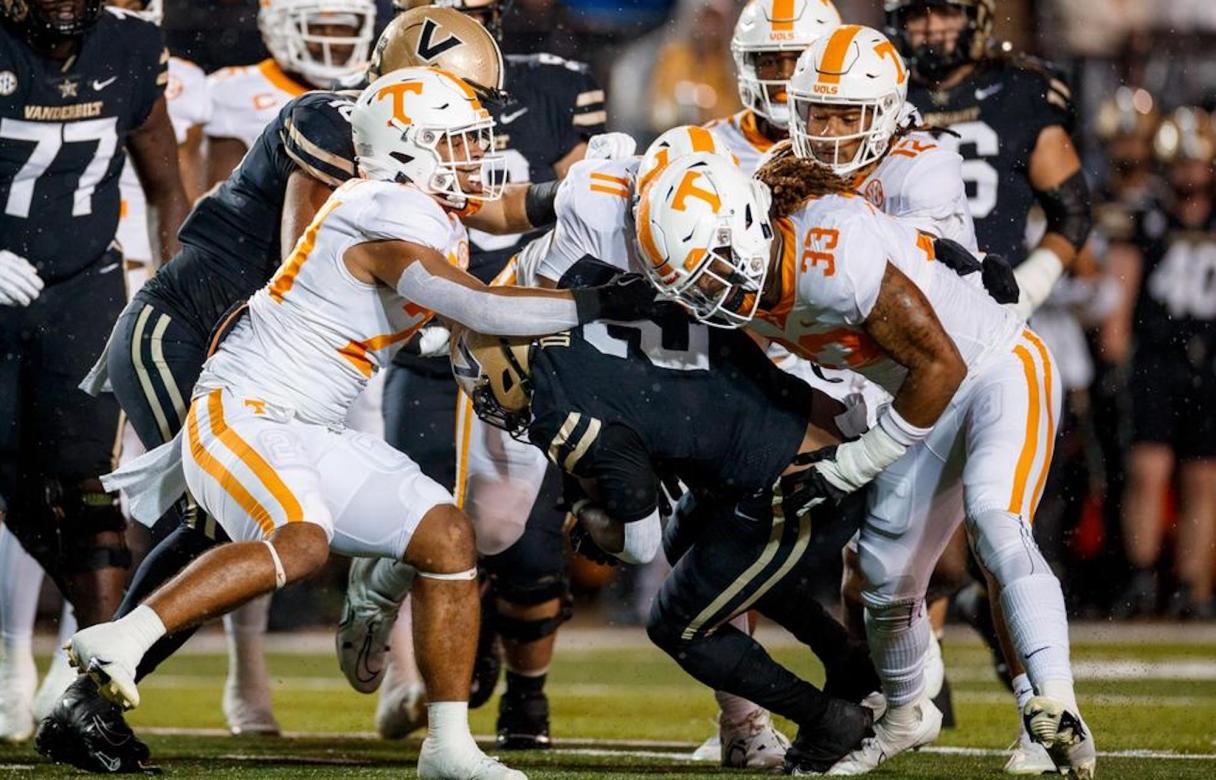

Saturday afternoon inside Neyland Stadium, the Tennessee Volunteers and the Vanderbilt Commodores will collide for the 117th time as state rivals.
They also will play for a 32nd and final occasion as Southeastern Conference Eastern Division foes.
Saturday not only marks the finish line for the SEC’s 2023 regular season but for its divisional era that began in 1992, when Arkansas and South Carolina joined the conference to form a 12-member collection that resulted in two six-team divisions and a groundbreaking league championship game. The SEC maintained divisions in 2012, when Missouri and Texas A&M were added to provide seven schools on each side, but the league has decided to scrap the divisional concept when Oklahoma and Texas arrive next year from the Big 12 Conference.
So the Iron Bowl between Alabama and Auburn will go on after this weekend, but it will no longer have any impact on an SEC West race.
“It has been fun to compete in the SEC and have divisions and to focus on what you have to do to try to win your division,” Alabama coach Nick Saban said. “I’m sure it will be a little different next year, but I haven’t given it a whole lot of thought. It’s still going to be about playing the best you can play and winning the games you’ve got to play.”
Saban has been the most successful coach in the SEC divisional era, having won 10 West titles with Alabama after winning two at LSU. His 10th with the Crimson Tide has set up an anticipated clash next week against Georgia inside Atlanta’s Mercedes-Benz Stadium.
Before Saban’s tremendous run, Steve Spurrier had been the best in the business with seven division titles at Florida from 1992-2000 and an eighth with South Carolina in 2010.
The SEC has yet to decide whether it will move forward with an eight- or nine-game league scheduling model after the 2024 season, but either format will allow each school to play every other school twice over a four-year period. A greater rotation throughout the conference will result in the loss of most annual matchups that have taken place in this divisional era, which is not popular with league traditionalists.
“I personally prefer the East and West setup,” Missouri coach Eli Drinkwitz said. “I think it gives you continuity with who you’re playing and a competitive continuity, so you know who you have to measure up against and to build your rosters to compete with certain teams. I think playing through the entire conference is going to be kind of difficult.
“This is just the new norm of college football, and it will be interesting to see if some of the tiebreakers take it out of what happened on the field and put it more into other things, which is something I don’t think college football fans really want. That’s hypothetical, and we’ll find out in the future.”
Perhaps in the very near future, as the Big 12 did away with divisions before this season and enters this weekend with seven of its 14 members still having a chance to play in next week’s league title game. While such a crowded race certainly can be viewed as fun, using a tiebreaker system for two teams that may not have played one another could have people longing for the divisional clarity sooner than later.
The biggest downside to divisional play has been those occasions in which the two top teams are in the same division, which the Atlantic Coast Conference has experienced with Clemson and Florida State and the Big Ten with Michigan and Ohio State. Of course, those teams at least got to settle the score once, and next year’s Big Ten without divisions could encounter the Wolverines and Buckeyes closing out the regular season and playing a week later for the conference title.
“It will be unique, and it will be a different experience,” Georgia coach Kirby Smart said. “Sometimes progress is growth, and progress and change is good. I think we are all comfortable with what we’ve done, but that doesn’t make it the best thing. The give and take is that you’re supposed to get the best two teams in the championship.
“That’s the hope. I don’t know if that 100% always happens, but it certainly has a better chance of happening than just doing it by divisions.”
Auburn’s Hugh Freeze and South Carolina’s Shane Beamer agree that divisions have worked well for the conference but understand why their time has come and gone. Beamer believes experiencing more league locales will be exciting for players, while Freeze said that scheduling balance will improve, adding that Auburn annually has played East power Georgia in addition to its opponents from the West, which has been the stronger side way more often than not during the last 15 years.
LSU’s Brian Kelly last season became the fourth SEC coach to reach the league championship game in his debut year, joining LSU’s Les Miles (2005), Auburn’s Gus Malzahn (2013) and Florida’s Jim McElwain (2015). Kelly doesn’t believe that ditching the divisions will change what the SEC represents.
“The depth and the talent, whether it be the East or West, is so good that you’re not just focused on the West or the East,” Kelly said. “When you go to Missouri, you’re not going, ‘Wow, we don’t have to win this game, because they’re not a West opponent.’ It doesn’t hit me as hard that we’re not going to be East and West and that we’ll just be one SEC, because I see it as the depth of the league and the challenge you have every week.
“We’ve got a banner, and we cherish that banner, but this is really about winning the SEC. Winning the West was certainly an accomplishment in our first year, but we’re all here for championships.”
Contact David Paschall at dpaschall@timesfreepress.com.
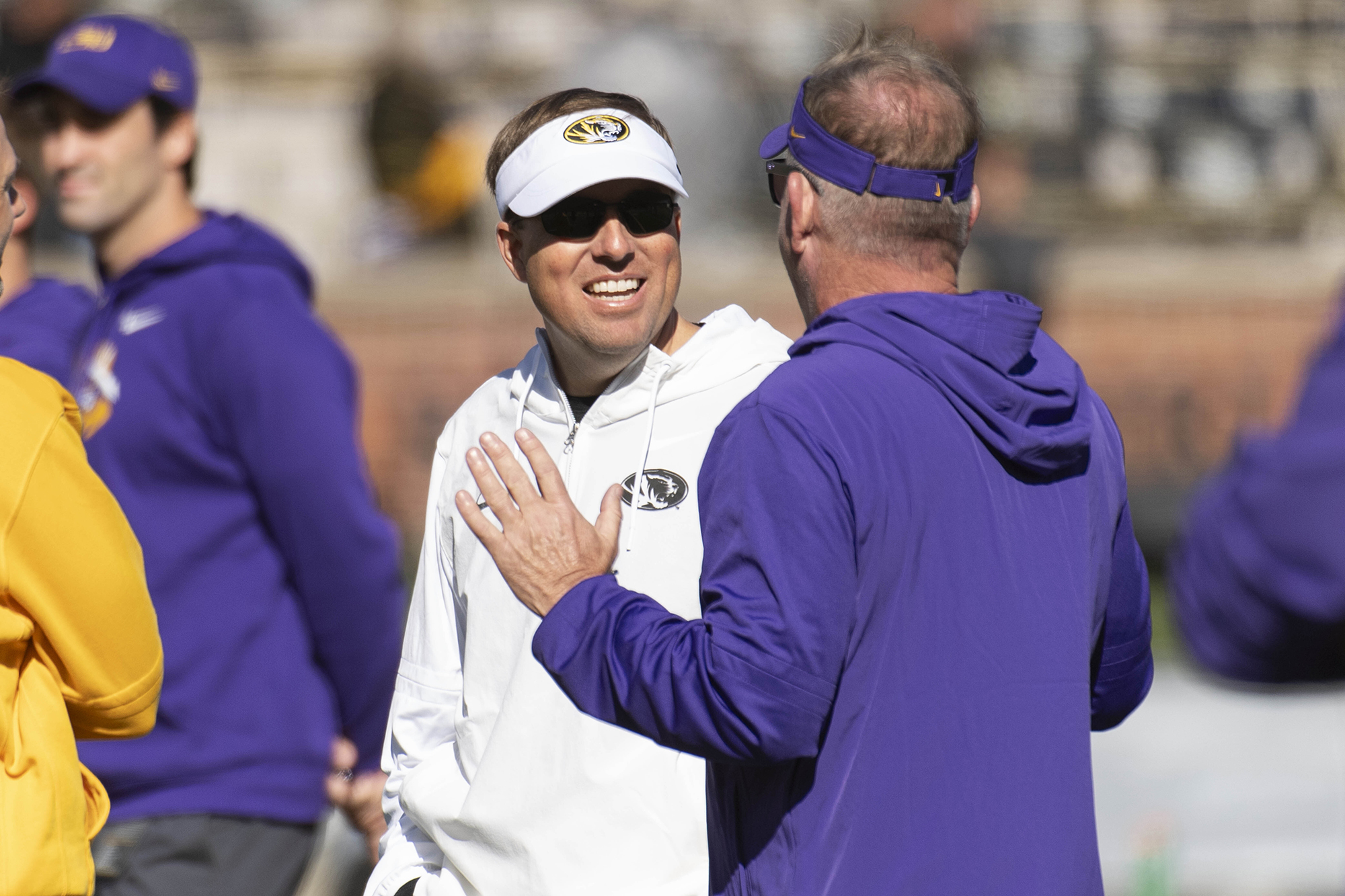 AP photo by L.G. Patterson / Missouri football coach Eli Drinkwitz, left, talks with LSU counterpart Brian Kelly before their teams face off on Oct. 7 in Columbia, Mo. Drinkwitz said he prefers the East-West format for the SEC, while Kelly doesn’t believe ditching divisions will harm the perception of the league as it grows to 16 members with the addition of Oklahoma and Texas next year.
SEC TITLE TRIPS
Southeastern Conference football programs and their number of division titles during an era that began in 1992 and is ending this season:
1. Alabama — 15 (West)
2. Florida — 13 (East)
3. Georgia — 11 (East)
4. LSU — 7 (West)
5. Auburn — 6 (West)
6. Tennessee — 5 (East)
7. Arkansas — 3 (West)
8. Missouri — 2 (East)
T9. Mississippi State — 1 (West)
T9. South Carolina — 1 (East)
T11. Kentucky — 0 (East)
T11. Ole Miss — 0 (West)
T11. Texas A&M — 0 (West)
T11. Vanderbilt — 0 (East)