
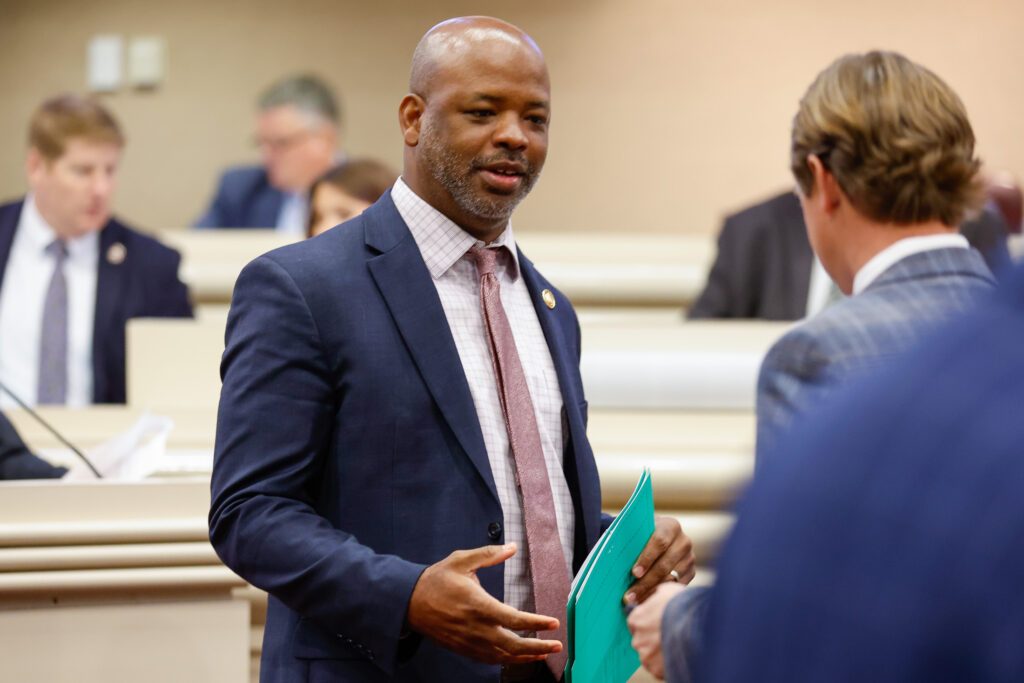
An Alabama state representative has prefiled a bill that would increase the state’s online sales tax and distribute the increase to public schools.
House Bill 17, sponsored by Rep. Chris England, D-Tuscaloosa, would increase the levy, officially known as the simplified sellers-use tax, from 8% to 9.25%. The added money would be allocated to local boards of education based on their average daily membership in the preceding school year.
“What I wanted to do is take that nine and a quarter — and since education isn’t getting anything really from the SSUT — that it would take that additional new money and distribute it to school systems on a per pupil basis,” he said in a phone interview.
Proceeds from the tax are currently split between state and local governments — 75% of the state allocation goes to the general fund, with the remainder going to the education trust fund.
England said it would be a consistent source of money. Revenues from the tax have grown significantly with the expansion of online shopping in the last several years and have helped stabilize the general fund budget.
Bricks vs. clicks
The proposed increase could also add to an ongoing debate over whether the tax gives online retailers an unfair advantage. According to a recent report from the Public Affairs Research Council of Alabama, which cites data from the Tax Foundation blog, brick-and-mortar stores are at a competitive disadvantage due to a weighted average of 9.25% sales tax across the state. Online retailers pay a flat 8%.
“This SSUT is a matter of kind of debate because should it be treated like a sales tax since it’s presumably displacing sales that would be otherwise made in the local jurisdiction and should it all flow to schools in the same proportion as the regular sales tax, or is it just a different kind of tax?” said Thomas Spencer, a senior research associate at the council. “And it’s up to the counties and cities to decide what to do with it.”
(READ MORE: Supreme Court ruling allows Tennessee to begin collecting taxes on online sales)
At the Dec. 14 State Board of Education work session, State Schools Superintendent Eric Mackey said the tax would “probably be a hot discussion in this legislative session.”
England said the model would give schools more discretionary funds. The state usually limits how local districts can spend state money. Local funds would allow districts to fund school resource officers or nurses as they need.
Some local communities have created their own methods of distributing the tax. Under a constitutional amendment approved last year, Morgan County distributes 85% of the money given to the County Commission to the local city and county boards of education. Thirteen and a half percent goes to the Morgan County Board of Education, and 1.5% was allocated to local volunteer firefighters.
Sen. Arthur Orr, R-Decatur, who sponsored the amendment, said the distribution reflected the desires of school districts in Morgan County.
“Since it was all sales taxes related, they felt very strongly that the money should come to them just like bricks and mortar,” Orr said in a phone interview.
The changes were first passed in a bill in 2019. The Alabama Supreme Court said the bill was constitutional in 2021, according to the Alabama Daily News. Voters approved the amendment with roughly 74% of the vote.
Orr said the bill came from seeing a decrease in brick-and-mortar sales taxes as online sales taxes increased.
City impacts
Spencer said the tax’s distribution model has a large effect on cities with a high concentrations of brick-and-mortar stores. More populous areas get less money back on a per-capita basis, and cities are more dependent on sales taxes.
“In its first few years of operation, the simplified sellers-use tax has substantially impacted municipal governments’ revenues and has allowed them to make investments that likely were not previously possible,” wrote Alabama League of Municipalities Executive Director Greg Cochran in a statement. “As we approach the next legislative session, we support and encourage collaboration between local and state officials in implementing policies that enhance the quality of life for citizens and encourage economic investment in all communities across Alabama.”
Sonny Brasfield, executive director of the Association of County Commissions of Alabama, said his organization believes counties should receive the same proportionate allocation of any increase.
“If you’re going to increase the rate, counties would receive 20% of the increase,” he said by phone.
Brasfield said “under no circumstances” would his organization support a wider expansion of Morgan County’s model, but he said the association has encouraged counties to have local conversations about how the money would best be expended. In Dale County, he said, there has been an increase in law enforcement compensation. Other counties have used the money to pledge for bond payments.
“County government plays a vital role in providing services to the citizens, and those counties’ governments got to be funded, just like every other level of government does,” he said.
England said his bill is one way to change things on a statewide level. He also said that it’s important for local boards of education to try and make deals with county governments.
The Public Affairs Research Council of Alabama, citing Alabama State Department of Education data, said eight school systems receive funding from county online sales tax revenue and seven receive funding from similar city tax funding.
Another reason for the tax, said England, is Alabama’s longstanding underfunding of public schools.
According to the U.S. Census weighted quartile data, Alabama spent $11,819 per student in fiscal year 2022. The average across all reporting states was $16,340.
“I always laugh when I hear people say we give education a lot of money,” England said. “Well, not really, and quite frankly, there’s nothing in state government that we fund enough.”
Read more at AlabamaReflector.com.