
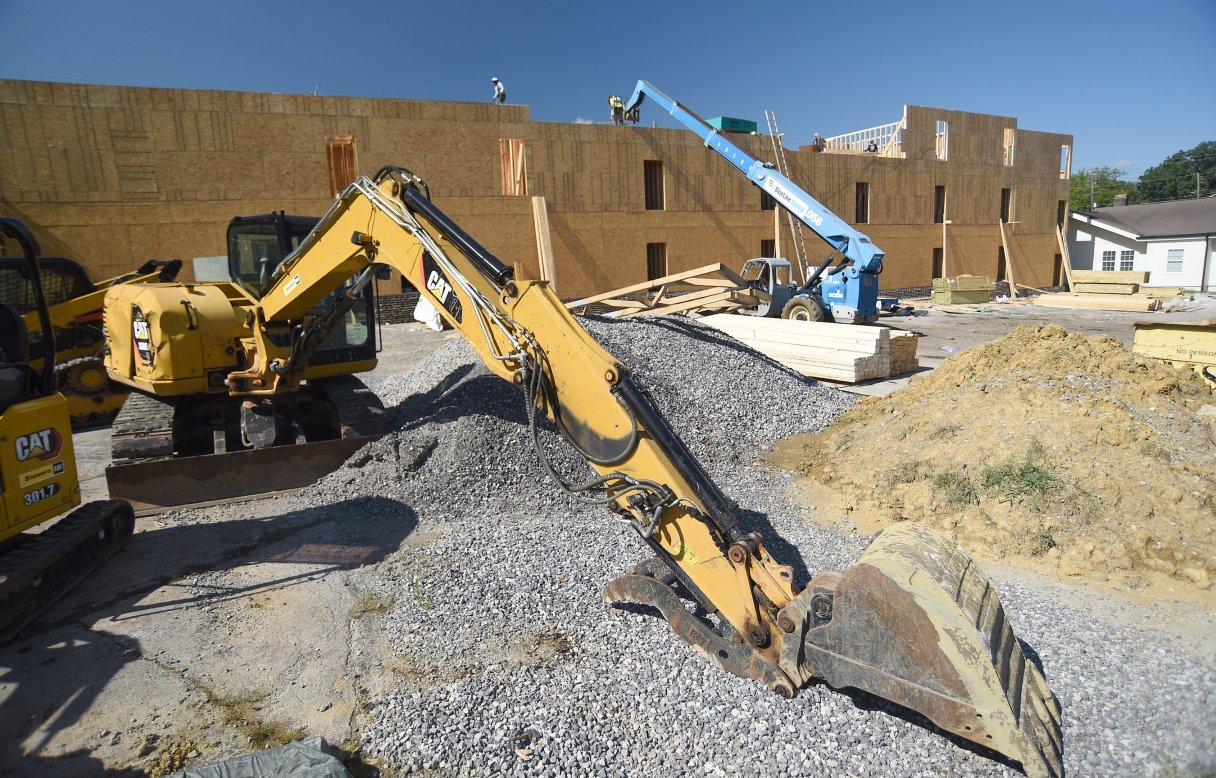
Chattanooga and Hamilton County will need 46,000 more apartments, single-family residences and other housing over 20 years to handle swelling growth, new planning studies show.
“It’s not astronomical,” said Karen Hundt, the Chattanooga-Hamilton County Regional Planning Agency’s director of community planning and design. “It’s close to what we’ve been seeing the last few years.”
The last three years of residential permits for the city and county — 3,318 for 2023, 2,935 for 2022 and 3,677 for 2021 — each have surpassed the prior top mark of 2,860 in 2007, figures show.
(READ MORE: Apartments proposed for Lee Highway)
Experts estimate Hamilton County’s population will near a half million residents during the next 40 years, the Regional Planning Agency said. That’s up from a U.S. Census Bureau projection of 380,000 last year.
At the same time, a top issue for people outside the city is the loss of character where they live, often in a quiet rural setting, the studies show.
Also, they worry change is occurring at such a rapid pace, services will not keep up. Concerns include maintaining roads, traffic congestion, and funding new schools and other services, according to the studies.
About a year ago, the Regional Planning Agency began work on the city and county blueprints called “Our Communities. Our Growth,” and the agency is starting to roll out findings.
For the county, the effort is a first of its kind, officials said. For the city, the results will replace aging plans.
Dan Reuter, the agency’s executive director, said with the area’s proximity to Nashville and Atlanta, suburbs and interstates serving as major freight corridors, the city and county are going to grow based on the past 10 years.
“Our location makes us a powerhouse for the southern U.S. economy, and our outdoor attractions and having one of the most robust internet networks in the nation are attracting new businesses and professionals,” he said in a statement. ‘Therefore, it’s critical that local governments in the Chattanooga region work together to manage growth.”
Hundt said one potential solution to growth fears is to put high-density housing in under-utilized commercial corridors where retail space has gone away.
“Let’s put it on the corridor,” she said by phone. “A lot of those in the city have transit service. Live on Main Street or Bailey Avenue and take the bus to work.”
(READ MORE: Main Street housing going up)
Such residents wouldn’t need an extra car, and they could save up money for a home, Hundt said.
“There are a lot advantages or pluses to it instead of scattering developments of all kinds,” the planning official said.
She said the planning agency is starting to look at tools and incentives to move in that direction. Updating the city’s zoning code could help, and consultants are looking at incentives such as a potential housing bonus.
“That gets us more development in those areas,” Hundt said.
Studies show 47,000 students are currently enrolled in Hamilton County public schools, 10,000 more are in private schools and another 20,000 in local colleges, and the planning agency said they’ll need jobs and housing in the future.
In addition, early feedback has indicated a strong community desire for adding new parks and greenways, maintaining open spaces and protecting mountains, ridges and creeks, according to the agency.
Meanwhile, the public has expressed concerns about increasing traffic congestion during peak hours and whether services are adequate or available for new development.
The studies show much of Hamilton County features slopes steeper than 30%, and areas within the floodway and the 100-year floodplain are constrained when it comes to new development, the agency said.
If development continues at the current rate of growth into outlying areas, it could result in the potential loss of 2,800 acres of land and sensitive resources, the planning agency said.
The agency will unveil some of the findings, including maps that envision the future of the community, this month.
Hundt said meetings with elected officials and department heads are to take place this month, while the plans will go to the broader community later in the spring.
By summer, the plans will be wrapped up and taken to city and county elected officials, she said.
“We want them to adopt the plans,” Hundt said. “They’re just guides, but it helps them make decisions about rezoning cases and where to spend capital improvement dollars.”
She said people can go to planhamilton.org and planchattanooga.org for input and updates.
Contact Mike Pare at mpare@timesfreepress.com or 423-757-6318.