
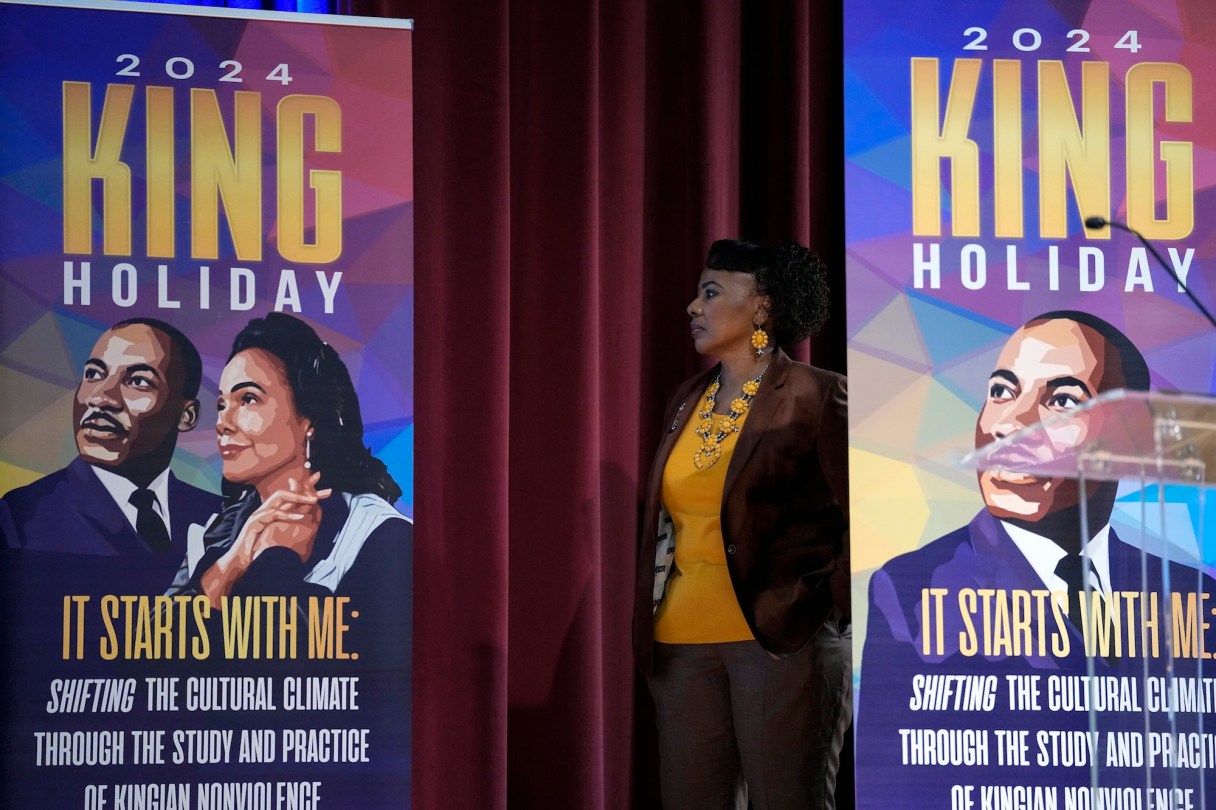
As we honor the Rev. Martin Luther King Jr.’s birthday with a federal holiday, there will be programs, pageantry and celebrations for a man who expressed a powerful dream in 1963 on the steps of the Lincoln Memorial. But that dream remains largely unfulfilled.
King’s dream was one of a colorblind society; he challenged America to live up to its founding promises of freedom, equality and justice for all. In spite of a record 62 Black members serving in Congress and Black mayors leading major cities — Chicago, New York, Los Angeles and Philadelphia — Black Americans face inequalities in education, criminal justice, health care, economics and contracting. What’s worse is that many state legislatures, including in Georgia, Florida and Mississippi, have passed laws removing Black history from schools and regulating how teachers can discuss race in the classroom, which is a blatant attempt to rewrite history.
King’s dream can be realized if Black elected leaders use their power and prestige to bring about equity. For the first time in history, there are a record seven Black statehouse speakers: Emanuel “Chris” Welch in Illinois; Joanna McClinton, Pennsylvania; Adrienne Jones, Maryland; Joe Tate, Michigan; Carl Heastie, New York; Rachel Talbot Ross, Maine; and Don Scott Jr., Virginia. According to USA Today, “state legislatures pass the policies that are the most likely to impact people’s day-to-day lives.” The minority leader of the U.S. House of Representatives is Hakeem Jeffries, a Black man. The collective power of Black elected leaders is unparalleled at this moment.
Black elected leaders must be bold in their policies to end generational poverty and provide hope for communities that have been left behind. They must not be content with the trappings of power.
The Black community needs equity in housing, health care, education, jobs and contracting. The Pew Research Center, in a poll last year, found that more than 80% of Black Americans “say efforts to ensure equality haven’t gone far enough.” In the same poll, 58% of Latinos, 55% Asians and 44% of white Americans suggest we haven’t done enough to ensure equality.