
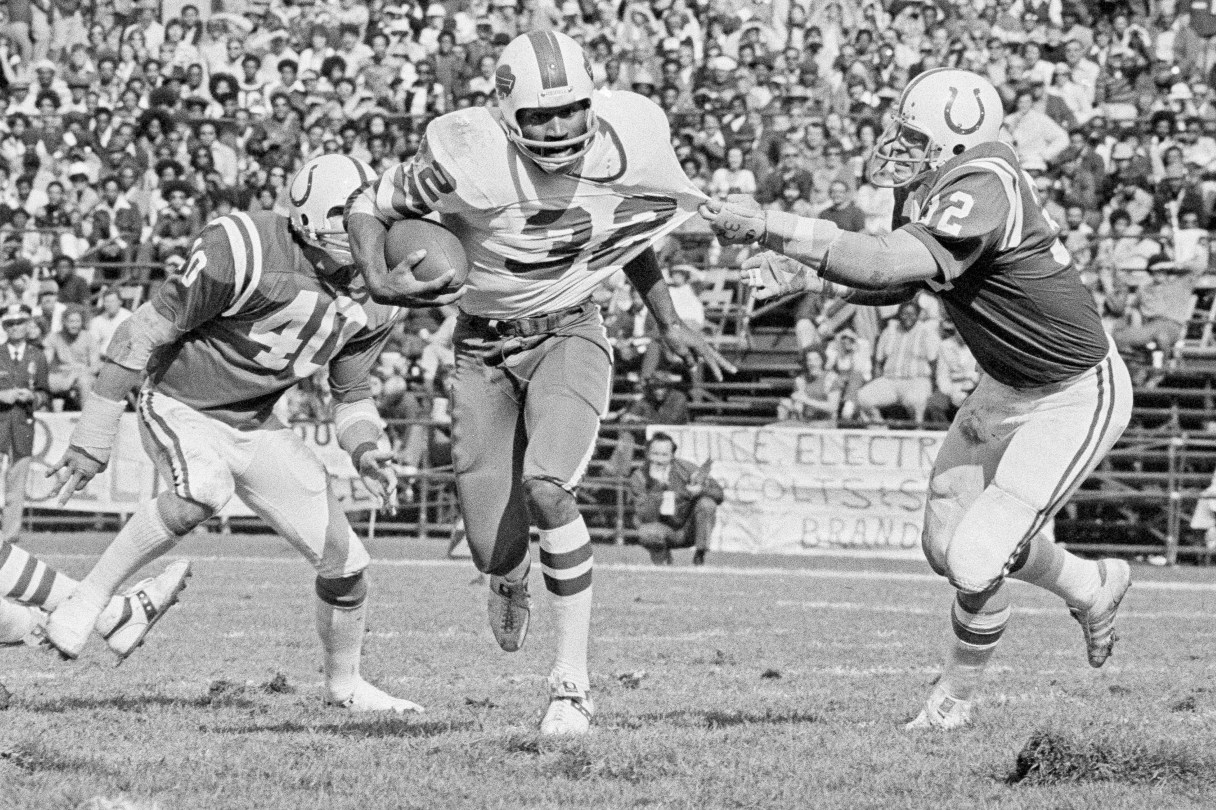
Long before the slow chase of a white Ford Bronco gripped a national television audience and the “Trial of the Century” captivated the country, O.J. Simpson was making his mark by speeding down football fields.
The Juice was the best running back of his era during an 11-year NFL career played mostly with the Buffalo Bills, setting records in the pros after he helped the University of Southern California to a national championship in the 1967 season and won the Heisman Trophy the year after that. But Simpson’s accomplishments on the field were overshadowed and his image was forever ruined by charges that he killed his former wife and her male friend in 1994. Though he was acquitted of murder, Simpson was later found liable for the deaths in a separate civil case.
Simpson’s tarnished legacy resulted in a muted reaction to news of his death Thursday at age 76. He wasn’t acknowledged publicly by the NFL, the Bills or the San Francisco 49ers, the team he played for in his final two seasons as he wrapped up his career in his hometown.
The Pro Football Hall of Fame issued a statement attributed to its president, Jim Porter, that read: “O.J. Simpson was the first player to reach a rushing mark many thought could not be attained in a 14-game season when he topped 2,000 yards. His on-field contributions will be preserved in the Hall’s archives in Canton, Ohio.”
Simpson’s name remains on the Bills’ Wall of Fame, which rings the inside of their stadium, but that could change when the Bills move into a new venue across the street that’s set to open in 2026. Fans previously petitioned the team to remove Simpson’s name from the wall.
Otherwise, there are very few reminders of Simpson’s time playing in Buffalo. No statues. Many of his teammates and friends have moved away or died.
“He and I had a bumpy start, and then we had a great relationship throughout,” former Bills defensive back Booker Edgerson told the AP. “Because he was a celebrity. And in his ways, he just didn’t understand. He was a young guy. He didn’t understand the game of professional football and what all the guys went through. He just didn’t react to the veterans as I thought he should have. Like, disrespect and everything.
“But once we got to know each other and everything, and then eventually when we became roommates for that one year, from that point on, he and I had a very good relationship.”
After his success at USC — he played his final two college seasons for the Trojans after two years at City College of San Francisco — Simpson didn’t initially live up to the hype and expectations of a No. 1 overall draft pick. He averaged 642 yards and four touchdowns in his first three seasons with the Bills, and some thought he would be a bust.
Then the arrival of coach Lou Saban in 1972 changed the trajectory of Simpson’s football career. Saban built Buffalo’s offense around Simpson’s skills, leading to his breakout.
The 6-foot-2, 212-pound Simpson ran more with grace than power, though he could push through defenders for that extra yard or two. He danced and juked, dodged and eluded tacklers, using his instincts to find open space that allowed him to use his speed to outrace the defense into the end zone.
Simpson rushed for 1,251 yards and six touchdowns in Saban’s first year with Buffalo. He followed up with one of the greatest seasons in NFL history, rushing for 2,003 yards and 12 scores in 1973, which led to him being voted league MVP.
He accomplished that remarkable total in 14 regular-season games, and his record average of 143.1 rushing yards still stands. Simpson topped 1,000 yards on the ground in each of his next three seasons, and 1975 was his best all-around statistical performance as he rushed for 1,817 yards and 16 scores and added 426 receiving yards and seven touchdown catches.
A knee injury ended his season early in 1977, and Simpson totaled less than 1,100 yards over his final two seasons in San Francisco.
The five-time All-Pro was inducted into the Pro Football Hall of Fame in 1985. By then, he was already a fixture on television as an actor, pitchman and football analyst.
Simpson first appeared in an ad for Hertz in 1975, and legions of sports fans knew him as the former player who dashed through airports wearing three-piece suits and holding a briefcase while hurdling railings on his way to the rental counter to secure his car. Simpson began acting during his time at USC, appeared in various roles on television shows while in the NFL and co-starred in several movies after retiring.
His promising on-screen career and everything else was halted after the murder allegations.
Hall of Fame guard Joe DeLamielleure was a rookie with the Bills during Simpson’s record-breaking season and became an important member of an offensive line known as “The Electric Company” that paved the lane for the big back to run free.
Simpson had matured as a teammate by the time DeLamielleure met him, aided by guidance he received from Edgerson and other veteran players who helped him find his way.
“He was like a star to us, even back then,” DeLamielleure told the AP. “He was like an icon even back then. … But I’ll tell you what, he was never cocky. He worked hard in practice. … He was just one of those guys who was bigger than all of us. But he hung with everybody. Very humble to football players and very respectful to the offensive line, because he’s a guy who shined a light on the offensive linemen throughout the league. He was a special person, a special player. … I watched Pete Maravich play. I also saw Muhammad Ali box. … Holy cow. But I was privileged to play with him.”
In the end, however, Simpson is remembered more for the murder trial than his football accolades.