
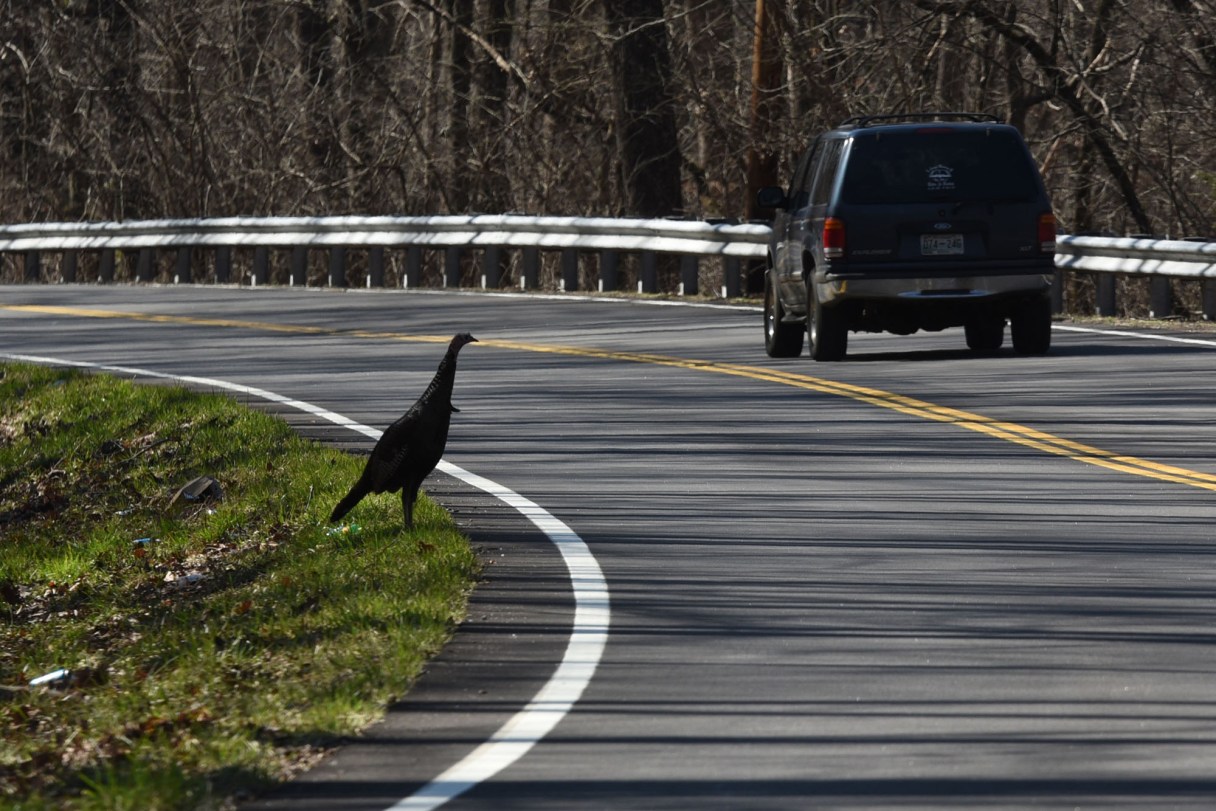
I knew I had about as much chance of calling in this turkey as I did of winning the Kentucky Derby. The guy I was guiding on this day — a nice guy from Virginia and a real turkey hunter (I don’t think he really needed me) — was reading my mind.
“He just doesn’t want to respond to any calling, does he?”
I hated to agree with him, but the answer seemed obvious. For the past three hours, we had been chasing/following this aggravating gobbler around a big chunk of real estate on the Virginia-West Virginia border.
When I say chasing or following, turkey hunters will know what I am talking about. This gobbler was doing his thing on what was probably a normal day for him. He had come off the roost at 6:27 in the a.m. I know ’cause I looked at the time when we heard the big reprobate come flopping off the limb where he had spent the night. (I was really hoping it was going to be the last time he did this.)
The major problem, of course, is we also heard about four or five of his girlfriends come off the roost at the same time. This meant he would have plenty of feminine companionship when he hit the ground and started his morning.
With no thought of getting coffee, a bowl of Wheaties or a buttered croissant, this gobbler immediately started following his lady friends around the hillside. He would occasionally (rarely) answer one of my pleading calls, but there was no way in the world he was going to turn and come our way. Turkey hunters out there are very familiar with this scenario: The turkey you are chasing will occasionally feign interest in your calling, but really there is no way in heck he is going to leave his girlfriends and come to you and be decently shot. Sometimes there is no justice in the world.
(READ MORE: For the slumping turkey hunter, gobblers’ silence isn’t golden)
On one of the many delays we had, sitting in the woods waiting to hear a distant (too distant) gobble from this turkey, I began to think about the different personalities of the gobblers we run into while out in the spring woods.
The silent turkey that lets you walk right under him on the roost.
Hunters know this form of awful turkey awfully well.
It is a beautiful bluebird morning, the songbirds are performing their version of the “Hallelujah Chorus,” and spring is showing in all its glory.
It’s one of those mornings when you would expect to hear turkeys gobble up on every knoll, hill and ridge, as well as down in every valley. (You know, like in the good ol’ days.) So you do your hoot owl call every 200 yards, then switch to your best rendition of sexy hen calls.
Yet you get nothing, zip, it is as quiet as the inside of Grant’s Tomb. (I’m told it is quiet there).
You round the bend in the woods road you are walking (it is now about 8:30 a.m.), and while passing a large red oak tree, you hear it — the sound that gives all turkey hunters a desperate, sick feeling. The flop, flop, flop of a 20-pound turkey as he crashes through the foliage, heading for parts unknown.
Why would any gobbler still be sitting there this late in the morning? Why did he not say anything to all the calling he heard you doing for the past 500 yards as you approached? Why?
No one knows. Not even the turkeys.
Turkeys that gobble their fool heads off one day, then are absolutely silent the next.
I have never understood this one.
You are in a place and discover a couple different turkeys, or more, that are gobbling good, and I mean really good. You make a call, they gobble. A crow flies over and caws a couple of times, they gobble. You slam the truck door, yes, they gobble.
You figure when you return in the morning, it is going to be awful for the turkey clan because at least one of them is going to ride home with you. The next morning, guess what? That’s right, utter silence. You would not think there is a turkey in a thousand miles.
Why do they do this? They don’t even know in heaven.
The turkey that comes charging toward you while you are calling, then shuts up and disappears.
Again, turkey hunters with lots of experience know this one.
You have the gun up, pointed in the turkey’s direction. He is hammering a gobble back at you every time you call. He is not in sight yet but has crossed the 50-yard line. You have the safety off and are envisioning pulling up to your buddy’s house and showing off this turkey.
One more thundering gobble that almost blows your hat off, and then that eerie silence again.
When he goes about five minutes and doesn’t gobble again, you know something is up. You sit and sit, the gun barrel starts to wobble, and you know it’s over.
What happened? Coyotes? You know you did not move and spook this turkey.
It is a mystery. I hate mysteries. I have no answers.
(READ MORE: Honestly, sometimes turkey hunting is just plain hard)
Well, there you have it. If you are a turkey hunter, you will know all of these birds.
If you are not a turkey hunter, I thought you might want to hear about all this.
And to John, who had to suffer with me chasing that snooty turkey we began with, well, I hope the next time you come back to Paint Bank, they will give you a good guide (not me).
“Guns & Cornbread” is written by Larry Case, who lives in Fayette County, W.Va. You can write to him at larryocase3@gmail.com.