
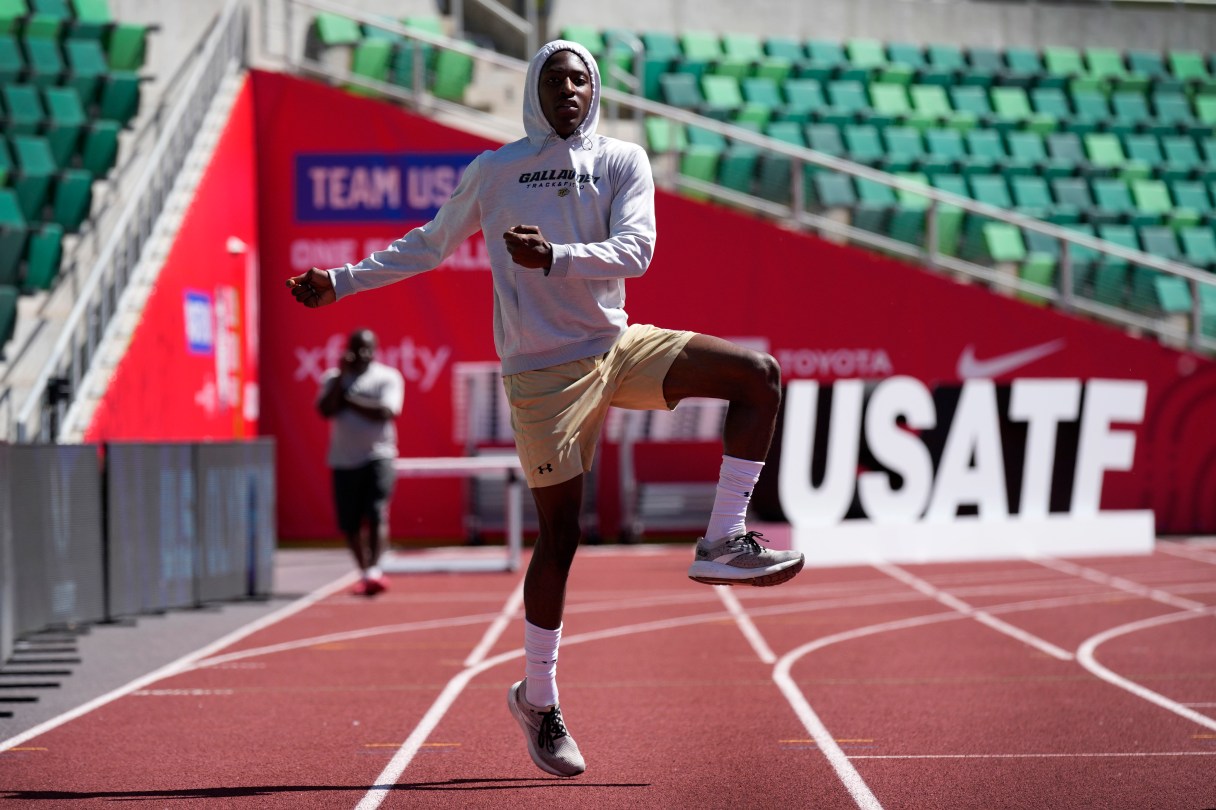
EUGENE, Ore. — When Eric Gregory crouches into the starting blocks, his coach will be right next to him.
It’s the best way for the 400-meter sprinter to ensure a fast start — because Gregory can’t really hear the starter’s commands or sometimes the starter’s pistol.
Gregory lost a majority of his hearing as a kid. So he waits for his coach, Byron Moore, to signal commands from a lane usually to his right, and a shout of “Let’s go!” after the pistol.
The system is working to perfection. Gregory is coming off his third straight NCAA Division III national title competing for Gallaudet University in Washington, D.C. He earned spot No. 35 out of 35 in the 400-meter field for the first round Friday at the Olympic trials for the U.S. track and field team that will represent the country next month in Paris.
To make it to Eugene, though, was only part of his plan. He’s eager to make a big impression.
“The only way people are going to respect us or look at us and see who we are is we’ve got to put in the work,” Gregory said in an interview conducted with the help of his coach and Sam Atkinson, Gallaudet’s associate athletic director for communications. “Just because we can’t hear, it doesn’t mean we can’t do. We have feet, we have hands, we can smell, we taste, can see, it doesn’t matter. You’ve got to do it.”
Gregory grew up in Louisiana and started losing his hearing when he was around 5 years old. Gregory said the reason isn’t known: It could’ve been due to an illness. Or it could’ve been the result of a childhood accident when he and his brother were wrestling and he fell on his head.
He has 25% hearing in his right ear and 35% in his left. He wears hearing aids, but not typically in a race. Because if the wind is blowing, it distorts any sort of sound.
That’s why he relies on Moore, the coach at Gallaudet, a global leader in the education for deaf and hard of hearing students. Moore got a heads-up on Gregory from Tony Tatum, a standout football player at the school who now works on the recruitment side for students and athletes. Tatum told Moore about this high school runner he might want to check out.
Already fast, Gregory just kept getting faster under Moore’s supervision. Gregory set the U.S. deaf collegiate record in the 400 with a time 45.73 seconds at the Division III national championship meet last month in Myrtle Beach, South Carolina. That time had a chance to earn him a lane at the Olympic trials.
“I looked at the list last week, and it said, ‘Accepted,”” said Moore, who said he’s been told he will receive a special credential to get him on the track. “My whole body started shaking.”
Gregory will be in the second lane on Friday in the second of five heats. The final is Monday, with the top three making the U.S. Olympic team for the Paris Games.
“We all want to see success come from this weekend,” Moore said. “Not just a thing where it was a publicity stunt or a mercy acceptance, but the fact he can come in here and do well, that’s the goal.”
The coach and sprinter are in sync on the track. For the “On your mark” command, Moore raises his hand and waits for him to get into the blocks. He puts his hand down to eye level. On “Set,” Moore pulls his hand back. Gregory then waits for the pistol to sound before leaving the blocks with Moore yelling, “Let’s Go!” to spur him on. The only hiccup is if an electric starting sound is used instead of a starting pistol. That’s hard for Gregory to hear.
The tandem have been told that at trials a starter’s pistol could be used for his heat. If not, Moore will be there to assist. For some of his athletes, Moore will pound the track at the start.
The only time the start has been a real challenge was during a meet in Gregory’s freshman year, when the runner didn’t get into a set position — crouching into the blocks — because he didn’t hear the command. The race went off anyway.
“Had a few words with the starter after that,” Moore said.
Gregory was adamant that he’s not operating from a disadvantage in an event where fractions of a second can make all the difference.
“If you can do it, you can do it,” Gregory said of running fast.
All he wants is a lane and a chance to compete against the likes of Michael Norman, the 400 champion at the 2022 world championship meet at Hayward Field, the same venue that’s hosting the trials.
“I’m racing with the big dogs,” said Gregory, who wants to follow in the footsteps of Moore and become a coach one day. “I’m racing somebody that’s able to put me in a position to grow and learn and get better.”
Gregory studies video and races all the time, sending clips to Moore at all hours of the night.
“He worked hard to be here,” Moore said. “He deserves to be here among these great athletes. He’s ready to show the rest of the world what he can do.”