
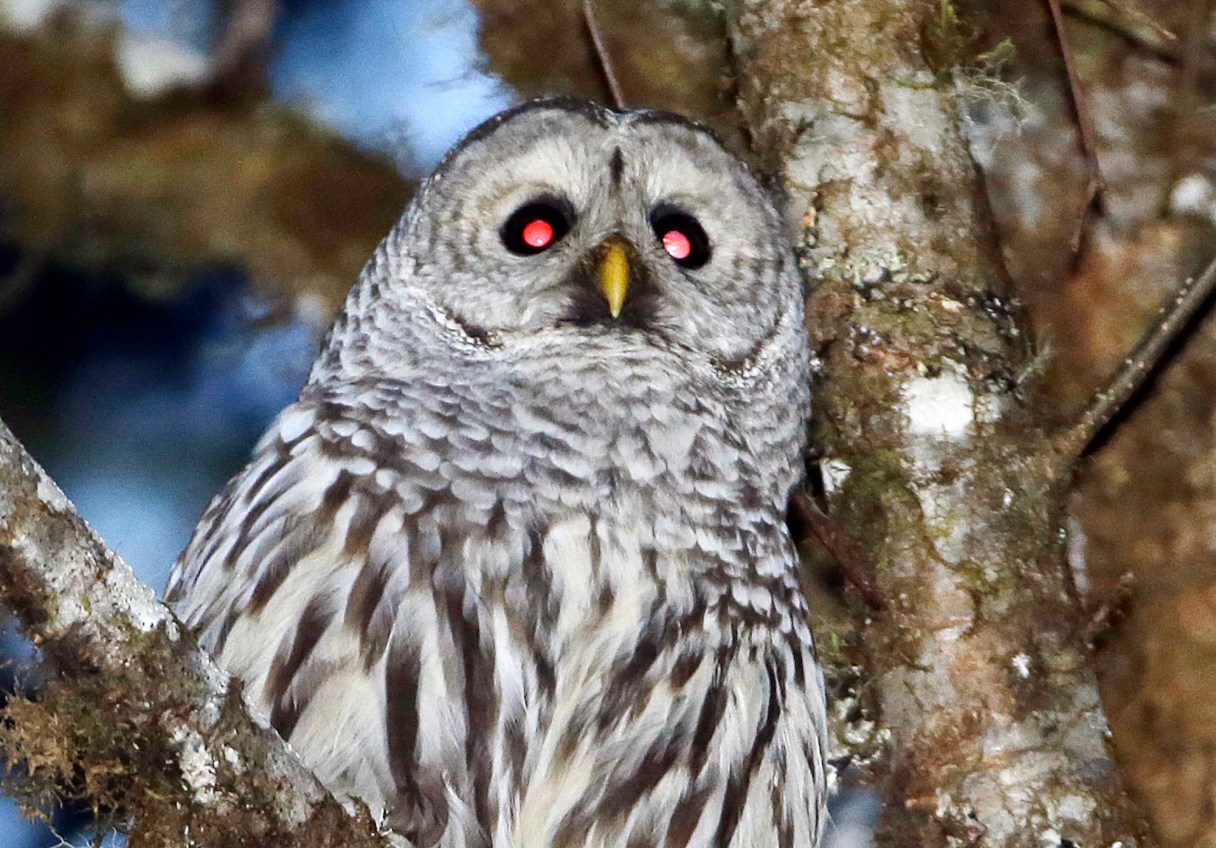
It’s routine practice for government officials to kill animals deemed invasive or destructive. For the most part, Americans accept this or look the other way — especially if the “pests” are insects, rodents or garden-munching deer. That’s changed now that the Fish and Wildlife Service plans to shoot thousands of owls in California, Oregon and Washington.
The species on the hit list is the barred owl — a creature whose adaptability has enabled it to spread into new areas. This expansion is driving the increasingly rare spotted owl to extinction.
This isn’t just natural selection in action. All over the world, human activity has changed landscapes so fast that the diversity of plants and animals is collapsing. In an attempt to stop this, authorities around the world are protecting coral reefs by killing starfish, protecting salmon by killing sea lions, and protecting red squirrels by killing grey ones.
Field experiments show that shooting barred owls can stave off the decline of the spotted owl, but there’s no end point. The current plan under the Fish and Wildlife Service would go on for 30 years and kill up to half a million owls — but it’s understood that the shooting would have to go on forever to save the spotted owl.
In the 1980s and 1990s, environmentalists used the spotted owl’s status under the Endangered Species Act to argue that a fraction of the old-growth forest in the Pacific Northwest should be protected from logging. They succeeded, but the spotted owls continued to decline — losing 80% of their numbers in the last 30 years.