
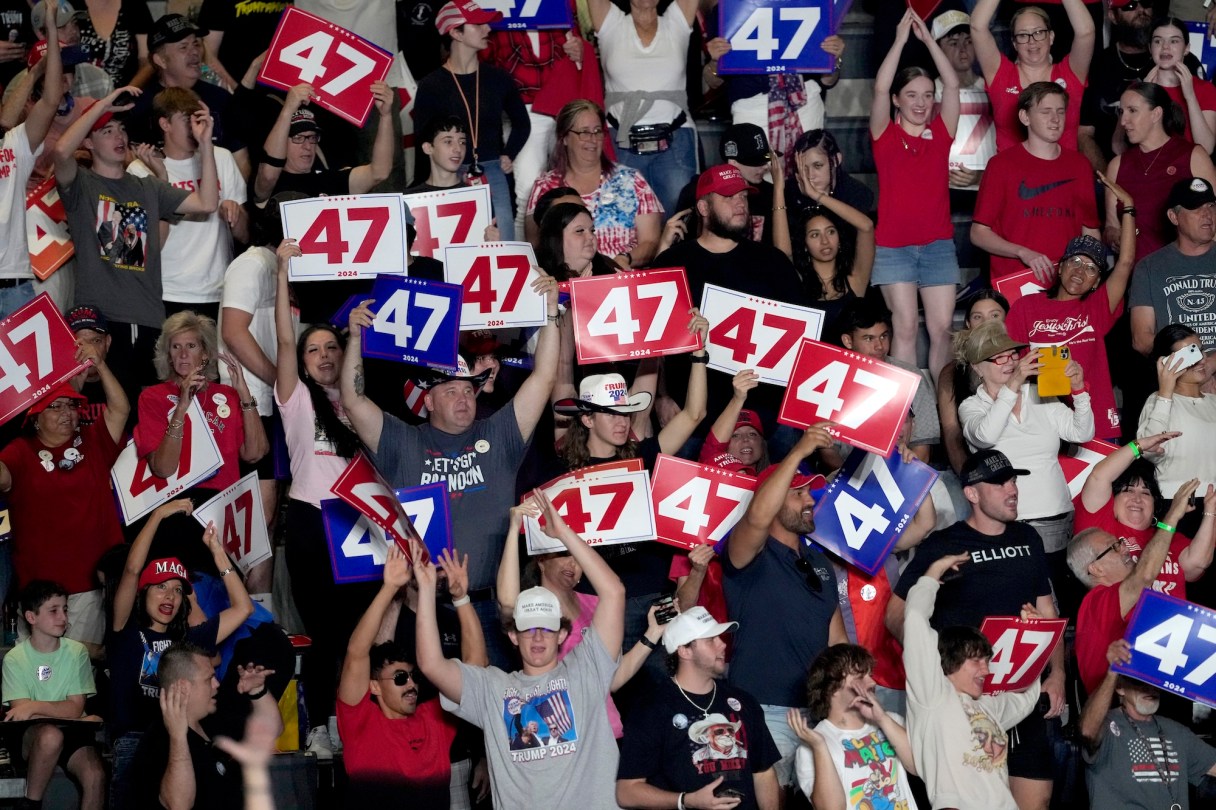
It was a simple social media post, critical of one of Donald Trump’s supporters, who justified his support with a bizarre misreading of the man and his motivations. But to be fair to the people on that side, I had to say that with our binary system, I could understand how someone could reasonably believe that he was a better choice than the alternative.
You can imagine the reaction. Trump was evil, and his supporters were evil. Had I said the same thing about Kamala Harris’ supporters with a different set of readers, the reaction would have been the same. That’s America now.
We are at the point in the election cycle when commenters start worrying about polarization, and readers who’ve been gorging for months on all the attack articles and ads start worrying that Americans have become too divided.
Elections in which voters have only two real choices polarize voters. The campaigns will try to make everyone feel they’re making a life-or-death decision, and people do get to feel that way, but in the past they tended to get over it.
But the mutual contempt now seems worse than ever, and now seems permanent. For one thing, it makes us feel good. Polarized people can be very happy with themselves, because what better sign of righteousness can there be than hating the devil?
Let’s go back to the kind of Trump voters I described. Let’s stipulate that many Trump voters are knaves. But let’s also stipulate that many are good people who are doing the best they can to do the right thing. (Both of which are true of Harris voters as well.)
What does someone do who is broadly in agreement with Trump’s policies, very much against Harris’, doesn’t believe Trump to be a true danger to democracy but does think that Harris is a danger to institutions and beliefs he values a lot? What does he do if he fully recognizes Trump’s defects and still thinks he’ll be better for America than Harris?
How, if he’s going to act with integrity, can he do otherwise than vote for Trump? You, in the same circumstances, would do the same.
The quandary he faces is like having to choose between the surgeon who flunked out of med school and the one who barely graduated and already has sky-high malpractice premiums. If you need the surgery, you’ve got to choose. You choose the one who actually graduated and hope for the best. That’s all you can do. You make the least bad decision, knowing it could kill you.
But, and this is part of democracy as well, your decision isn’t final. It’s made in a context, in a system. What you hope for is that the rest of the medical system will protect you.
You assume that other doctors are watching your surgeon, that the doctors and nurses in the post-op ward will look out for anything going wrong, and everyone else will make sure you recover — that all the long-established procedures protect you from the worst consequences of the bad decision you had to make.
Americans together can do that, if we want. If we’ll extend the respect democracy requires even to people we think make a huge mistake.
It’s a very big, very complex country, and very hard to subvert. As Trump found out.
In any case, democracy depends upon a kind of old-fashioned humanism. It isn’t easy. It takes some imagination to see how other people see the world, and some faith to hold the working assumption that they’re responsible and serious. It’s the orientation that modern democracies depend upon, trusting the truth will eventually win out.
It’s not something one would bet on, but it’s worked so far, and as Churchill famously said, it beats the alternatives.