
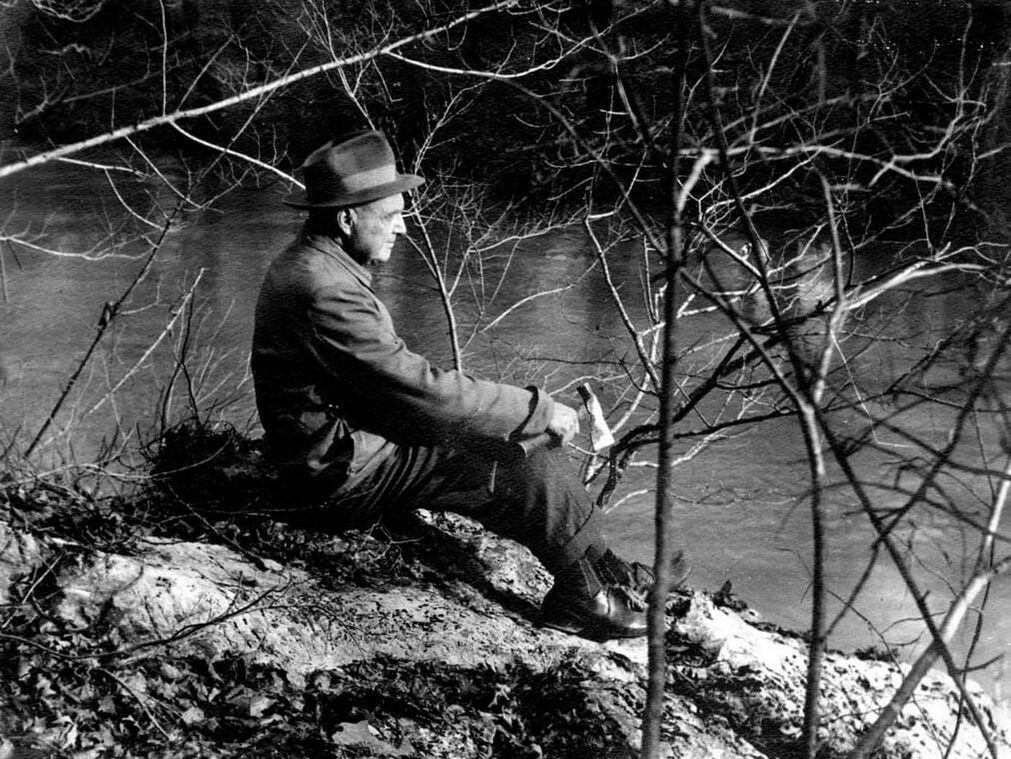
(Editor’s note: second in series)
In early 1947, an elm blight struck Chattanooga and the nation. It killed more than 3,000 beautiful trees in Hamilton County in less than two months. Lou Williams, chairperson of the Chattanooga Chamber of Commerce Forestry and Recreation Committee, consulted Robert Sparks Walker. The naturalist explained that the virus known as phloem necrosis, which was discovered in 1918 in Ohio, had slowly spread across the Upper Midwest and then swept much of the country. No known cure was available for its destruction.
Walker suggested planting willow oaks to replace the elms. Those “graceful but fine shade” trees could be “judiciously planted” in the hope that the elms might come back in the future. He explained that Chinese Chestnut trees were deployed to counter the American Chestnut tree blight that in the 1930s killed most of that species in the United States. Stressing the importance of trees in the natural landscape, especially in the foothills of the Appalachian Mountains, Walker hit upon another idea that could be advanced by the local Audubon Society.
The creation of special “literary acres” at the Elise Chapin Wildlife Sanctuary would help achieve two of Walker’s aims: a teaching center to help young students identify native trees and their distinguishing traits, plus as a preservation center to combat future attacks on nature. As the sanctuary expanded, shade-loving plants would be added to enhance strolls at the sanctuary.
The first tree planted was dedicated to Mrs. Francis King, the founder in 1928 of the Signal Mountain Garden Club and nationally acclaimed gardener, who retired to Alma, Michigan. In her letter to the local Audubon board, King wrote that she “appreciated the honor accorded her by the club more than the many medals she had received during her career as a garden club worker.”
Over the next months, additional trees were added to the grove.
In April 1947, a tree was planted and christened in honor of the fictional hero Holdfast Gaines in the novel of the same name co-authored by Pulitzer Prize winner Odell Shepard and his son, Willard O. Shepard. In accepting the honor, the elder Shepard stated, “As Holdfast Gaines was majestic and mighty and beneficent, so may this red oak become. As he strove to establish peace and amity between people of diverse regions and races, so may this oak be a living link between New England and the South.” A second tree was planted at the same ceremony and dedicated to special guest Austin F. Hawse, “nationally known conservationist” and former state forester for Connecticut and New Hampshire.
Shortly afterward, Professor Curtis Page of the University of Chattanooga joined the Audubon board to christen a hickory tree in honor of “Samson Occom, a full-blooded Mohegan Indian who was a founder of Dartmouth College in Hanover, New Hampshire, first established for educating the American Indian.” Lookout Mountain’s John H. Wheelock christened a tree for his ancestor, the Rev. Eleazar Wheelock, “who in 1750 founded Moor’s Indian Charity School at Lebanon, Connecticut … . Samsom Occom was a graduate of the Moor School.” The Robert Sparks Walker Audubon Society Board proclaimed in “its resolution” that the grove and Elise Chapin Wildlife Sanctuary would “pay tribute” to their Native American roots.
The next trees represented other distinguished Americans. In January 1948, Nash Buckingham, author of “Gems in the Outdoors Field,” as well as “Game Bag,” “The Tattered Coat,” “De Shootingest Gent’man” and “Ole Miss,” visited Chattanooga’s Martin-Thompson store, was honored at a luncheon hosted by the Chattanooga Times and escorted to the sanctuary. Robert Sparks Walker dedicated a tree in recognition of Buckingham’s writings “over a long period of years in the conservation of the country’s natural resources.”
Later in the autumn, Prudence Polk, Mrs. George Hillman and Chattanooga’s Laurence Polk participated in the planting of a tree in honor of their family ancestor, President James Knox Polk. Meanwhile, Mrs. Charles D. Lanier of Greenwich, Connecticut, widow of poet Sidney Lanier’s son, presided over the planting of a water oak in memory of the poet, who had visited Lookout Mountain. As a part of the commemoration, the widow read aloud Lanier’s “A Ballad of Trees and the Master.”
Walker’s idea was gaining acclaim. Robert L. Kincaid, president of Lincoln Memorial University in northeast Tennessee, wrote the resident naturalist, congratulating him on a “delightful sanctuary for the preservation of … nature’s glories.”
Linda Moss Mines is the Chattanooga and Hamilton County historian. For more on local history, visit Chattahistoricalassoc.org.