
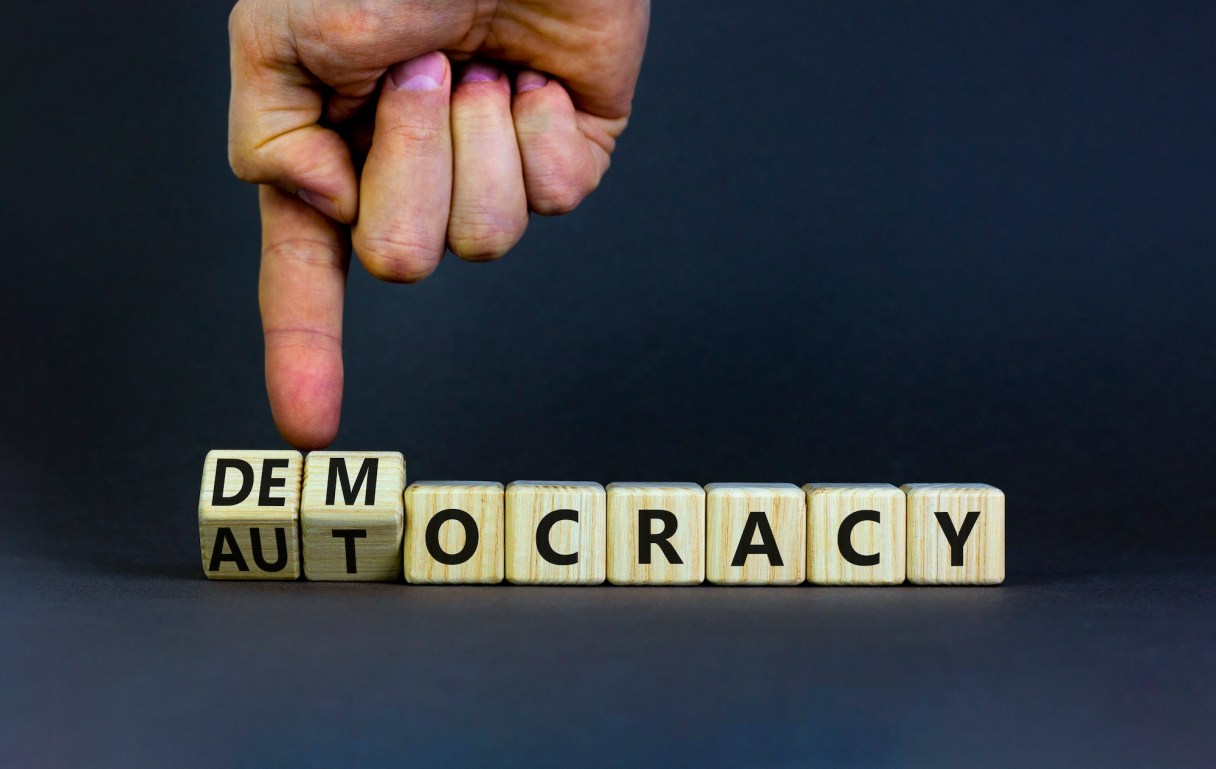
Let’s not sugarcoat it. If President-elect Donald Trump attempts what he has foreshadowed, we are about to enter the most challenging period of our 248-year-old republic.
At the same time, Americans remain an idealistic, compassionate people who believe in our Constitution, Bill of Rights, and principles of fairness and opportunity. And our country is one where a large majority support the institutional guardrails that undergird our system – the courts, an independent media, national and state legislatures as checks on executive power, a civil service that pledges allegiance to the rule of law rather than to an individual or ideology.
Concerns about everything from inflation to the so-called “deep state” underpin much of Trump’s support, but pollsters have also found that for many, democracy was also on the ballot this fall – not because they reject it, but because they feel it has failed them, their families and their communities.
In this view, Trump will not destroy democracy; instead, he will give it back to the people. This will turn out to be a mirage, but that is where we are. What, then, are we to do?
We want America to succeed
In the coming months, the right-wing echo chamber will reverberate with the phrase: “Being American means wanting the president to succeed.” Such a statement is both dangerous and un-American.
If Trump does as he has promised, his successes could actually mean America’s failure. Tariffs will likely increase the costs of imported goods by 20% or more. Cuts to Medicaid will challenge state budgets and affect the health of millions. Politicizing the Department of Justice to stamp out opponents will undermine the rule of law. The potential use of the military and our state national guards to conduct mass deportations will tear American families apart while disrupting key elements of our economy. Tax cuts will impose costs on future generations and make economic opportunity more difficult. Undermining NATO will embolden our enemies and make the world a more dangerous place.
We have a duty to oppose those policies and principles not because they emanate from Trump, but because they are bad for the country. And Trump’s support is not monolithic. While he retains zealots who will support whatever he does, many of the policies he will advance will draw fire from those who voted for him.
Checks and balances remain the heart of the American system. Ideas are to be vetted and policy constructed within this cauldron, and opposition is essential not only to successful policy but to America’s greatness.
Allegiance to the office – not the man
In our system, a president has certain prerogatives, including the selection of his Cabinet. But this power is not unfettered and leaves the actual appointments to the Senate. We call this “advise and consent,” and it provides a check and balance against political overreach. Trump’s win was no mandate (his popular vote margin was about 1.5%), and while democratic principles require acknowledgment of his victory, they do not command blind allegiance to the man.
Many of Trump’s Cabinet picks appear to be based more on loyalty than competence. The Senate should provide appropriate deference, but need not confirm any of them. Moreover, our elected representatives have a responsibility to thoroughly vet proposed appointees, and to insist on rigorous FBI clearance.
Multi-front opposition
American opposition to Trumpist approaches requires rejection of attempts to normalize his presidency while avoiding catastrophizing about its potential result. Much remains about which we should worry, but we cannot let this sap our energy; otherwise, it becomes easier for the grifters to have their way. Opposition will neither be easy nor time-limited.
With Trump in control of the executive and legislative branches, this feels like a Herculean task. But remember that our political system remains complex. Lawsuits can counter illegal executive orders, and presidents cannot pass legislation simply on their own. On the day Trump takes office, he will be a lame duck and will find that even his legislative allies have a keen sense of political survival that may prove to be a formidable obstacle to plans that can hurt their constituents. Actions that frustrate his agenda may be subtle and not generate large headlines, but they will occur.
Opposition will occur in many states as well. Trump’s plans for mass deportation, for example, can only succeed with massive support from law enforcement. But what happens if he attempts to federalize national guards typically under the control of governors, either to send them to the border or conduct raids of workplaces and homes? Governors will immediately be placed on the hot seat. Will they voluntarily relinquish their authority to the national government to permit their constituents to be used to round up families to be sent back to Central America?
Our time of challenge
Martin Luther King Jr. said that the “ultimate measure” of people is not where they stand “in moments of comfort and convenience,” but how they respond to a challenge. That challenge is now upon us, and finding your niche within these groups can, as King said, “build dikes of courage to ward off the flood of fear.”
David Toscano, an attorney and a former Democratic leader in the Virginia House of Delegates, is he author of “Fighting Political Gridlock: How States Shape Our Nation and Our Lives.”