
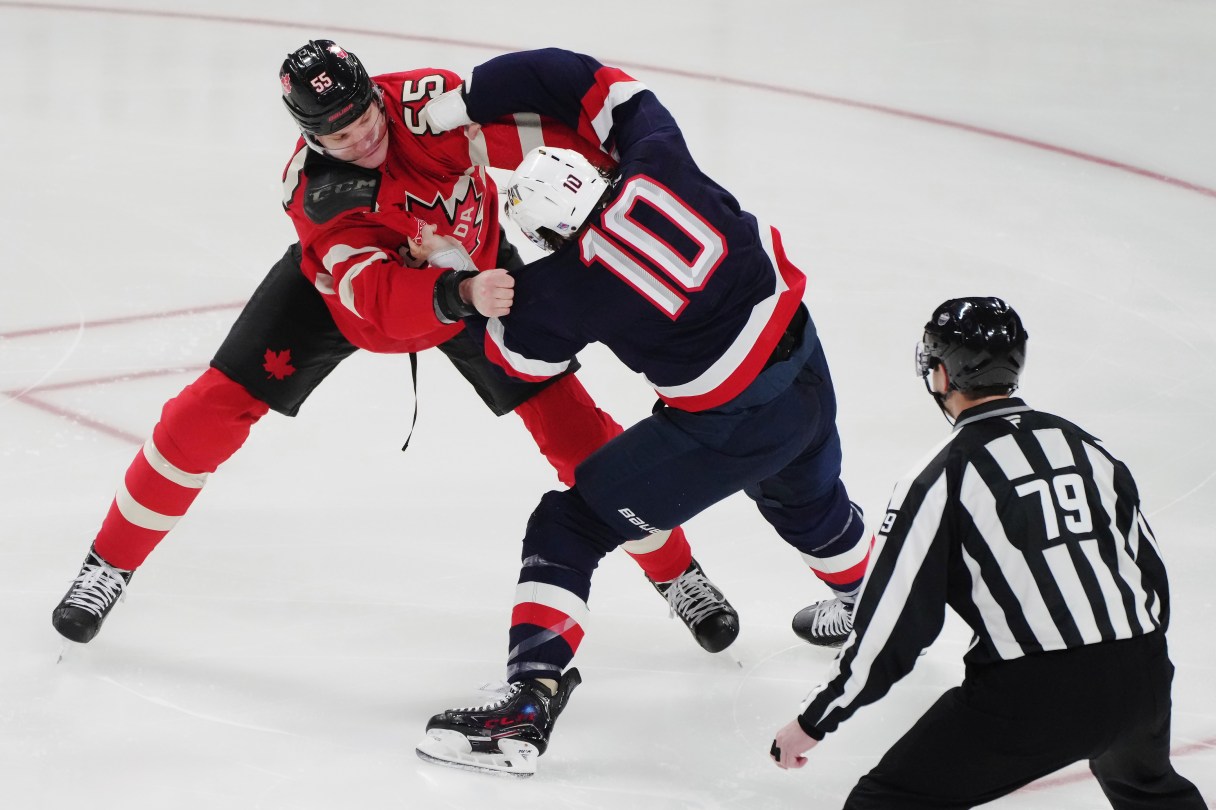
BOSTON — The men’s hockey teams for Canada and the United States tried to skate back the geopolitical tension that has infiltrated the 4 Nations Face-Off as they looked ahead to Thursday night’s championship game of what has turned into one of the sport’s best international tournaments in decades.
Setting aside the animosity that has been building between the two countries over tariff talks, national anthems and annexation, the players and coaches said they wanted to leave their fans with an appreciation for the game like the one they picked up from iconic events such as the Americans’ “Miracle on Ice” victory over the Soviet Union at the 1980 Winter Olympics in Lake Placid, New York.
“That event in USA Hockey inspired a generation of players: my generation,” said U.S. coach Mike Sullivan, who was 11 when the Americans won gold with victories in the medal round against the Soviets, 4-3, and (two days later) Finland, 4-2.
“I think this group that we have in our dressing room an opportunity to do that and inspire the next generation. And I think they recognize that,” added Sullivan, who followed several of the U.S. Olympians to Boston University before an 11-year NHL playing career and two decades more as a coach. “Without a doubt, that 1980 team, still to this day, has had such an influence on American hockey.”
After sitting out the past two Winter Olympics, the NHL’s best returned to international play this month for a tournament that replaced the league’s All-Star Game, a midseason exhibition that mattered little and was treated by the players as such.
Instead of that, Canada, Finland, Sweden and the U.S. all sent their stars this winter. And something happened once they started playing for their countries: The hockey has been historic, especially the fight-filled round-robin matchup between the North American teams Saturday that was TV’s most-watched hockey game in a decade outside of a Stanley Cup Final.
“Anybody that thought they were going to come in here and see an All-Star Game was sorely, sorely mistaken. This has been anything but,” Canada coach Jon Cooper said Wednesday. “It’s been all-stars, but it’s not been an All-Star Game.”
Add in the cross-border tension after U.S. President Donald Trump’s tariff war and his calls for Canada to be made the 51st state, and the tournament has much of the flavor of the Cold War meeting that surrounded the Americans facing the Soviets four decades ago in Lake Placid.
Canadian fans loudly booed the U.S. national anthem Saturday night in Montreal. Monday night in Boston, when the TD Garden public address announcer called for respect, the payback for “O Canada” was tepid; instead, the Americans belted out “The Star-Spangled Banner” at full throat.
“All that stuff, throw it all out the window. It’s one game here, and one game for everything,” U.S. forward Matthew Tkachuk said. “Our team’s helped grow the game here in this country already. And I think a win can just knock that door right down and open up a whole new wave of hockey players throughout the whole country.”
Canadian forward Brad Marchand, who plays for the Boston Bruins and will be skating on what is ordinarily his home ice in the NHL, dismissed the political angle, saying the hockey was good enough to sell itself. He recalled watching in his family’s basement when the Canadians beat the U.S. in the gold medal game of the 2002 Salt Lake City Olympics.
And he hopes some kid in Nova Scotia was watching when the Americans and Canadians matched up Saturday in Montreal, or when they do again Thursday night in Boston.
“This will be another memory, another core memory for a lot of a lot of kids growing up, a lot of hockey fans for both American and Canadian players — and probably kids all across the world,” he said. “So it’s a gift and a privilege to play in these games. And definitely one you don’t take for granted.”
The Americans’ 3-1 victory earlier in the tournament began with three fights in the first nine seconds, then settled into a fast-paced clinic that ranks among the top games in international hockey history.
The sequel “feels bigger than that,” Tkachuk said.
“It’s going to be an incredible environment,” he said. “Obviously, wearing the jersey and representing your country is such an incredible honor and what we play for. But the opportunity that we have is something that I don’t even think we thought was possible and what we could create.”
That’s what compelled Ted Sells to drive some five hours from his home in Gull Lake, Saskatchewan, to a 12-hour flight through Calgary and Dallas to get to Boston for the title game. He wandered through the TD Garden pro shop looking for Canadian gear and saw none; a clerk told him they were sold out.
Sells said he hoped the teams could set aside the politics and just play hockey.
“Everybody has their team and their favorite,” he said. “But they shake hands at the end. And that’s good.”
Across the store, James Kopacki said he had no animosity toward the Canadians; he was deciding whether to buy his wife, a Bruins fan, a Marchand jersey. The U.S. Navy veteran came up from Fort Worth, Texas, to watch the game in person, buying tickets for the final after watching on television as the Americans beat Canada in the round-robin showdown.
“That game turned out to be so good. That’s why we’re here,” he said. “I’ve never seen a game like that, as far as the tension and the desire to win. And not just that: the tension between our countries.”
Kopacki said he spent $1,500 on the tickets and admitted he has been monitoring the price as the hype increases.
“If the tickets reach $5,000,” he said, “then we’re going to sell them and go to a bar in Boston and watch for free.”