
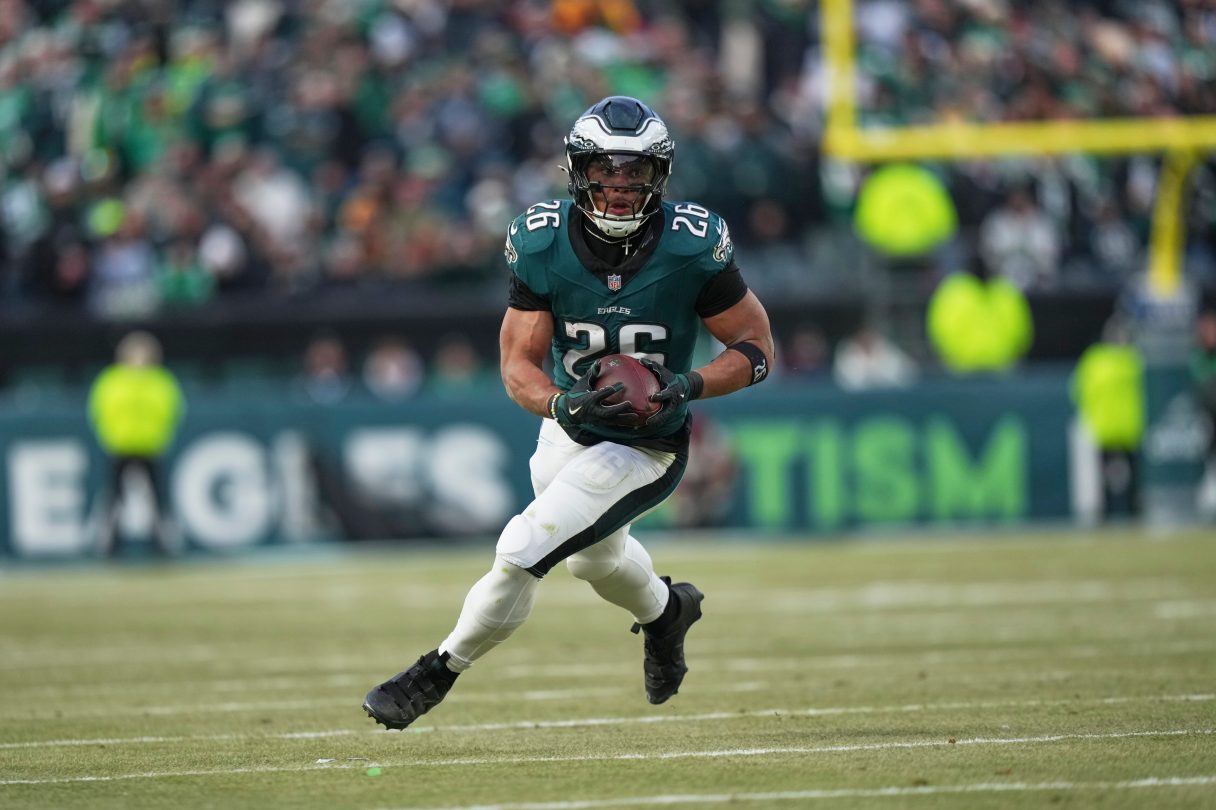
The offseason addition of Saquon Barkley helped elevate a sluggish offense for the Philadelphia Eagles and has led the team to Super Bowl LIX.
The NFC champions will face the AFC’s Kansas City Chiefs, who are seeking an unprecedented third straight Lombardi Trophy, on Feb. 9 at the Superdome in New Orleans (6:30 p.m. on Fox).
While building teams through the draft is still the most desirable avenue for success in the NFL, free-agent additions have played a major role for several Super Bowl teams since unrestricted free agency came to the NFL in 1993.
If Barkley can help the Eagles what would be just the second Super Bowl title in franchise history, he will join a list of stars who helped their teams win NFL titles after signing big free-agent deals.
Barkley posted one of the most prolific seasons ever for a running back after signing a $37.75 million, three-year contract in March, having joined the Eagles after spending his first six NFL seasons with the New York Giants, one of Philadelphia’s division rivals in the NFC East. He became the ninth NFL player to rush for 2,000 yards in a regular season, set a league record with seven touchdown runs of at least 60 yards in the regular season and playoffs, and needs 30 yards rushing to break Terrell Davis’ record of 2,476 yards set in the 1998 season for most ever in a season, playoffs included.
Here’s a look at some of the most impactful free agents on Super Bowl championship teams over the past three decades.
Reggie White, Green Bay Packers
The first major unrestricted free agent left Philadelphia before the 1993 season and helped build a powerhouse in Green Bay. White, a prep star at Chattanooga’s Howard and a college standout for the Tennessee Volunteers, was the NFL’s most dominant defensive player for most of the 1990s and turned the Packers into a perennial contender. Green Bay ended a 10-year playoff drought in White’s first season for the Packers, made it to the NFC title game in his third year, then won the title in his fourth.
Deion Sanders, San Francisco 49ers and Dallas Cowboys
After playing his first five seasons for the Atlanta Falcons, “Prime Time” played a major part in two Super Bowl titles starting when the star cornerback joined San Francisco in 1994 as part of a major spending spree. After winning four titles in the 1980s, the 49ers lost to Dallas in back-to-back NFC title games in the 1992-93 seasons, creating a sense of urgency for notoriously impatient team owner Eddie DeBartolo.
The investment in Sanders played immediate dividends. He had three interception returns for touchdowns on the way to winning defensive player of the year in 1994 and had interceptions in the NFC title game win over the Cowboys and Super Bowl win against the San Diego Chargers.
Sanders left after that season and joined the enemy, signing with the Cowboys. He helped deliver a Super Bowl title his first season in Dallas as well.
Drew Brees, New Orleans Saints
Brees showed flashes early in his career with the Chargers but was deemed expendable after the 2005 season with San Diego set to turn over the offense to 2004 first-round draft pick Philip Rivers.
Brees was coming off shoulder surgery that scared away the Miami Dolphins, and he wound up signing with New Orleans. The Saints had won one playoff game in their history before Brees arrived, and their viability in New Orleans was in doubt after the damage from Hurricane Katrina. Brees helped solidify the franchise’s long-term status by leading them to the NFC title game in his first year and winning it all in his fourth season.
The shoulder injury proved to be of little concern as Brees spent 15 years in New Orleans before retiring as one of the game’s most prolific passers.
Charles Woodson, Packers
After the big-splash signing of White in the initial class of unrestricted free agents, the Packers were much less aggressive the following decade. However, they did step up to sign Woodson after the standout defensive back left the Oakland Raiders after the 2005 season.
Woodson revived his career in Green Bay and was the league’s defensive player of the year in 2009. The next season, he helped the Packers win their fourth Super Bowl title despite exiting late in the first half with a broken collarbone.
Peyton Manning, Denver Broncos
After leading the Indianapolis Colts to the Super Bowl title for the 2006 season and becoming one of the game’s top quarterbacks ever, Manning needed to look for a new home in 2012. A serious neck injury forced him to miss the previous season and led the Colts to turn the team over to rookie Andrew Luck.
After a free agency tour, Manning opted to sign in Denver in a move that paid immediate dividends. In four seasons with the Broncos, Manning won two NFL MVP awards, led the Broncos to two AFC titles and won Super Bowl 50 to cap the 2015 season. It was his final game before announcing his retirement.
Tom Brady, Tampa Bay Buccaneers
After winning a record six Super Bowl titles in New England, Brady and the Patriots broke up after the 2019 season. While the Patriots haven’t come close to getting back to the title game, their former quarterback got there in his first season in Tampa Bay after throwing for 4,633 yards and 40 touchdowns in his first season.
Helped along by the addition of tight end Rob Gronkowski, one of his favorite targets in New England, Brady helped the Bucs end a 12-year playoff drought and won his seventh Super Bowl ring, knocking off teams quarterbacked by Brees (Saints), Aaron Rodgers (Packers and Patrick Mahomes (Kansas City Chiefs) along the way.