
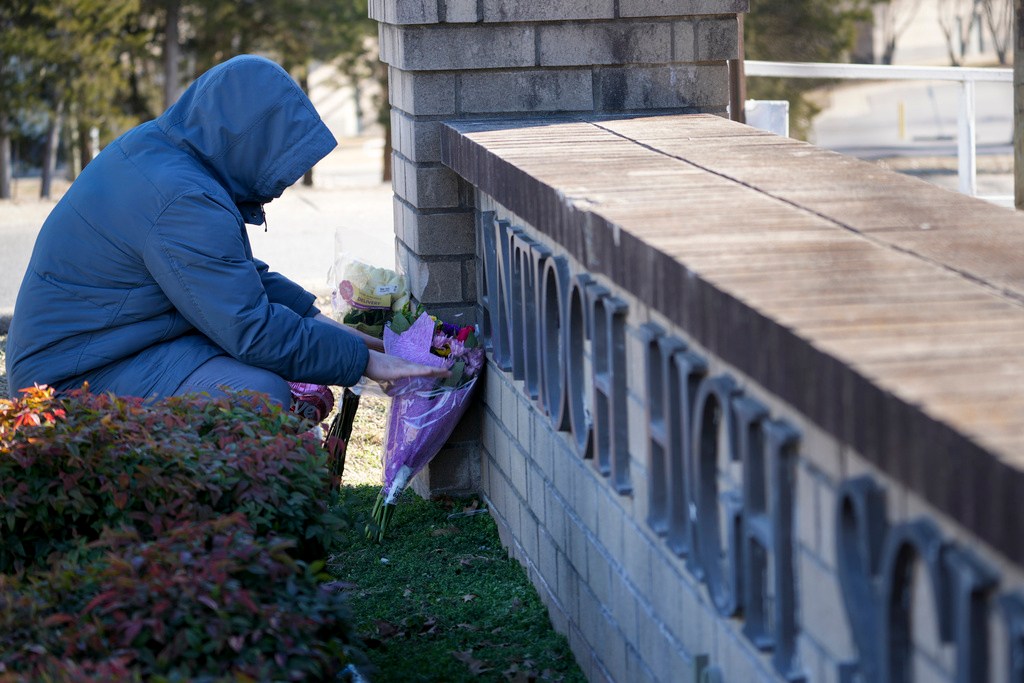
After the deadly shooting at Antioch High School in January, many came forward to say that such violence is not OK.
“For years, I’ve done nothing but try to prevent such a thing from happening to me,” said an Antioch High School senior who said she had been to the Capitol twice before the shooting at her school to protest. “Once again, on Jan. 22, an unruly gunman entered another school with an illegal firearm. Not only was it just another school, it was my school, my safe place. To those in charge of keeping my safe space safe, I do not forgive you.”
But has the momentum after such tragedies changed over time?
Instead of calls for red flag laws, a ban on assault weapons or even background checks, the main focus from advocates, students and politicians alike immediately following the Antioch High School shooting was school security and mental health. This is a major tone shift from seven years ago, when a man opened fire inside a Nashville Waffle House, killing four people. Even just two years ago, when a shooter killed three children and three adults at The Covenant School, the immediate response was swarms of people at the Capitol calling for gun laws.
The specific details of each incident are relevant to the response they inspire — whether the shooting takes place in a school or not, and how many people are killed. But previously, a common thread was that they reliably led to calls for more aggressive restrictions on guns. Now, with a Republican supermajority in the state legislature seemingly uninterested in passing even the most minor of gun laws, that seems to have changed.
One of the people who has made those calls is Maryam Abolfazli. She was a volunteer with Awake TN and one of many who spent a lot of time at the Capitol after the Covenant shooting. Her fight for safety for Nashville kids led her to run, ultimately unsuccessfully, against Republican U.S. Rep. Andy Ogles to represent Tennessee’s 5th Congressional District in 2024.
“Maybe one day in a blue moon we’ll get things like safe storage, and those kind of incremental marginal — but important — things,” Abolfazli said. “But in the meanwhile, kids are getting killed.”
Following the Antioch shooting, there were student-led rallies held at the Capitol and local schools, albeit with dialed down intensity compared to the response to the Covenant School shooting.
Efforts focused on more community-based initiatives, such as a snack drive that made over 2,000 care packages for Antioch students, and how to care for kids mentally, emotionally and with practical resources. Abolfazli said action like this could go a long way in making a difference, especially in a place like Tennessee.
“We’re not allowed to talk about mental health because then that arms the GOP,” Abolfazli said. “But I’m done not talking about it because it’s not getting us anywhere anyways, we’re not getting the bills we want anyways.”
In all of these cases, as with most shootings around the country, the shooters’ mental health became a central concern. But overall, reactions around the city to the Antioch shooting have made one thing clear: the focus of how to stop gun violence is no longer on guns.
WAFFLE HOUSE
The recent discourse has been notably different from what came after 29-year-old Travis Reinking walked mostly nude into an Antioch Waffle House, opened fire with an AR-15 and killed four people on April 22, 2018.
Then-Mayor David Briley took to social media the following day with this message: “Let’s be honest about what happened. The citizens of Nashville were terrorized last night by a man with an AR-15. Enough is enough.”
Then-U.S. Rep. Jim Cooper, a Democrat, also called directly for gun control.
“Many will say now is not the time to discuss change,” he said in a statement to the Nashville Scene. “But now is the time. We can and must do everything possible to prevent these tragedies and keep Americans safe. That starts with restricting widespread civilian access to military-grade assault weapons.”
District 60 Democratic Rep. Shaundelle Brooks’ 23-year-old son, Akilah Dasilva, was killed in the Waffle House Shooting. At the time, she was not yet involved in politics, but the tragedy inspired her to dedicate her life to advocating for gun control and preventing similar shootings. She spent years testifying to Tennessee’s state legislature and to federal lawmakers in D.C., and five years later, she was one of the most prevalent faces at the Capitol after the Covenant School shooting. In 2024, she won her election to the state house, making gun safety her top priority.
COVENANT SCHOOL
On March 8, 2023, a former student killed three elementary school students and three adults before being killed by police at The Covenant School.
For weeks after, thousands of people gathered at the state Capitol to call for gun law reform.
“There was a lot of momentum,” said Alice Ornes, a 16-year-old sophomore at Hume-Fogg Academic High School. “I really felt like we had the capabilities to make a change, because there were so many of us, and so many people from my school walked out right after Covenant, and I just felt like we had so much power because of our numbers. I felt like we were all united because we all wanted the same thing. We all went to prevent gun violence.”
Ornes, who was in middle school during the Covenant shooting, is now president of the Hume-Fogg chapter of Students Demand Action. Nearly every day for weeks following the Covenant shooting, Ornes, students like her, parents and teachers crowded into the capitol calling for change. Tensions were high, especially in the state house, where Speaker Cameron Sexton had multiple protesters removed, sections of the gallery were closed to the public and two Democratic representatives were removed from office before going on to regain their seats.
But despite all of the action, no substantial gun law reforms came of it.
Advocates’ hopes were reignited when Gov. Bill Lee, whose wife lost a close friend in the Covenant School shooting, called a special session in August 2023 to address firearms legislation. Four bills — one addressing human trafficking, one allocating $30 million toward mental health and school security, one to provide free firearm locks to Tennessee residents and one to change requirements for clerks notifying TBI about the conclusion of criminal proceedings — came of that session, leaving advocates disappointed, with one Covenant mom saying that the special session felt “hurtful and disrespectful.”
“That was so disheartening, and it made me so mad to be up there sitting in the Capitol, up on the balcony, day after day, missing school, and they would get their lunch delivered, go get Chick-fil-A, they would just act like nothing could affect them,” Ornes said. “They could not care less. And that was really disheartening and disappointing.”
‘FAR OFF’
With another school shooting slowly fading from the news, there is a sense among gun reform advocates that direct conflict with the Republican supermajority is unlikely to lead to success and may well be counterproductive.
Jonathan Metzl, the director of the Department of Medicine, Health, and Society at Vanderbilt University and the author of the 2024 book “What We’ve Become: Living and Dying in a Country of Arms,” said he thinks the shift in reaction to shootings reflects the lay of the political land.
“I think the response is measured in reality right now,” he said. “After previous shootings, there was hope that there would be legislative change. But in the current environment, it’s not just because of elected officials, it’s because the Democrats don’t control the judiciary in many places because of gerrymandering and lost elections and things like that. So, the idea that we’re going to pass meaningful gun reform just feels quite far off for a lot of people.”
Given what he described as the unfortunate reality, he said this is “a moment for the gun safety side to kind of recalibrate.” In his book, he laid out a plan for pursuing gun safety in ways that don’t involve government regulation of guns specifically.
“What I argue is to really research deeply what makes public space safe and what makes people feel safe in public space and then invest in that,” he said. “There’s a lot of research that shows fixing street lights and building green space and jobs programs and other kinds of community investments actually reduce gun crime more than a lot of the regulations we’ve been arguing for.”
Jessica Jaglois, communications director for the group Voices for a Safer Tennessee, told the Banner in a statement that the organization would continue to “advocate for evidence-based solutions that make a real impact,” including secure gun storage initiatives.
“Preventing juvenile access to firearms at home is critical,” she said. “Tennessee tragically ranks among the top 10 states for youth suicide by firearm and third in the nation for accidental shootings by children. While no single law can prevent these tragedies, responsible firearm storage is a widely supported, pragmatic step that can save lives.”
Formed after the Covenant shooting, Voices for a Safer Tennessee faced some criticism last year after it was reported that it had contributed tens of thousands of dollars to state Republicans. But the contributions were a reflection of the group’s decision to emphasize the potentially less polarizing goal of gun safety as opposed to gun control, a notion almost certain to shut down any discussion at the state legislature. In a message to supporters last month outlining their efforts to track 94 legislative proposals related to firearms, the group said it “remains committed to advancing solutions that protect our communities while respecting Second Amendment rights.”
This article first appeared on Nashville Banner and is republished here under a Creative Commons license.