

Around 10:30 p.m. on Nov. 15, Tennessee Highway Patrol Trooper Dajuan Clark was patrolling near Lower Broadway in Nashville when he came across a woman under the pedestrian bridge. According to an affidavit filed in court the next day, Clark observed that the woman was “camping with bedding, pillows and blankets and all her belongings in various bags.” Because she’d been previously warned, Clark wrote in the affidavit, he arrested her for unauthorized camping on state property, a felony.
About an hour later, Trooper Declan Ryan was walking through Riverfront Park when he saw a man sleeping on blankets. After informing the man that the park had closed at 10 p.m., Ryan arrested him under the same camping law.
Those two were among 10 unhoused people arrested and charged with unauthorized camping downtown between Nov. 10 and Nov. 20 last year. Another man had also been arrested two weeks earlier. The spate of bookings caught Metro Nashville government officials and community advocates off guard, as the felony camping law has rarely been enforced since it was passed in 2022. Almost all of the cases have since been dismissed by prosecutors. In one, the defendant pleaded guilty to a lesser charge.
The arrests raised questions about what role the state troopers were playing in the network of law enforcement and security downtown and what led to the sudden enforcement of a law that even Gov. Bill Lee expressed misgivings about when it was approved by the Republican-controlled state legislature. Public records obtained by the Nashville Banner and interviews with state and local officials revealed a lack of communication between various agencies and shed light on the murky arrangement between downtown business interests and off-duty law enforcement.
Troopers Ryan and Clark, who together made four of the 11 arrests, both have off-duty work authorization forms on file for work with the Nashville Downtown Partnership, via security firm Solaren. Their task was to “respond to all calls for service by the Downtown Partnership safety ambassadors, render aid or liaison social services to at-risk populations inside of the (Central Business Improvement District) boundaries.” Representatives of the Nashville Downtown Partnership, a private nonprofit composed of downtown property owners and businesses, defended the work of its private security contractor in an interview with the Banner. The group is funded by payments from property owners and a security fee on most sales tax-eligible transactions downtown. The program pays off-duty uniformed state troopers to patrol the business district, and troopers retain their arrest powers when off-duty.
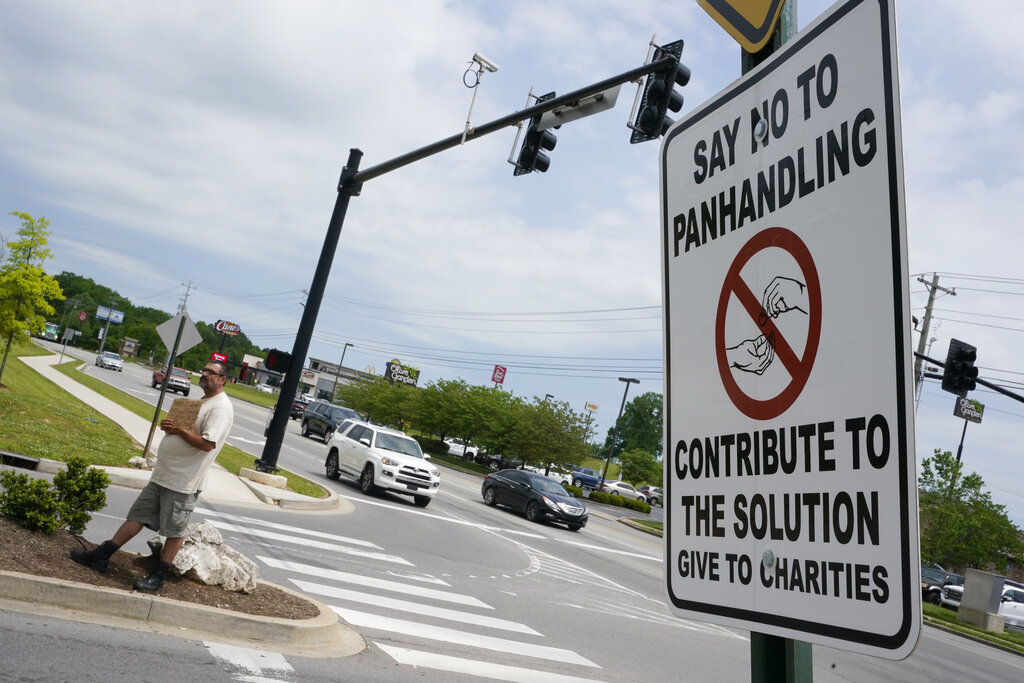 Adam Atnip, who is homeless and lives in his car, panhandles near a sign asking people not to give directly to panhandlers on May 10, 2022, in Cookeville, Tenn. Tennessee in 2022 it a felony to camp on local public property such as parks. (AP file Photo/Mark Humphrey)
The authorization, reviewed by the Banner, requires arrests to be “vetted by the chain of command or the District Attorney’s office” and requires the use of body-worn cameras. A Banner request for footage from one of the arrests is currently in process.
In Ryan’s case, the forms were not signed by his superiors until weeks after the arrests. Solaren off-duty authorization forms for three other THP troopers who made felony camping arrests around the same time were not provided as part of a records request.
In response to a November media inquiry about the arrests, THP spokesperson Bill Miller asked Chris Dye, the captain overseeing the THP’s Nashville district, for more information. Dye, in an internal email reviewed by the Banner, denied that THP personnel had made any arrests for felony camping.
Public communication at the time was scant.
“It’s not anything that I’m aware of, but that’s not to say that hasn’t happened,” Lt. Bill Miller told the Nashville Scene in November.
That appears to have been the extent of THP’s public disclosure about the arrests. News coverage from last year makes no mention of Solaren or the Nashville Downtown Partnership.
“THP troopers acted within their lawful authority to enforce state law while working an approved off-duty assignment, and each trooper was in full compliance with department policy regarding secondary employment,” Tennessee Department of Safety and Homeland Security spokesperson Jason Pack said, though he declined to answer specific questions about the missing and post-dated authorizations. “THP remains committed to working alongside local officials and community leaders to keep all Tennesseans safe.”
TAKEN BY SURPRISE
When news of arrests under the felony camping law started spreading in November, local officials were taken aback. And despite Pack’s claim that the troopers were acting within policy, no further felony camping arrests appear to have been made since the November rush, and local officials were told by THP that new policies were put in place in response.
“When we learned of the arrests, we reached out to the THP and NDP leadership to understand what happened,” Alex Apple, spokesperson for Nashville Mayor Freddie O’Connell, said. “THP leadership told us the troopers had acted against protocol and assured the mayor’s office no further arrests would occur. The downtown partnership said they had been unaware of the matter.”
In an email exchange reviewed by the Banner, Metro Councilmember Jacob Kupin, who represents downtown, wrote to THP leadership that “to my knowledge, Metro departments did not have awareness that this was going on.”
Late last year, state Rep. Aftyn Behn, a Democrat who represents downtown Nashville, requested a meeting with senior THP leaders. According to the email chain, Behn initiated the meeting to request that people arrested under the felony camping law be diverted to the Shelter Court program run by Nashville Judge Lynda Jones.
“I wanted to solicit your interest in having the Tennessee Highway Patrol partner with Judge Jones to expand Shelter Court as an alternative pathway for unhoused individuals encountered by officers in downtown Nashville,” Behn wrote to Col. Matt Perry of the THP. “Instead of arrests, referrals to Shelter Court could serve as an opportunity to connect individuals with housing programs, health care services and other resources they may desperately need.”
Jones, Behn, Kupin and state Sen. Jeff Yarbro eventually participated in the meeting with Perry and other top THP officials shortly before Christmas. Participants told the Banner that they came away with the impression that the THP had changed its off-duty policies as a result of the arrests. But when asked whether discipline or new oversight has been instituted since, THP and Department of Safety representatives would not say.
Metro Nashville Police Department spokesperson Don Aaron told the Banner that the Central Precinct was generally aware of state troopers’ off-duty work for the Downtown Partnership but “did not have knowledge of the camping arrests until after the fact,” at which point, he added, they “generally knew that the administration of the THP was looking at what had occurred.”
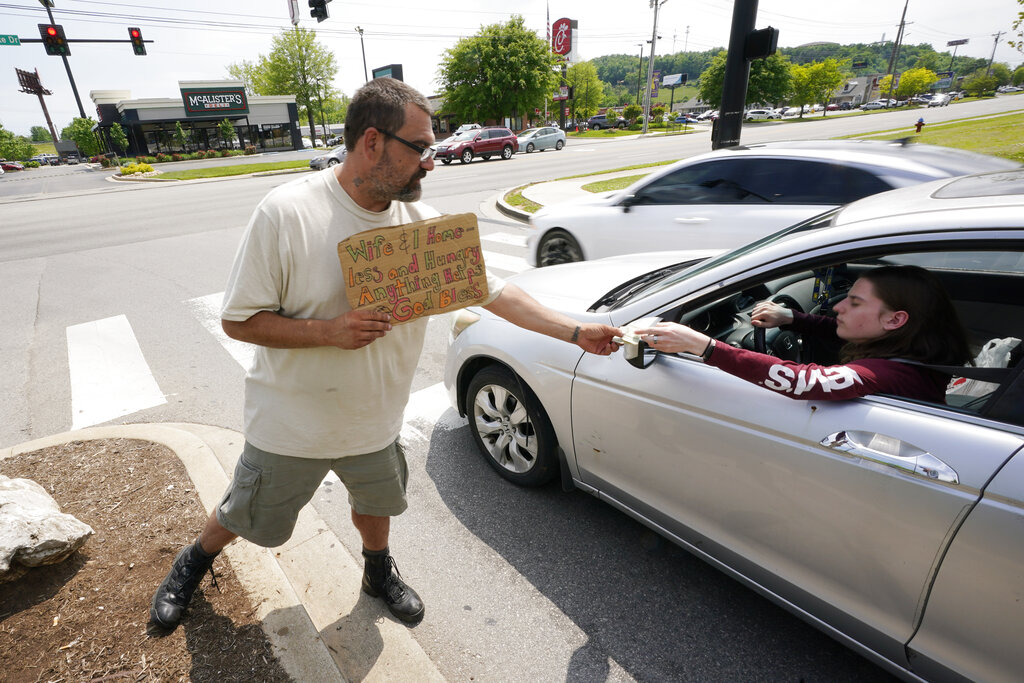 Adam Atnip, who is homeless and lives in his car, accepts money from a driver as he panhandles on May 10, 2022, in Cookeville, Tenn. Tennessee in 2022 it a felony to camp on local public property such as parks. (AP file Photo/Mark Humphrey)
Aaron said that police department does not have a policy about enforcing the felony camping law, but it does not appear that any local police officer has made an arrest under the law. The Central Precinct has a specialized unit of dozens of officers dedicated to the downtown entertainment district, with officers congregating close to the park on weekend nights.
DOWNTOWN PARTNERSHIP
Solaren’s checkered history has been detailed in a series of WSMV stories. The Tennessee Department of Commerce and Insurance last year sought to shut the company down for allowing employees to impersonate sworn police officers. Also last year, the Davidson County Sheriff’s Office suspended four employees over their work with the company. In 2023, the Downtown Partnership reportedly learned that Solaren was using uncertified officers in its work for the partnership.
Despite all that, the THP apparently continues to permit its personnel to work for Solaren, and the Downtown Partnership continues to contract with the company for downtown security.
“We’ve seen those stories as well, but the unique thing about our program is we only hire Tennessee Highway Patrol right now, so there’s no question that they are an official law enforcement officer,” David Corman, a former Nashville police commander who runs security for the Downtown Partnership, told the Banner. “As long as we are guaranteed that they’re full-time law enforcement officers in the state, then we’re happy with that.”
Still, Nashville Downtown Partnership might not work with Solaren forever. The contract is up in April 2026.
“It, like every other contract, has a term, and this organization, like every organization that is providing services, wants to get the best quality for the services that they’re providing,” partnership chief operating officer Ben Simpson told the Banner. “So it wouldn’t be out of the norm when any contract terms out for us to look and see what the market has to offer.”
Simpson said the Downtown Partnership has nothing to do with decisions made by off-duty officers indirectly in its employ.
“A THP officer is a THP officer all the time, and it is their sole discretion to make an arrest,” he said. “They don’t contact us. They don’t ask our opinion. It is completely within their discretion, as a sworn officer of the state of Tennessee, to perform that action. They do a great job of keeping the place clean, safe, active and attractive.”
The Downtown Partnership executive said the partnership’s goal is to avoid arrests, but he did not say whether the partnership has asked Solaren to change tactics in the wake of the rash of arrests. He pointed to a program in which the group’s ambassadors seek to reconnect homeless people with family members and pay for them to travel to those family members. He said the group made 280 of those connections last year.
“We’re extremely proud of how we deal with the unhoused downtown,” Simpson said. “We find that those connections are the best way for our outreach people not to have to see the same faces, because you’re not just moving them to city services or state services. You’re moving them into a home with a family member or a loved one that’s going to help go the extra mile.”
STATUS OF CHARGES
On March 7, prosecutors dismissed three of the four remaining felony camping charges without stating a reason. None of the defendants appeared in court. The final remaining open charge has an April court date, though public defenders expect that to be dismissed, too. The only one of the 11 people arrested to be convicted was a woman who pleaded guilty to criminal trespass, a misdemeanor. That would be in line with the stance Davidson County District Attorney Glenn Funk has taken on the law.
“If you give someone who is experiencing homelessness a felony for camping, then what you’ve done is made them permanently homeless because folks who have a felony record cannot rent an apartment anywhere in Nashville,” he told the Banner.
But he also acknowledged the tension underlying the whole recent episode.
“Folks that are experiencing homelessness are members of our community, and they deserve human dignity,” he said. “At the same time, there are some impacts that folks who are experiencing homelessness have on the quality of life for people who live in the neighborhoods near the encampments as well as people who are going to businesses downtown. … We have to make sure that we have a safe community for everybody.”
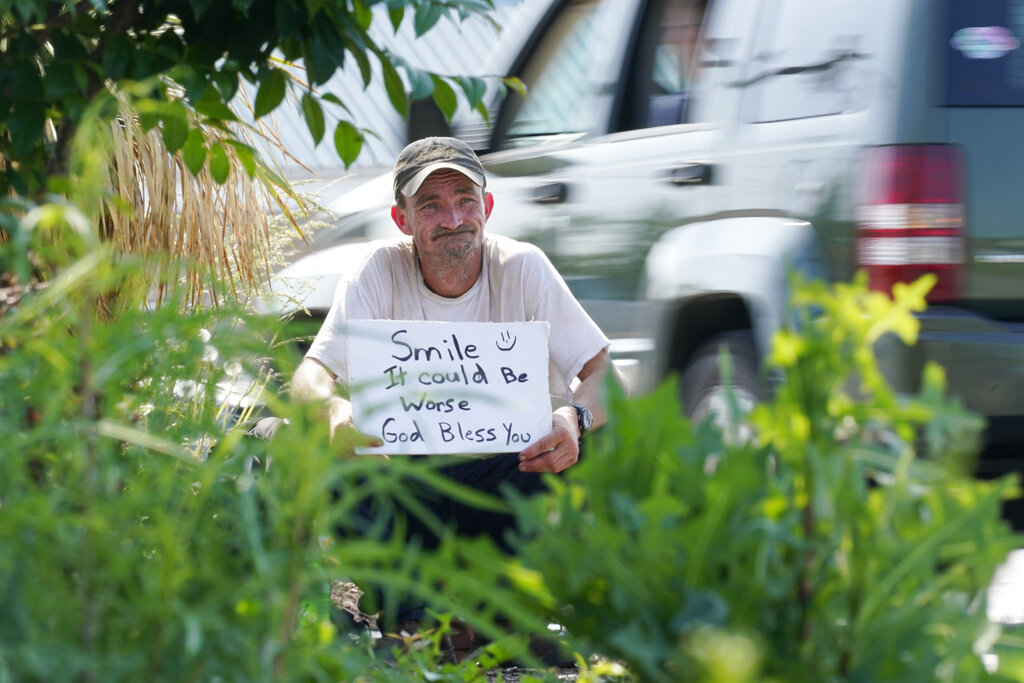 Sean Fuller, who is homeless, panhandles at the entrance to a store on May 10, 2022, in Cookeville, Tenn. Tennessee in 2022 it a felony to camp on local public property such as parks. (AP file Photo/Mark Humphrey)
‘CRUEL AND INEFFECTIVE’
Allie Wallace, executive director of homelessness advocacy group and service provider Open Table Nashville, decried the arrests, and called on law enforcement to exercise discretion or take advantage of diversion programs.
“Some of these folks were already bedded down for the night, trying to go to sleep, and then to be interrupted in that way and to be arrested simply for existing outdoors is so cruel and ineffective,” Wallace told the Banner. “It just causes so much harm to people who are already experiencing such a traumatizing existence because they’re just trying to survive outside.”
Wallace also described the disparities she and her teams have witnessed downtown, where intoxicated revelers outnumber unhoused people many times over.
“The difference in the way that we address and speak about those crowds, it’s alarming to me,” she said. “The difference between somebody who can just be a drunk tourist on the sidewalk versus somebody who literally doesn’t have anywhere else to go. The language we use around that is just so dehumanizing and it’s really disheartening.”
The Banner made an effort to locate some of the defendants in the felony camping cases, something that even the attorneys representing them said was difficult. Wallace asked what some of the downstream effects of their now-dismissed charges could be.
“Looking at the folks who were arrested I would ask and wonder, have any of these people been housed?” she said. “Have they gotten the services they need? Are they getting back on their feet because they got arrested and cited for a felony? Or are they back out on the streets again?”
Funk could not immediately confirm whether any of the recently arrested unhoused people received evaluation and treatment at the Behavioral Care Center operated by the Davidson County Sheriff’s Office or were diverted through one of the various alternative court programs, but he agreed to follow up with information about how the cases were handled. He said he has been talking to law enforcement and Metro officials about how to make sure “people who are charged with committing crimes while they are homeless can get the support they need.”
“I think we’re on the same page now, but I am trying to communicate with all of our system partners about trying to find ways to handle these issues in the best way possible.”
This article first appeared on Nashville Banner and is republished here under a Creative Commons license.