
Thursday, October 29, 2026Oct 29

This story is free to read.

How ancient reptile footprints are rewriting the history of when animals evolved to live on land

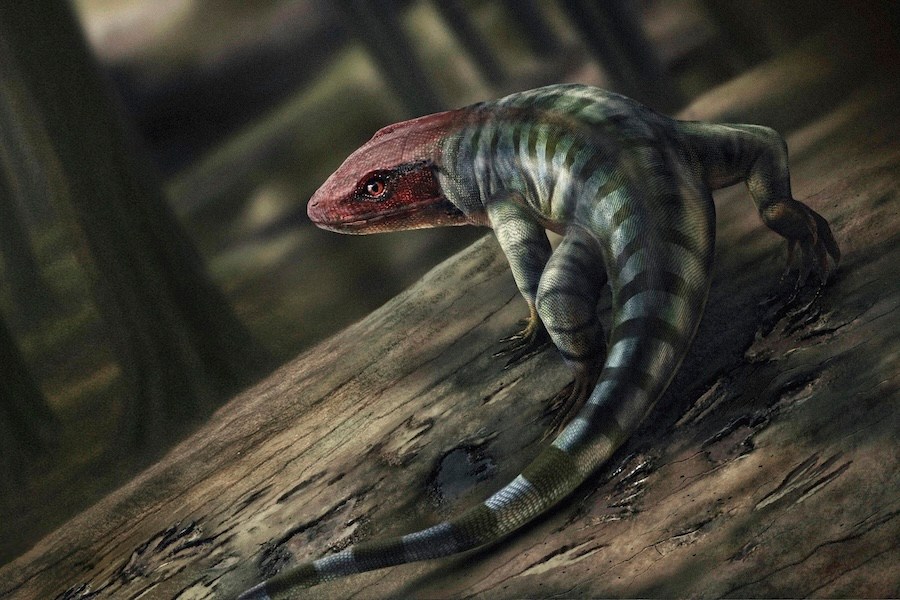
This image provided by Prof. Per Erik Ahlberg shows an artist's illustration of the possible appearance of a reptile-like creature that lived around 350 million years ago in what's now Australia. The animal was around 2 ½ feet long (80 cm) and its feet has long fingers and claws, which are visible in newly discovered fossil footprints. (Marcin Ambrozik/Prof. Per Erik Ahlberg via AP)
This image provided by Prof. Per Erik Ahlberg shows an artist's illustration of the possible appearance of a reptile-like creature that lived around 350 million years ago in what's now Australia. The animal was around 2 ½ feet long (80 cm) and its feet has long fingers and claws, which are visible in newly discovered fossil footprints. (Marcin Ambrozik/Prof. Per Erik Ahlberg via AP) This image provided by Prof. Per Erik Ahlberg shows an artist's illustration of the possible appearance of a reptile-like creature that lived around 350 million years ago in what's now Australia. The animal was around 2 ½ feet long (80 cm) and its feet has long fingers and claws, which are visible in newly discovered fossil footprints. (Marcin Ambrozik/Prof. Per Erik Ahlberg via AP)

WASHINGTON (AP) — Scientists in Australia have identified the oldest known fossil footprints of a reptile-like animal, dated to around 350 million years ago.

The discovery suggests that after the first animals emerged from the ocean around 400 million years ago, they evolved the ability to live exclusively on land much faster than previously assumed.

“We had thought the transition from fin to limb took much longer,” said California State University paleontologist Stuart Sumida, who was not involved in the new research.

Previously the earliest known reptile footprints, found in Canada, were dated to 318 million years ago.

The ancient footprints from Australia were found on a slab of sandstone recovered near Melbourne and show reptile-like feet with long toes and hooked claws.